The practical, accessible painting and drawing guidance that made The Artist's Manual and The New Artist's Manual beloved classics now returns in a new ebook. With the same breadth of content as the originals, this updated version is packed with easy to follow instructions, including comprehensive information about all varieties of materials and tools, along with hundreds of critical techniques for mastering composition, color, line, tone, and more. Copiously illustrated in 1, 300 color photos and examples from working artists, this new edition is the definitive guide for artists of every skill level looking to begin, develop, and perfect their skills. The Complete Artist's Manual is today's essential studio companion.
- 400 pages
- English
- ePUB (mobile friendly)
- Available on iOS & Android
eBook - ePub
About this book
Information
Topic
ArtSubtopic
Art TechniquesChapter 1
SUPPORTS
Before starting a painting or drawing, it is worth spending some time choosing and preparing the surface, or support, as this will have a great bearing on which medium you use, and the effects that you are able to achieve with it. Although the range of canvases, panels and papers may seem somewhat bewildering at first glance, finding the right support for your purpose is not very difficult when you understand the properties of each one. A properly prepared support will greatly increase the longevity of a work and, in addition, you can derive a lot of pleasure and satisfaction from this aspect of the artist’s work.
CANVAS
In painting, canvas is still the most widely used of all supports. Stretched-and-primed canvas is taut but flexible, and has a unique receptiveness to the stroke of the brush. The two most common fibers for making canvas are linen and cotton, although burlap and synthetic fibers are also used. Each of these fibers differs in terms of durability, evenness of grain, ease of stretching and cost.
Linen is considered the best canvas because it has a fine, even grain that is free of knots and is a pleasure to paint on. Although expensive, it is very durable and, once stretched on a frame, retains its tautness. Good-quality linen has a tight weave of even threads which will persist through several layers of primer and paint; avoid cheap linen, which is loosely woven.
Preparing linen canvas
The weaving process makes raw linen canvas prone to shrinking and warping when it is stretched, and it has a tendency to resist the application of size. However, both these problems can be solved by temporarily stretching the canvas, wetting it and allowing it to dry. Then remove the canvas from the stretcher bars and re-stretch it; this second stretching creates a more even tension across the cloth.
Cotton canvas
A good-quality 410–510gsm (12–15oz) cotton duck is the best alternative to linen, and is much cheaper. Cotton weaves of below 410gsm (12oz) are fine for experimenting with, but they stretch much more than linen and, once stretched, they are susceptible to fluctuations in tension in either humid or dry conditions. The weave of cheap cotton quickly becomes obscured by layers of primer and paint, leaving the surface rather flat and characterless.
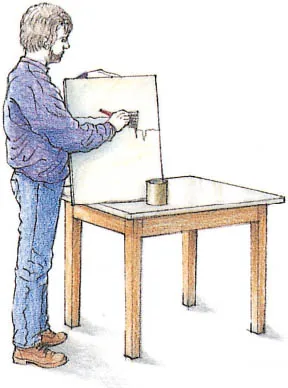
Wet the stretched linen canvas and allow it to dry.
Canvas weights
The weight of canvas is measured in grams per square metre (gsm) or ounces per square yard (oz). The higher the number, the greater density of threads. Better-grade cotton canvas, known as cotton duck, comes in 410gsm (12oz) and 510gsm (15oz) grades. Lighter-weight canvases of between 268gsm (8oz) and 410gsm (12oz) are recommended for practice only.
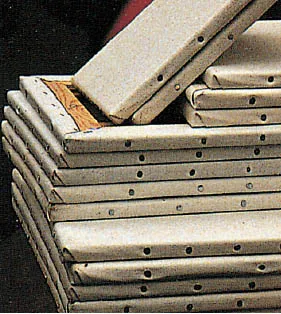
Ready-prepared supports
You can buy ready-primed and stretched supports which consist of a piece of canvas mounted on a stretcher. These supports are convenient, but are expensive when compared to the cost of stretching, sizing and priming your own canvas.
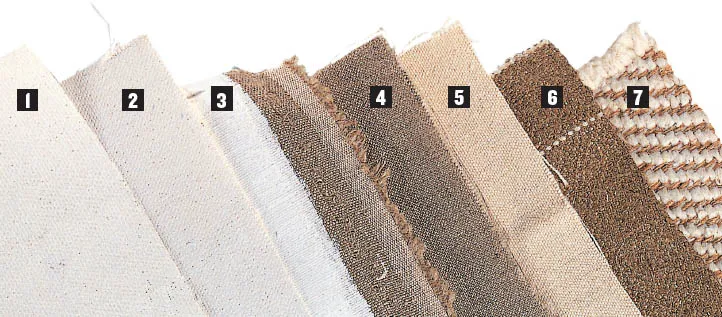
Popular artist’s canvases
1 Ready-primed cotton-rayon mix
2 Ready-primed cotton duck
3 Ready-primed artist’s linen
4 Superfine artist’s linen
5 Cotton duck
6 Flax canvas
7 Cotton and jute twill
Burlap
Burlap is inexpensive, but has a very coarse weave and requires a lot of priming. It is liable to become brittle and lifeless in time.
Synthetic fibers
Synthetic fabrics, such as rayon and polyester, are now used in the manufacture of artists’ canvas. These canvases come ready-prepared with acrylic primer and are worth trying out, as they are exceptionally strong and durable, flexible but stable, and resistant to chemical reaction.
Canvas textures
If you use bold, heavy brushstrokes, canvas with a coarsely woven texture is the most suitable. A smooth, finely woven texture is more suited to fine, detailed brushwork. Another consideration is the scale of your painting. A fine-grained canvas is best for small works, as the texture of coarse-grained canvas may be too insistent and detract from the painting.
Ready-primed canvas
Ready-primed canvas comes prepared with either an oil- or an acrylic-based primer. It is better to use an oil-primed canvas for oil painting and leave acrylic-primed ones for acrylic paintings, but you can use an acrylic-primed canvas for oils if you paint thinly and on a small scale.
Canvas may be single- or double-primed. The latter is more expensive; it has a denser surface, but it is less flexible than single-primed canvas.
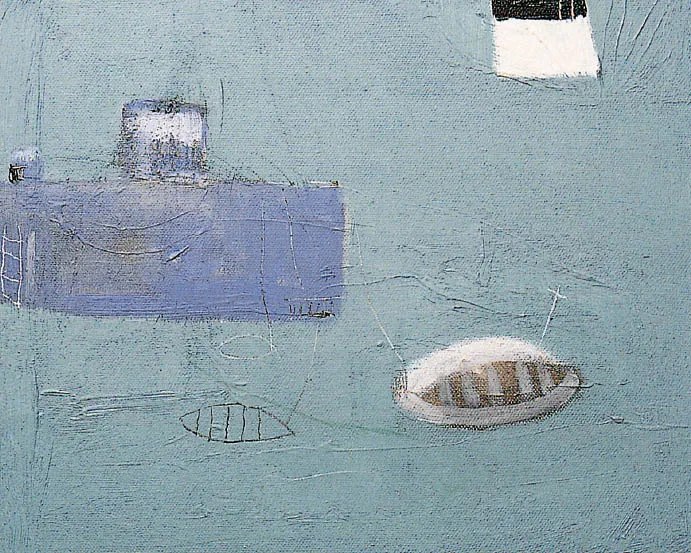
Canvas texture
The formal elegance of this abstract painting is enhanced by the subtle texture of the linen canvas, which appears through the thin layers of oil paint.
Pádraig Macmiadhachain
Blue Morning
Oil on canvas
25 × 30cm (10 × 12in)
Oil on canvas
25 × 30cm (10 × 12in)
Buying economically
Before buying lengths of canvas, work out how you will divide up the fabric to make as many pictures as possible with the minimum of wastage (canvas rolls come in several widths). When doing your calculations, do...
Table of contents
- Cover
- Title
- Copyright
- Contents
- Introduction
- Acknowledgements
- 1/ Supports
- 2/ Drawing Media
- 3/ Painting Media
- 4/ Where Shall I Start?
- 5/ Drawing & Sketching
- 6/ Painting Techniques
- 7/ Color & Composition
- 8/ What Shall I Paint?
- 9/ The Studio
- 10/ Gallery of Art
- Reference
- Index
- About the Author
Trusted by 375,005 students
Access to over 1.5 million titles for a fair monthly price.
Study more efficiently using our study tools.
Frequently asked questions
Yes, you can cancel anytime from the Subscription tab in your account settings on the Perlego website. Your subscription will stay active until the end of your current billing period. Learn how to cancel your subscription
No, books cannot be downloaded as external files, such as PDFs, for use outside of Perlego. However, you can download books within the Perlego app for offline reading on mobile or tablet. Learn how to download books offline
Perlego offers two plans: Essential and Complete
- Essential is ideal for learners and professionals who enjoy exploring a wide range of subjects. Access the Essential Library with 800,000+ trusted titles and best-sellers across business, personal growth, and the humanities. Includes unlimited reading time and Standard Read Aloud voice.
- Complete: Perfect for advanced learners and researchers needing full, unrestricted access. Unlock 1.5M+ books across hundreds of subjects, including academic and specialized titles. The Complete Plan also includes advanced features like Premium Read Aloud and Research Assistant.
We are an online textbook subscription service, where you can get access to an entire online library for less than the price of a single book per month. With over 1.5 million books across 990+ topics, we’ve got you covered! Learn about our mission
Look out for the read-aloud symbol on your next book to see if you can listen to it. The read-aloud tool reads text aloud for you, highlighting the text as it is being read. You can pause it, speed it up and slow it down. Learn more about Read Aloud
Yes! You can use the Perlego app on both iOS and Android devices to read anytime, anywhere — even offline. Perfect for commutes or when you’re on the go.
Please note we cannot support devices running on iOS 13 and Android 7 or earlier. Learn more about using the app
Please note we cannot support devices running on iOS 13 and Android 7 or earlier. Learn more about using the app
Yes, you can access The Complete Artist's Manual by Simon Jennings in PDF and/or ePUB format, as well as other popular books in Art & Art Techniques. We have over 1.5 million books available in our catalogue for you to explore.