- English
- ePUB (mobile friendly)
- Available on iOS & Android
eBook - ePub
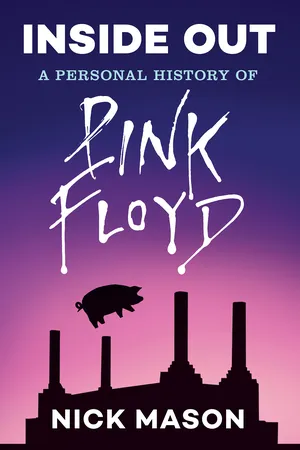
Inside Out: A Personal History of Pink Floyd (Reading Edition)
About this book
The definitive history of Pink Floyd by founding member Nick Mason, this reading edition brings up-to-date the band's incredible story as told uniquely from the inside out. Including the complete text of the original in an easy-toread format, a new chapter covering the passing of Rick Wright and the release of the group's final album, and 80 pages of images from Mason's archives plus new photos, Inside Out is a masterly rock memoir and an eye opener for both veteran fans and those just discovering the group.
Information
Subtopic
Music Biographies

Roger Waters only deigned to speak to me after we’d spent the best part of six months studying at college together. One afternoon, as I tried to shut out the murmur of forty fellow architectural students so that I could concentrate on the technical drawing in front of me, Roger’s long, distinctive shadow fell across my drawing board. Although he had studiously ignored my existence up until that moment, Roger had finally recognised in me a kindred musical spirit trapped within a budding architect’s body. The star-crossed paths of Virgo and Aquarius had dictated our destiny, and were compelling Roger to seek a way to unite our minds in a great creative adventure.
No, no, no. I’m trying to keep the invention to a minimum. The only reason Roger had bothered to approach me was that he wanted to borrow my car.
The vehicle in question was a 1930 Austin Seven ‘Chummy’ which I’d picked up for twenty quid. Most other teenagers of the time would probably have chosen to buy something more practical like a Morris 1000 Traveller, but my father had instilled a love of early cars in me, and had sourced this particular car. With his help, I learnt how to keep the ‘Chummy’ operational. However, Roger must have been desperate even to want me to lend it to him. The Austin’s cruising speed was so sluggish that I’d once had to give a hitch-hiker a lift out of sheer embarrassment because I was going so slowly he thought I was actually stopping to offer him a ride. I told Roger the car was off the road, which was not entirely true. Part of me was reluctant to lend it out to anyone else, but I think I also found Roger rather menacing. When he spotted me driving the Austin shortly afterwards, he had his first taste of my penchant for occupying that no-man’s-land between duplicity and diplomacy. On a previous occasion, Roger had accosted Rick Wright, who was also a student in our class, and asked him for a cigarette, a request Rick turned down point blank. This was an early sign of Rick’s legendary generosity. These first, mundane, social contacts – during the spring of 1963 – contained the seeds of the relationships we would enjoy and endure over the years ahead.
Pink Floyd emerged from two overlapping sets of friends: one was based around Cambridge, where Roger, Syd Barrett, David Gilmour and many future Floyd affiliates hailed from. The other – Roger, Rick and myself – came together in the first year of an architecture course at the Regent Street Polytechnic in London, which is where my recollections of our common history begin.
I had in fact already retired as a drummer by the time I arrived at the Poly (since rather grandly retitled the University of Westminster). The college was then based in Little Titchfield Street, just off Oxford Street in the centre of the West End. The Poly, in retrospect, seems to be from a bygone era, with old-fashioned wooden panelling reminiscent of a giant, utilitarian public school. As far as I can remember there were no real onsite facilities, other than some tea-making equipment, but the Poly – in the heart of the rag trade area around Great Titchfield and Great Portland Streets – was surrounded by cafés offering eggs, sausage and chips up to midday, when steak and kidney pie and jam roly-poly would be the menu du jour.
The architectural school was in a building housing a number of other related disciplines and had become a well-respected institution. There was still a fairly conservative approach to teaching: for History of Architecture a lecturer would come in and draw on the board an immaculate representation of the floor plan of the Temple of Khons, Karnak, which we were expected to copy, just as they had been doing for thirty years. However, the school had recently introduced the idea of peripatetic lecturers, and played host to some visiting architects who were on the frontline of new ideas, including Eldred Evans, Norman Foster and Richard Rodgers. The faculty clearly had a good eye for form.
I had strolled into studying architecture with no great ambition. I was certainly interested in the subject, but not particularly committed to it as a career. I think I felt that being an architect would be as good a way to earn a living as any other. But equally I wasn’t spending my time at college dreaming of becoming a musician. Any teenage aspirations in that area had been overshadowed by the arrival of my driving licence.
Despite my lack of burning ambition, the course offered a variety of disciplines – including fine art, graphics and technology – which proved to deliver a good all-round education, and which probably explains why Roger, Rick and I all, to a greater or lesser degree, shared an enthusiasm for the possibilities offered by technology and visual effects. In later years we would become heavily involved in everything from the construction of lighting towers to album cover artwork and studio and stage design. Our architectural training allowed us the luxury of making relatively informed comments whenever we brought the real experts in.
For those interested in tenuous connections, my interest in the mix of the technical and visual probably came from my father, Bill, a director of documentary films. When I was two, he accepted a job with the Shell film unit, and so we moved from the Birmingham suburb of Edgbaston, where I’d been born, to North London, where I spent my formative years.
Although my father was not particularly musical, he was definitely interested in music, especially when it related directly to one of his films. In those instances, he could become quite passionate about music ranging from Jamaican steel bands to string sections, jazz or the wilder electric ramblings of Ron Geesin. He was also fascinated by recording equipment, stereo test records, sound effects and racing cars, in various combinations, all interests which I inherited.
However, there was some hint of a musical heritage within the family: my maternal grandfather, Walter Kershaw, played in a banjo band with his four brothers and had had a piece of music published, called ‘The Grand State March’. My mother Sally was a competent pianist, whose repertoire included Debussy’s now extremely politically incorrect ‘Golliwog’s Cakewalk’. The selection of 78s at home was even more eclectic, including classical pieces, Communist workers’ songs performed by the Red Army Choir, ‘The Teddy Bears’ Picnic’ and ‘The Laughing Policeman’. Doubtless traces of these influences can be found somewhere in our music – I shall leave it to others more energetic to winkle them out. I did take some lessons on the piano, as well as the violin, but they failed to uncover a musical prodigy and both instruments were abandoned.
I will also confess to a mysterious attraction for Fess Parker singing ‘The Ballad Of Davy Crockett’, a single released in the UK in 1956. Even in those days the unholy relationship between music and merchandising clearly existed, since I was soon sporting a natty nylon coonskin cap exquisitely set off by its rakish tail.
I must have been about twelve when rock music first impinged on my consciousness. I can remember struggling to stay awake through Horace Batchelor’s exhortations for his unlikely pools system on Radio Luxembourg, hoping to catch ‘Rocking To Dreamland’. I helped Bill Haley’s ‘See You Later Alligator’ reach the UK Top Ten in March 1956 by buying it on a 78 from the local electrical store, and later that year I splashed out on Elvis Presley’s ‘Don’t Be Cruel’. Both of these were played on the family’s new state-of-the-art gramophone that was electric and connected to a device resembling a cross between the cabinets made in the days of Louis XIV and a Rolls-Royce dashboard. At thirteen I had my first long-playing album – Elvis’s Rock ’N’ Roll. This seminal album was bought as a first LP by at least two other members of the Floyd, and almost all of our generation of rock musicians. Not only was this fantastic new music, but for a teenage rebel it also had the additional frisson of receiving the kind of parental welcome usually reserved for a pet spider.
It was about this time that I set off with my satchel, and in short flannel trousers and school blazer – the latter pink with a black trim and an iron cross badge – to see Tommy Steele performing at a variety show in East London. I was on my own. Apparently none of my school friends was as enthused. Tommy was top of the bill, and the rest of the bill was dire. Comics, jugglers and other refugees from the English music halls vied to clear the hall before Tommy came on, but I stuck it out. I have to say he was terrific. He sang ‘Singing The Blues’ and ‘Rock With The Caveman’ and looked exactly like he did on The Six-Five Special, the original pop show on UK television. He wasn’t Elvis, but he was certainly the next best thing.
Within a couple of years, I had gravitated towards a group of friends from the neighbourhood who had also discovered rock ’n’ roll, and it seemed an excellent idea to put a band together. The fact that none of us knew how to play was only a minor setback, since we didn’t have any instruments. Consequently allocating who played what was something of a lottery. My only link with drumming was that Wayne Minnow, a journalist friend of my parents, had once brought me a pair of wire brushes. After the failure of my early piano and violin lessons, this seemed a perfectly legitimate reason to become a drummer. My first kit, acquired from Chas. E. Foote of Denman Street in Soho, included a Gigster bass drum, a snare drum of indeterminate age and parentage, hi-hat, cymbals, and an instruction book on the mysteries of flam paradiddles and ratamacues (which I am still attempting to unravel). Equipped with this devastating armoury I joined my friends to form the Hotrods.
The group included Tim Mack on lead guitar, William Gammell playing rhythm, and Michael Kriesky on bass. We also boasted a sax player, John Gregory, though his sax, which predated the standardisation of concert A at 440 cycles, was half a tone higher than a new model, and consequently unplayable with an ensemble. Michael, with help from the rest of us, had built his bass from scratch. Frankly, the Saxons building a space probe would have had more success, but we did achieve the vague outward appearance of an instrument. Although we had access to some amps, these were so shameful that when we posed for a group photo, we felt obliged to mock up a Vox cabinet using a cardboard box and a biro.
Thanks to my father’s film work we had access to a brand new stereo Grundig tape recorder. Rather than waste time rehearsing we immediately launched into our first recording session. The studio technique involved a trial and error positioning of two microphones somewhere between the drums and amplifier. Regrettably these tapes still exist.
The Hotrods never really developed beyond endless versions of the theme from the TV show Peter Gunn, and my career in music seemed destined to falter. But now I had gone from prep school to Frensham Heights, an independent co-ed school in Surrey. Here there were girls (I met my first wife Lindy there), a jazz club, and you could wear long trousers after the third form. Yes, this was the sophisticated life I had been looking for.
Compared to being at prep school, I really enjoyed my time at Frensham – the school was in a large country house with extensive grounds, near Hindhead in Surrey. Although it was fairly traditional – in terms of blazers and exams – it had a far more liberal approach to education, and I have fond memories of both art and English teachers there. I also began to learn the skills of negotiation. Since the school was close to Frensham Ponds, I had managed to acquire a canoe, and in return for lending it to the games master, I was able to avoid ever having to play cricket. As proof of this the clothing inventory included an expensive cricket sweater; mine never emerged from its original cellophane wrapping . . .
The school used the ballroom in the country house for assemblies and other functions, but on a regular basis it was used for its original purpose, when we would dance waltzes, foxtrots and veletas. However, during my time at Frensham, the ballroom dances evolved into hops, although I am sure that we had to get special clearance to play the latest singles, an attempt by the school to limit the invasion of pop music. We did have a jazz club, though. This was not something created by the masters, but an informal gathering of pupils: Peter Adler, the son of the great harmonica player Larry, was at the school. I remember him playing piano, and we may have tried playing jazz together at some point. It was difficult even to listen to our own jazz records, since the school only had one LP player, and we would only have had our own players towards the end of my time there. The club was probably more of an opportunity to get out of doing something more arduous and less agreeable, but it did at least represent a nascent interest in jazz. Later on I would spend time in London going to places like the 100 Club to hear the leaders of the trad jazz movement in England, players like Cy Laurie and Ken Colyer. However, I never liked the paraphernalia of a lot of trad jazz – all the bowler hats and waistcoats – and I moved on to bebop. I still have a great enthusiasm for modern jazz, but as a teenager, the advanced playing techniques required were an insurmountable barrier. I went back to perfecting the drum part to ‘Peter Gunn’.
After leaving Frensham Heights, and following a year in London spent improving my studies, I arrived at the Regent Street Poly in September 1962. I studied a bit, produced various pieces of work for my portfolio, and attended numerous lectures. I did, however, show serious application in attempting to cultivate the correct look, with a penchant for corduroy jackets and duffle coats. I also tried smoking a pipe. It was some time during my second term at college that I fell in with what the older generation used to call a ‘bad lot’, namely Roger.
Our first abortive conversation about the Austin ‘Chummy’ had perhaps surprisingly led to a growing friendship, based on shared musical tastes. Another bond in the friendship that developed between us was a common liking for anything that took us outside the school building, whether trawling up and down the Charing Cross Road looking at drums and guitars, going to matinée shows at West End cinemas, or heading off to Anello and Davide’s, the ballet-shoe makers in Covent Garden who were then also making Cuban-heeled cowboy boots to order. The prospect of a weekend break at Roger’s house in Cambridge also occasionally encouraged an early Friday departure from the rigours of class work.
Politically we came from fairly similar backgrounds. Roger’s mother was an ex-Communist Party member and a staunch Labour supporter, as were my parents: my father had joined the Communist Party to oppose fascism, and then on the outbreak of war left the CP and became a shop steward in the ACT, the Association of Cinematographic Technicians. This kind of background was also shared by our respective girlfriends, and later wives, Lindy and Judy. Roger had been the chairman of the youth section of the Campaign for Nuclear Disarmament in Cambridge, and he and Judy took part in a number of CND marches from Aldermaston to London. Lindy and I did join at least one CND march on the outskirts of London on the last day, and she later was part of the Grosvenor Square demonstration which the police broke up with a rather heavy hand. I would now tend to say that probably reflects quite accurately my own general commitment to politics – slightly to the left of half-hearted with only the occasional outburst of good behaviour.
Some of Roger’s strength of conviction had probably been picked up from his mother Mary, a teacher who’d shown her personal toughness by bringing up Roger and his elder brother John single-handed after her husband Eric Waters (who was also a teacher) had been killed in Italy during the Second World War. Roger had attended Cambridgeshire High School for Boys at the same time as Syd Barrett – among their fellow pupils was Storm Thorgerson, who later on would play a major role in the band’s history as our graphic designer for over three decades. The school also provided Roger with the raw material for a particular kind of bullying teacher who would later appear as a caricature in The Wall.
Roger’s musical activities were not particularly different from any other teenager’s at the time: a bit of guitar strumming, picking up riffs and ideas from old blues records. Like me he was an avid listener to Radio Luxembourg, as well as the American Forces Network. When he came down to college in London his guitar travelled with him. An early indication of putting our training to good use was the way he had used Letraset, then a specialist design tool, to print ‘I believe to my soul’ on the body of the guitar. To our eyes, it looked pretty smart.
Along with his g...
Table of contents
- Cover
- About the Author
- Title
- Copyright
- Contents
- Chapter 1 Poly Days
- Chapter 2 Going Underground
- Chapter 3 Freak Out Schmeak Out
- Chapter 4 The Sum of the Parts
- Chapter 5 Change of Tempo
- Chapter 6 There Is No Dark Side
- Chapter 7 Hard Labour
- Chapter 8 The Balloon Goes Up
- Chapter 9 Writing On the Wall
- Chapter 10 Communications Failure
- Chapter 11 Restart . . . And Restoration
- Chapter 12 Wiser After the Event
- Chapter 13 Remembering a Day
- Afterthoughts and Thanks
- Chronology
- Picture Credits
- Index
- Chronicle Ebooks
Trusted by 375,005 students
Access to over 1.5 million titles for a fair monthly price.
Study more efficiently using our study tools.
Frequently asked questions
Yes, you can cancel anytime from the Subscription tab in your account settings on the Perlego website. Your subscription will stay active until the end of your current billing period. Learn how to cancel your subscription
No, books cannot be downloaded as external files, such as PDFs, for use outside of Perlego. However, you can download books within the Perlego app for offline reading on mobile or tablet. Learn how to download books offline
Perlego offers two plans: Essential and Complete
- Essential is ideal for learners and professionals who enjoy exploring a wide range of subjects. Access the Essential Library with 800,000+ trusted titles and best-sellers across business, personal growth, and the humanities. Includes unlimited reading time and Standard Read Aloud voice.
- Complete: Perfect for advanced learners and researchers needing full, unrestricted access. Unlock 1.5M+ books across hundreds of subjects, including academic and specialized titles. The Complete Plan also includes advanced features like Premium Read Aloud and Research Assistant.
We are an online textbook subscription service, where you can get access to an entire online library for less than the price of a single book per month. With over 1.5 million books across 990+ topics, we’ve got you covered! Learn about our mission
Look out for the read-aloud symbol on your next book to see if you can listen to it. The read-aloud tool reads text aloud for you, highlighting the text as it is being read. You can pause it, speed it up and slow it down. Learn more about Read Aloud
Yes! You can use the Perlego app on both iOS and Android devices to read anytime, anywhere — even offline. Perfect for commutes or when you’re on the go.
Please note we cannot support devices running on iOS 13 and Android 7 or earlier. Learn more about using the app
Please note we cannot support devices running on iOS 13 and Android 7 or earlier. Learn more about using the app
Yes, you can access Inside Out: A Personal History of Pink Floyd (Reading Edition) by Nick Mason, Philip Dodd in PDF and/or ePUB format, as well as other popular books in Media & Performing Arts & Music Biographies. We have over 1.5 million books available in our catalogue for you to explore.