- 168 pages
- English
- ePUB (mobile friendly)
- Available on iOS & Android
eBook - ePub
About this book
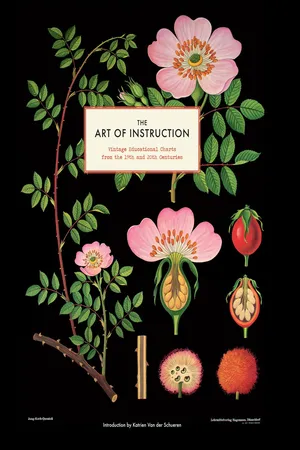
Large-scale wall charts were fundamental tools of classroom instruction throughout Europe in the mid-nineteenth and twentieth centuries. Collected here for the first time in one deluxe volume are over 100 of these vintage educational posters now important relics in the history of science, art, and design. From the anatomy of a tulip or an apple tree to that of a hedgehog or starfish, the botanical and zoological images in this collection are captivating with their curious visuals and intricate details. With a compelling introduction about the history of educational charts and their production, The Art of Instruction provides a glimpse into a rich, significant heritage and will enlighten those with an interest in art, design, science, or natural history.
Information
Topic
ArtSubtopic
Art GeneralAppendix:
Keys for Jung-Koch-Quentell Charts
The following keys accompany the Jung-Koch-Quentell charts, which were originally illustrated in the 1890s and updated in the 1950s and 1960s. All the Jung-Koch-Quentell charts in this book are presented exactly as they were originally printed—without any explanatory text on the image itself. The keys included here are taken from the educational manuals that the printer, Hagemann Educational Media, supplies with each wall chart.
We have provided keys for as many of the charts as are available.
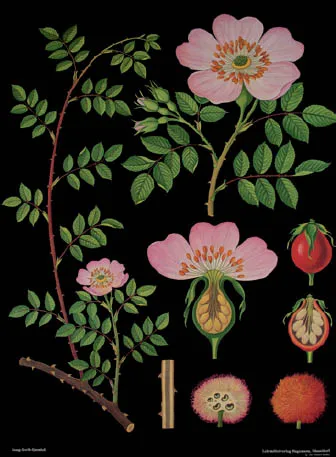
plate 1
Dog Rose: Rosa dumetorum
Long twig, bearing no flowers; Short twig with flower; Apical flower and buds on short shoot (enlarged); Single flower cut longitudinally; Ripe hip (pseudocarp and collective fruit); Hip in longitudinal section; Prickles (epidermal outgrowths); Gall cut open, with larvae of the gallfly; Rose gall.
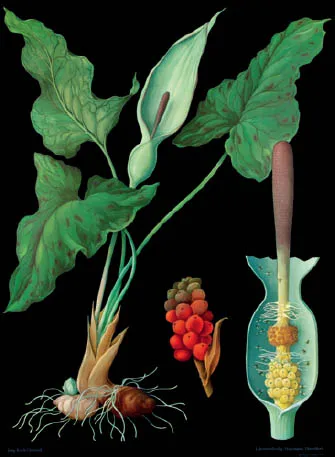
plate 2
Wild Arum: Arum maculatum
Plant in flower: a) tuberous and fibrous root formation, b) leaves, c) spathe enfolding completely the lower end of the spadix; Spadix with lower end of spathe removed to expose flowers (enlarged): a) female flowers, b) male flowers, (a–b) also show hairs, c) upper end of spadix; Ripe berries crowded on fruit stem.
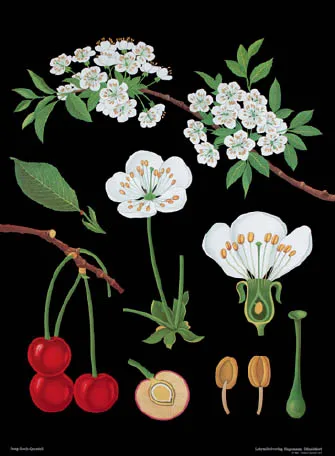
plate 3
Cherry Tree: Prunus avium
Branch with blossoms; Single leaf with leaflets and gland; Single flower seen from above; Flower in longitudinal section; Stamen; Ovary with style and stigma; Branch with ripe cherries; Section of fruit.
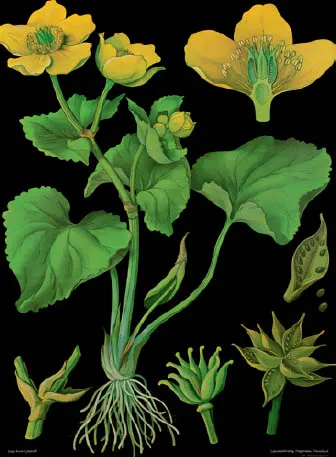
plate 4
Marsh Marigold: Caltha palustris
Plant in bloom: a) roots and creeping stem, b) leaf and leaf stalk, c) flowers open and closed; Stem node showing bifurcation with leaf bud; Longitudinal section of flower (enlarged); Unripe fruit (enlarged); Ripe fruit (enlarged); Ripe follicle opening and releasing its seed (greatly enlarged).
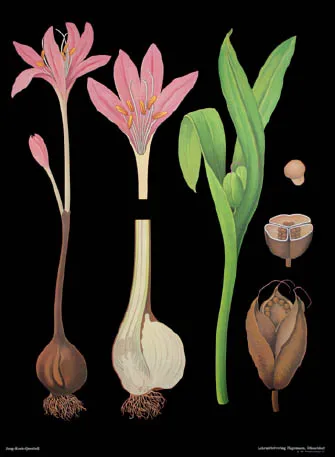
plate 5
Meadow Saffron: Colchicum autumnale
Meadow saffron showing the whole plant at time of flowering; Dissections showing: a) flower cut obliquely, b) corm; Spring shoot showing leaves and swelling ovaries; Fruit and seeds showing: a) cross section through the fruit before ripening, b) ripe, bursting fruit, c) single seed.
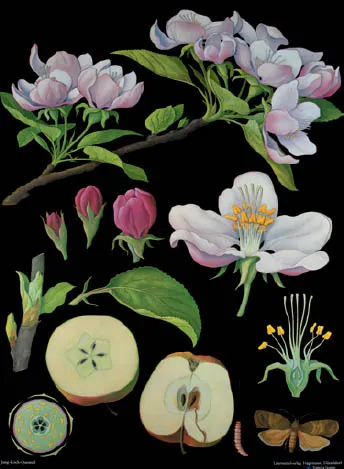
plate 6
Apple Tree: Pirus malus ssp. Domestica
Twig with foliage leaves and blossom; Leaf buds and foliage: a) bud with foliage leaves opening, b) individual leaf with veins, stalk, and small leaves; Individual blossom: a, b, c) blossom buds in various stages of opening, d) individual blossom (greatly magnified); Longitudinal section through a blossom; Floral diagram; Fruit and seed: a) horizontal section through apple showing receptacle and gynoecium, b) vertical section with part consumed by grub; Grub, an example of the pests: a) emerged grub letting itself down to the ground by a thread, b) moth (imago).
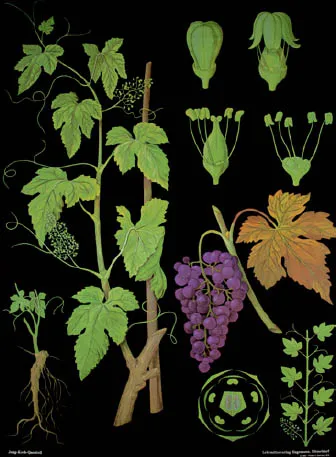
plate 7
Wine Grapevine: Vitis vinifera
Branch of the vine with leaves, tendrils around a stick, and flowers. Three panicles at the top in bud and (below) with open flowers; Single flower (enlarged): a) bud, b) flower lifting its calyx from the crown, c) flower with pistil, d) flower without pistil, showing stamens only; Transverse section of the flower; Scheme of branching of the shoot, with sympodium; Piece of branch with ripe panicle of berries (grapes) with yellowing leaf; Cutting with roots.
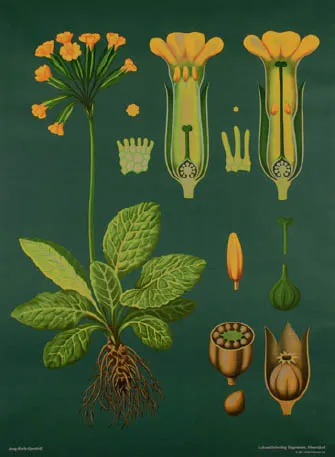
plate 8
Cowslip Primrose: Primula officinalis
Plant in blossom; Thrum-eyed flower (with short style) in longitudinal section; Anthers of the short-styled type with pollen grains (enlarged); Pin-eyed flower (with long style) in longitudinal section; Anthers of the long-styled type with pollen grains (enlarged); Anther; Style with stigma and ovary; Ripe fruit; Ripe fruit in longitudinal section; Ripe seed.
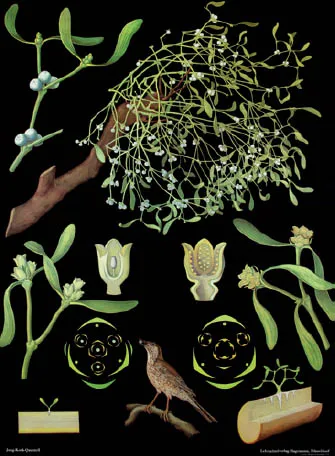
plate 9
Mistletoe: Viscum album
Plant on a branch; A piece of mistletoe with ripe berries (slightly magnified); Female blossom of the dioecious plant: a) sprig with pistil blossom, b) longitudinal section through a specimen of pistil blossom (more greatly magnified), c) diagram of the pistil blossom; Male blossom of the dioecious plant: a) sprig with pollen blossom, b) longitudinal section through a specimen of pollen blossom (more greatly magnified), c) diagram of the pollen blossom; The semi-parasite clings to the host plant: a) longitudinal section through mistletoe sprouting on a young sprig of wood, b) growing mistletoe with main feeder, bark roots, and secondary feeders on an older branch, here cut to show the roots; The mistle thrush (Turdus viscivorus), the main spreader of mistletoe.
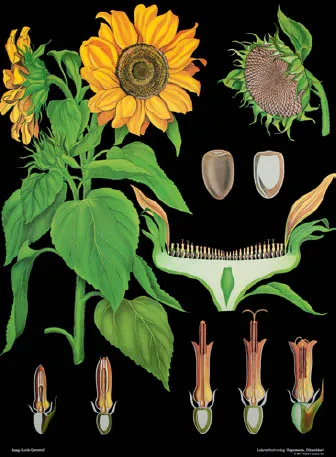
plate 10
Sunflower: Helianthus annuus
Total view of the overground part; Longitudinal section through infloresc...
Table of contents
- Cover
- Title
- Copyright
- Contents
- Introduction
- Botany
- Zoology
- Appendix
- Credits
- Bibliography
- References
- Author Biography
- Acknowledgments
Trusted by 375,005 students
Access to over 1.5 million titles for a fair monthly price.
Study more efficiently using our study tools.
Frequently asked questions
Yes, you can cancel anytime from the Subscription tab in your account settings on the Perlego website. Your subscription will stay active until the end of your current billing period. Learn how to cancel your subscription
No, books cannot be downloaded as external files, such as PDFs, for use outside of Perlego. However, you can download books within the Perlego app for offline reading on mobile or tablet. Learn how to download books offline
Perlego offers two plans: Essential and Complete
- Essential is ideal for learners and professionals who enjoy exploring a wide range of subjects. Access the Essential Library with 800,000+ trusted titles and best-sellers across business, personal growth, and the humanities. Includes unlimited reading time and Standard Read Aloud voice.
- Complete: Perfect for advanced learners and researchers needing full, unrestricted access. Unlock 1.5M+ books across hundreds of subjects, including academic and specialized titles. The Complete Plan also includes advanced features like Premium Read Aloud and Research Assistant.
We are an online textbook subscription service, where you can get access to an entire online library for less than the price of a single book per month. With over 1.5 million books across 990+ topics, we’ve got you covered! Learn about our mission
Look out for the read-aloud symbol on your next book to see if you can listen to it. The read-aloud tool reads text aloud for you, highlighting the text as it is being read. You can pause it, speed it up and slow it down. Learn more about Read Aloud
Yes! You can use the Perlego app on both iOS and Android devices to read anytime, anywhere — even offline. Perfect for commutes or when you’re on the go.
Please note we cannot support devices running on iOS 13 and Android 7 or earlier. Learn more about using the app
Please note we cannot support devices running on iOS 13 and Android 7 or earlier. Learn more about using the app
Yes, you can access The Art of Instruction by in PDF and/or ePUB format, as well as other popular books in Art & Art General. We have over 1.5 million books available in our catalogue for you to explore.