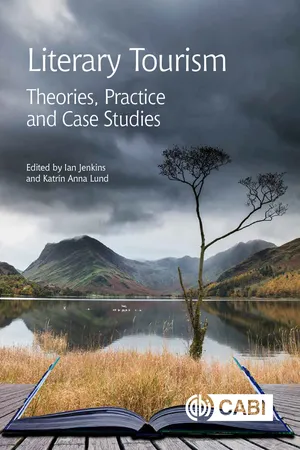
Literary tourism is a nascent field in tourism studies, yet tourists often travel in the footsteps of well-known authors and stories. Providing a wide-ranging cornucopia of literary tourism topics, this book fully explores the interconnections between the written word and travel. It includes tourism stories using guidebooks, films, television and electronic media, and recognises that stories, texts and narratives, even if they cannot be classified as traditional travel writing, can become journeys in themselves and take us on imaginary voyages. Furthermore, the book: - Provides a grounding in the theoretical perspectives on literature and the tourist experience;- Explores practical applications of literary tourism, such as destination promotion and creation, responsible tourism and learning benefits;- Uses global case studies to study literary tourism in action. Appealing to a wide audience of different disciplines, it encompasses subjects such as business literary writing, historical journeys and the poetry of Dylan Thomas. The use of these different perspectives demonstrates how heavily and widely literature influences travel, tourists and tourism, making it an important read for researchers and students of tourism, social science and literature.
eBook - ePub
Literary Tourism
Theories, Practice and Case Studies
- English
- ePUB (mobile friendly)
- Available on iOS & Android
eBook - ePub
Literary Tourism
Theories, Practice and Case Studies
About this book
Information
Part 1: Theory Relating to Literature and the Tourist Experience
How and what can literary tourism tell us about how we travel and tourism? Why is it important to study it? What kinds of knowledge does it bring forth? Maybe it has nothing entirely new to tell us, but we demonstrate how examining literary travels brings forth important, sometimes complex, perspectives of travel and tourism often overlooked. Exploring literary tourism reveals, for example, how destination development is a dynamic process through how destinations are ceaselessly improvised by those who travel through them, no matter if the journey follows a literary text or produces it. It shows us how texts write places that are simultaneously written and re-written as people journey through them performing texts, their own and others, factual and fictional, or mostly somewhere in-between. This blurs the boundaries between writing and journeying. The author who publishes a travelogue has put her/his own travel into a textual form that others may follow, consciously or unconsciously, even without undertaking the actual, physical travel, and it may be argued that a story must always be a journey. It is also becoming increasingly common that places are directly storied through the image of literature as tourists are offered a glimpse into the spaces where factual and/or fictional accounts took place, identifying with characters, allowing the imagination to bring them into hyper or even more-than-human realities. Yet another way to story places is by connecting them to the concept of ‘literature’ through events and festivals that celebrate literary works.
Accounts of literary tourism may paint a picture of place and shape its image as stories provide structure. As such, literary tourism is not innocent. It can provide a veil that masks other realities that are omitted from the actual gaze. However, as tourists perform places, they add meaning to places through their personal experiences as they improvise their version of the place. Literary journeys open up multidimensional experiences as narratives – pasts, presents, factual, fictional – entangle. The surrounding landscapes are brought to life, no matter whether they are urban or rural, as they take an active part in the narration. The enmeshment of narratives may even provide a vision and wanderings into a possible future of travel and tourism development.
All this emphasizes the ambiguity of the concept of authenticity, one that is much pondered over in the humanities and social sciences, and not least in tourism studies. However, as Tolkien once pointed out, the fantasy offers a world to step into and provides a sense for the real and authentic. And by journeying in a world like that, the literary traveller may be seen as deliberately avoiding the beaten track to experience something different from those labelled mainstream tourists. This leaves us with questions about what constitutes a beaten track and for whom, how the beaten track comes into being and, furthermore, who is a tourist and who is not, and who is labelled as such by whom? This emphasizes the complexity of tourism – not just literary tourism, but tourism in general – because the heterogeneous worlds that tourists step into are there to be experienced and enacted as authentic, or not. Thus, what examining literary tourism demonstrates is that tourism destinations, literary or not, are not merely places of consumption. The gaze is always complicated and offers a glimpse into a variety of narratives: past, present and future. However, how we travel and want to identify with our travels is always dependent on the narratives we choose to combine.
1 Travelling Against Time: Flemish Authors Travelling to Italy in the Interwar Period
Department of Cultural Studies, Radboud University, Nijmegen, The Netherlands

According to The World Tourism Organization (World Bank Group, n.d.a), the number of tourist arrivals worldwide was over one billion in 2015, three times more than in 1995. The Yearbook of Tourism Statistics shows a steady rise, with only two interruptions: minor dips between 2002 and 2003 and between 2008 and 2009. It is tempting to link the dips to events that had a massive global impact: the terror attacks from autumn 2001 and the start of the economic crisis with the collapse of Lehman Brothers in September 2008. Although this explanation is all too easy1, it is striking that the effect of those events seems very limited: a drop in tourist arrivals of about 1.3% and 4.2% respectively. The conclusion might be that the tourist industry is not much affected by external events on a global scale, no matter how devastating their nature. But do they affect the tourist discourse? How do tourist narratives respond to such realities? The question is evidently too broad for one chapter, so I will concentrate on one specific historical case study: Flemish travellers to Italy in the interwar period.
It is impossible to say how many people from the Flemish-speaking part of Belgium visited Italy in those days: there are only statistical data available for Belgian visitors. What is more, it was only after 1927 that the Belgians got their own category in these statistics; before that, they were included in the same category with the Dutch, Danish and Scandinavians. Syrjämaa (1997) calculated that in 1927 16,000 Belgians travelled to Italy. That number remained the same in 1928, grew to 25,000 in 1929, then dropped to 13,956 in 1930, presumably because of the financial crisis. 1931 and 1932 – the last years for which she tried to provide numbers – showed a rapid increase despite the global economic crisis, with respectively 39,987 and 36,769 Belgian visitors (Syrjämaa, 1997, p. 393). Professor in economics Fernand Baudhuin claims in 1931 that ‘le Belge voyage peu hors de chez lui; l’une des raisons doit être trouvée dans les prix plus élevés ailleurs’ (Baudhuin, 1931, p. 196), but does not come up with exact numbers. According to Yves Segers, Belgians spent 200 million BEF abroad in 1929, 125 million in 1935 and 150 million in 1936 – with Italy and Lourdes as popular destinations (Segers, 2003, p. 219).
Although we will never know exact numbers, we can derive from different phenomena that Italy was clearly in the picture as a travel destination for Flemish travellers in those days. In 1922 a journal for tourists was started under the name De Toerist (the name was changed to Toerisme in 1926) by the Vlaamschen toeristenbond, an organization that was also established in 1922 and had over 100,000 (mostly middle class) members within a decade (Raymaekers, 2012). Italy featured quite often in its contents. There was a lot of practical information on travel schemes, the prices of the visa2, passports, new rules and regulations for foreign visitors, available guidebooks. They announced lectures, slideshows and movies3, they reported on new traffic infrastructre and they applauded the establishment of the ‘Touring Club Italo-Tedesco, Deutsch-Italienischer Touristenverband’. Furthermore, they published travelogues. Already in the very first year there was a series of texts by G. Celis, a priest who reported extensively on his journey to Italy in April 1914, and similar texts were published in the course of subsequent years.4 They also published reviews of travelogues. One example is the review of Een klassieke reis in het ‘Schoone Italië’ by Claes (1925); the reviewer calls it a ‘practical’ book, a must-have ‘for those who travel as tourists to Italy’.5
In this chapter, I will focus on literary accounts of journeys to Italy, published as books, by Flemish authors who visited fascist Italy in the interwar period. How do their travelogues relate to a long tradition of cultural depictions of the country and to the political reality of those days?
Description of the Database and Political Context
It proved to be very difficult to trace the exact number of travelogues, but by systematically analysing Boekengids – a bibliographical magazine that started in 1921 – I was able to identify 16 travelogues entirely dedicated to a trip to Italy and published as books between 1925 and 1941. They were written by 13 different Flemish authors:
1. Jozef Deswert, Naar Rome! ‘Anno Santo’ (Deswert, 1925)
2. Ernest Claes, Een klassieke reis in het ‘Schoone Italië’ (Claes, 1925)
3. Felix Timmermans, Naar waar de appelsienen groeien (Timmermans, 1926)
4. H. Haeck, De bedevaart van Toon Verheyen (Haeck, 1928)
5. E. Van Hemeldonck & Fr. Ramon, Van Toontje die naar Rome ging (Van Hemeldonck and Ramon, 1927)
6. M. van Hoeck, Schoonheidsvizoenen. Reisindrukken uit Italië (Van Hoeck, 1928)
7. Alfons Lambrecht, Naar de Gondelstad (Lambrecht, 1928)
8. Gab. Celis, Door het kunstrijk Italië (Celis, 1929)
9. Gab. Celis, Naar Rome: reisindrukken (Celis, 1928)
10. Jozef Simons, In Italië (Simons, 1930)
11. M.E. Belpaire, Reukwerk (Belpaire, 1932)
12. Louisa Duykers, Aquarellen uit Italïe (Duykers, 1933)
13. Hilarion Thans, Vertellen: Derde Deel (Thans, 1937)
14. Cyriel Verschaeve; Italië. Studies over kunst (Verschaeve, 1938)
15. Hilarion Thans, Door oud en nieuw Italië (Thans, 1938)
16. Hilarion Thans, Langs heilige bergen. Vertellen: 4 (Thans, 1941)
This means an average of one travelogue a year: there clearly was a market for these books. I was unable to find information on readers, but in one of the books I consulted I found the following handwritten text: ‘Souvenir of my trip to Rome in the Holy Year 1925’ – which means that travellers were buying them. Since paid holidays for ordinary working people were only established in 1936 in Belgium, it seems logical that many people reading these travelogues did so as ‘armchair tourists’, without being able to go to Italy themselves.
Some of these books were (modified) reprints. Een klassieke reis in het ‘Schoone Italië’ (Claes, 1925) by Ernest Claes was first published in 1908 under the title Het schooner Italië. Reisvertelling (1908). Aquarellen uit Italïe (Duykers, 1933) by Louisa Duykers featured in 1911 in the literary magazine Dietsche Warande & Belfort. A part of Timmermans’s text featured as a series in De Maasbode and Nieuwe Venlosche Courant in the summer of 1925 and Celis published earlier in De Toerist. Apart from Felix Timmermans, who published his travelogue with his usual Dutch publishing house, all the publishing houses are Flemish and Catholic. Almost half of the authors were priests (Thans; Verschaeve; Celis; Van Hoeck; Haeck; Deswert), the others were non-clerical but moving, working and publishing in Catholic circles. Among them, there were two women, Duyckers and Belpaire, both connected to the literary magazine Dietsche Warande & Belfort as authors, and in the case of the latter, also as mentor and financer. I was unable to find any travel books to Italy by authors from the other ‘pillars’ (the term to describe the political and organizational segregation of societies along ideological lines), socialist nor liberal, from the interwar period.
Evidently, for Catholics Italy was the country to visit, since it had already been the seat of the Church for centuries and was the most important site of the Grand Tour. One of the first reports of a Grand Tour, The Voyage of Italy, or, A Complete Journey through Italy, was written by the Roman Catholic priest Richard Lassels (1670). In his ‘A preface to the reader’ he tries to counter those who say that he ‘hunt[s] too much after Ceremonies, and Church antiquities’ by saying that ‘I cannot speak of Rome the Christian, but I must speak of Relicks, Ceremonies and Religion’ and by stressing that he paid a lot of attention to ‘prophane’ subjects as well. A steady stream of travelogues about a pilgrimage to Rome had found its way to European readers for centuries. In the early days of the Belgian nation state (founded in 1830), for instance, the priest P. Visschers published several books on his journey to Italy.6 By the interwar period in Belgium, a tourist industry had already started to develop around the idea of going on to Italy. In De Toerist and Toerisme we find various invitations for guided tours to Italy.7 Interestingly, several of the travelogues I found describe a guided journey – often explicitly named a ‘pilgrimage’– in which the group is accompanied by the parish priest. All this helps to explain why the travelogues I found were Catholic.
The political context evidently played a role as well. Fascists took over power on the 28 October 1922. The movement strongly opposed democratic socialism and liberalism but took care to keep close ties with the Roman Catholic Church. This gave Italy a negative image in liberal and socialist circles, which became even worse when on 10 June 1924, the socialist leader of the opposition Giacomo Matteotti was murdered by members of the Ceka, who possibly received their orders directly from Mussolini (Carocci, 1975, p. 32). In his ‘Discorso sul delitto Matteotti’ on 3 January 1925 in the House of Representatives, Mussolini claimed personal responsibility for inciting the violence in the country and declared himself dictator, arguing that Italy needed stability at all costs. The murder, the investigation and the trial, as well as Mussolini’s speech, were widely covered in newspapers all over the world, and the Low Countries were no exception. The assassination also meant the start of a very turbulent and internationally mediatized relationship between the Belgian minister of foreign affairs from 1925 to 1927, the socialist Emile Vandervelde, and il Duce. On 16 October 1925, Vandervelde refused to meet Mussolini in person at the conference of Locarno. The next year, he was the only minister of foreign affairs not to congratulate Mussolini after he survived an assault on 7 April (he only lost th...
Table of contents
- Cover
- Half-title Page
- Title Page
- Copyright
- Contents
- List of Contributors
- Preface: A Short Discourse on the Development, Importance and Effect of Literary Tourism
- Part 1: Theory Relating to Literature and the Tourist Experience
- Part 2: Practical Applications of Literature to the Tourist Experience and Tourist Industry
- Part 3: Case Studies of Literary Tourism and their Effects on the Tourist
- Index
- aboutcabi
- Backcover
Trusted by 375,005 students
Access to over 1.5 million titles for a fair monthly price.
Study more efficiently using our study tools.
Frequently asked questions
Yes, you can cancel anytime from the Subscription tab in your account settings on the Perlego website. Your subscription will stay active until the end of your current billing period. Learn how to cancel your subscription
No, books cannot be downloaded as external files, such as PDFs, for use outside of Perlego. However, you can download books within the Perlego app for offline reading on mobile or tablet. Learn how to download books offline
Perlego offers two plans: Essential and Complete
- Essential is ideal for learners and professionals who enjoy exploring a wide range of subjects. Access the Essential Library with 800,000+ trusted titles and best-sellers across business, personal growth, and the humanities. Includes unlimited reading time and Standard Read Aloud voice.
- Complete: Perfect for advanced learners and researchers needing full, unrestricted access. Unlock 1.5M+ books across hundreds of subjects, including academic and specialized titles. The Complete Plan also includes advanced features like Premium Read Aloud and Research Assistant.
We are an online textbook subscription service, where you can get access to an entire online library for less than the price of a single book per month. With over 1.5 million books across 990+ topics, we’ve got you covered! Learn about our mission
Look out for the read-aloud symbol on your next book to see if you can listen to it. The read-aloud tool reads text aloud for you, highlighting the text as it is being read. You can pause it, speed it up and slow it down. Learn more about Read Aloud
Yes! You can use the Perlego app on both iOS and Android devices to read anytime, anywhere — even offline. Perfect for commutes or when you’re on the go.
Please note we cannot support devices running on iOS 13 and Android 7 or earlier. Learn more about using the app
Please note we cannot support devices running on iOS 13 and Android 7 or earlier. Learn more about using the app
Yes, you can access Literary Tourism by Ian Jenkins, Katrín Anna Lund, Ian Jenkins,Katrín Anna Lund in PDF and/or ePUB format, as well as other popular books in Business & Hospitality, Travel & Tourism Industry. We have over 1.5 million books available in our catalogue for you to explore.