- 192 pages
- English
- ePUB (mobile friendly)
- Available on iOS & Android
eBook - ePub
About this book
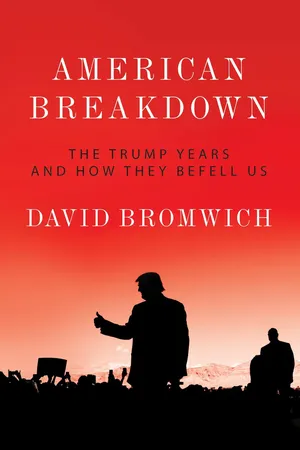
American Breakdown is the brilliant political diary of one of America's leading essayists, David Bromwich, whose work has drawn wide appreciation for its incisive portraits and accurate prognosis. From his analysis of the Cheney-Bush co-presidency, in which foreign policy was reduced to permanent war, and Barack Obama's practice of reconciliation without truth, Bromwich chronicles the emergence of Donald Trump-the demagogue of a culture of corruption from which all traces of political interest and candor have dropped away. An unsparing account of the degradation of American democracy, the book leads off with a new introduction on the prospects for change during the new Democratic Congress.
Information
1
The Cheney Co-Presidency
November 2008
When George W. Bush testified before the 9/11 Commission, Dick Cheney was with him in the Oval Office. What was said there remains a secret, but throughout the double session, it appears, Cheney deferred to Bush. Aides to the president afterward explained that the two men had to sit together for people to see how fully Bush was in control. A likelier motive was the obvious one: they had long exercised joint command but neither knew exactly how much the other knew, or what the other would say in response to particular questions. Bush also brought Cheney for the reason that a witness under oath before a congressional committee may bring along his lawyer. He could not risk an answer that his adviser might prefer to correct. Yet Bush would scarcely have changed the public understanding of their relationship had he sent in Cheney alone. “When you’re talking to Dick Cheney,” the president said in 2003, “you’re talking to me.”
The shallowest charge against Cheney is that he somehow inserted himself into the vice presidency by heading the team that examined other candidates for the job. He used the position deviously, so the story goes, to sell himself to the credulous younger Bush. The truth is both simpler and more strange. Since 1999, Cheney had been one of a group of political tutors of Bush, including Condoleezza Rice and Paul Wolfowitz; in this company, Bush found Cheney especially congenial—not least his way of asserting his influence without ever stealing a scene. Bush, too, resembled Cheney in preferring to let others speak, but he lacked the mind and patience for discussions: virtues that Cheney possessed in abundance.
As early as March 2000, Bush asked him whether he would consider taking the second slot. Cheney at first said no. Later, he agreed to serve as Bush’s inspector of the qualifications of others; his lieutenants were his daughter Liz and David Addington. Some way into that work, Bush asked Cheney again, and this time he said yes. The understanding was concluded before any of the lesser candidates were interviewed. It was perhaps the first public deception that they worked at together: a lie of omission—and a trespass against probity—to give an air of legitimacy to the search for a nominee. But their concurrence in the stratagem, and the way each saw the other hold to its terms, signaled an equality in manipulation as no formal contract could have done. It is hardly likely that an exchange of words was necessary.
The vice-presidential search in the spring of 2000 was characteristic of the co-presidency to come in one other way. It involved the collection of information for future use against political rivals. In this case, the rivals were the other potential VPs, among them Lamar Alexander, Chuck Hagel, and Frank Keating. They had been asked to submit exhaustive data concerning friends, enemies, sexual partners, psychological vicissitudes (noting all visits to therapists of any kind), personal embarrassments, and sources of possible slander, plus a complete medical history. Each also signed a notarized letter that gave Cheney the power to request records from doctors without further clearance.
All this information would prove useful in later years. Barton Gellman reveals in Angler that soon after Frank Keating was mentioned as a likely candidate for attorney general, a story appeared in Newsweek about an awkward secret in his past: an eccentric patron had paid for his children’s college education. No law had been broken, and nothing wrongly concealed; but the story killed a chance for Keating to be named attorney general, and the leak could only have come from one person. Doubtless most of the secrets in Cheney’s possession were the more effective for not being used.
Cheney by nature is a high functionary and inside operative, ready to learn and eager to ferret out the background of people and events, both the things he is supposed to know and the things he is not. It is symptomatic that in the Ford administration, when Cheney served as White House chief of staff, he declined a generous offer of cabinet status: higher visibility, he believed, would only diminish his actual potency. By the end of his time in that office, he had narrowed down access to the president to the people he himself preferred; and at his retirement, Cheney’s staff gave him, as Stuart Spencer recalls, “a bicycle wheel with all the spokes busted out except for one—his.”
A now forgotten aberration of the Republican convention in 1980 may have helped to crystalize his thinking about the advantages of a recessive stance. For a few frantic days that summer, it looked as if Ronald Reagan would need someone with demonstrable experience on the ticket if he was to have a chance in November; and there were serious discussions of a co-presidency to be shared between Reagan and Ford. Cheney, a close adviser to Ford, was an interested witness, and he saw how the excess and literalness of Ford’s “wish list” for vice-presidential powers caused the negotiations to break down. Still, this was a tantalizingly close call; and it could only have left Cheney thoughtful about future possibilities. Suppose one day the Republican Party nominated another charmer, cut out, like Reagan, for the getting of votes but as fundamentally uninterested as Reagan was in the actual running of government.
No two persons and indeed no twenty in Reagan’s administration enjoyed the power that Cheney settled into in 2001; but the role of the president in these two administrations has been much the same. He is the campaigner, the crowd-pleaser (if he can), the known presence at the visible desk who signs the laws and executive orders. The amiability of George W. Bush has turned out to be less versatile and translatable than Reagan’s: the boyish vulgar humor and back-slapping require easy success as a precondition; and apart from the three and a half years after the September 11 attacks—the period of the “fast wars” and the “war presidency”—his two terms in office have been marked by conspicuous failures.
Bush’s exceedingly low spirits have been palpable now for many months; and without the one to two hours of strenuous exercise that are the heart of his day, his mental state would surely be a good deal grimmer. And yet, for this very reason the growing evidence about Cheney’s bad judgments has not greatly diminished Bush’s reliance on him. If the vice president dominates policy less than he did before 2006, the reason is only that others around Bush have become more confident. It remains nonetheless a relationship without any parallel in American history. “The vice president,” as Jacob Weisberg observes in The Bush Tragedy, “built his power over Bush by finding ways to give power to Bush.” There has never been a moment in this administration when the dependency let up.
Something subtly changed in Dick Cheney between 1995 and 2000, some equilibrium or inward balance of ambition and ordinary prudence. These were his years as CEO of Halliburton, where he did not post enormous profits: his decision, in 1998, to merge Halliburton with Dresser Industries and the subsequent asbestos claims against Dresser led the value of Halliburton stock to fall from $54 to $9 a share between August and December 2000.
Yet Cheney as CEO had a value as great as that of any official who has passed through the revolving door that separates government office from corporate chairmanships. His importance was as a connection maker, a facilitator, a speculative explorer of large innovations. While at Halliburton, Cheney would commission a study of the utility of employing private security contractors to fight in wars—only a piece of “research” at the time, but it would pay later for both the company and the vice president, with the off-the-books contracts that by privatizing state protection kept much of the Iraq occupation out of public view.
These were the years, too, of Dick Cheney’s close association with the American Enterprise Institute and its offspring, the Project for the New American Century. The parent think tank, once an ordinary home for postwar business conservatism, had mutated, under the guidance of Irving Kristol, into the most lavish and energetic of the quasi-academic lobbies of neoconservative doctrine. The AEI, in the late 1970s and the early 1980s, had been transformed into an institute for the promotion of laissez-faire economics, militarized foreign policy, and the dismantling of the welfare state. It differed from, say, the Rand Corporation in eschewing any claim to impartiality of analysis. It was polemical and took confrontational positions that were disseminated early in the lectures and seminars open to resident fellows. The AEI differed, also, from an older centrist policy outfit like the Brookings Institution in having superior access to the mass media, thanks to careful self-advertisement and the coaching that its representatives often received from editors and agents such as Adam Bellow and Lynn Chu. A more-in-sorrow style was favored in discussing the grim necessity, for example, of increasing America’s nuclear stockpile or stopping the “culture of poverty” in the black community by cutting off federal programs.
Cheney’s familiarity with the policy institute way of talking was a steady and not a negligible factor in his ability to gain acceptance for his most outlandish maneuvers in the years between 2001 and 2003: the tax cuts and no-bid contracts with the Pentagon; withdrawal of the United States from the Anti-Ballistic Missile Treaty; the sudden commitment of the Pentagon to vast expenditures on missile defense, notwithstanding the record of test failures among missiles engendered by the Star Wars program under Reagan; the systematic exaggeration of the menace of Saddam Hussein in order to build support for a war against Iraq; and, in the triumphal mood of April 2003, the refusal to consider diplomatic contacts with Iran to obtain a “Grand Bargain” for peace in the Middle East.
Yet to those who knew the language, Cheney was only the forward edge of a policy long in the works. It had been announced almost in public in the turn-of-the-century strategy document Rebuilding America’s Defenses, the most substantial work commissioned by the Project for the New American Century. Like the sponsors of that treatise—among them Paul Wolfowitz, Lewis “Scooter” Libby, William Kristol, Frederick Kagan, and Stephen Cambone—and like the adepts of American hegemony at the AEI, Cheney, before he took office as vice president, had concluded that there were no necessary limits on US domination of the world. This conviction hardened during the Clinton years—a window of time, as neoconservatives sometimes say, in which America could have asserted far more control than it did, and with a freer military hand. Cheney’s institutional prowess, and his readiness to execute policies long in the making, point to a larger pattern that James Mann wrote well about in Rise of the Vulcans.
Republicans, since 1975, have had a foreign policy establishment that stays in place even when they are out of power. (The Democrats can claim nothing of the sort.) Through the continuity of neoconservative advisers, the military-statist wing of the Republican Party has thus, for three decades now, had the consistency and coherence of a shadow government. Though remarked by no one at the time, most of its essential policies—including “force projection” in the Middle East and continued pressure on Russia in spite of the fall of communism—were already in place by 1996, when the leading foreign policy adviser to Bob Dole was Paul Wolfowitz.
The Cheney doctrine of preventive war was first announced in a document called Defense Planning Guidance, drafted in 1992 by Zalmay Khalilzad (now US ambassador to the UN after serving as ambassador to Iraq) and revised by Lewis Libby. This guide was cleared for public release in early 1993 by Cheney in his final days as George H. W. Bush’s secretary of defense. Cheney took considerable pride in the prescription here that the United States should “act against” emerging threats “before they are fully formed.” George W. Bush would still be echoing those phrases in his June 2002 commencement address at West Point: “We must take the battle to the enemy, disrupt his plans, and confront the worst threats before they emerge.” Richard Perle saying “we have no time to lose” (July 11, 2002) and Cheney himself telling the Veterans of Foreign Wars that “time is not on our side” (August 26, 2002) kept up the same drumbeat with the same theory to support them. Defense Planning Guidance conferred on America the right to launch at will an international war of aggression. As for the larger strategy, extractable from Rebuilding America’s Defenses, it was marked by an overriding ambition for global mastery, for the possession of irresistible military forces, for an expanded arsenal of nuclear weapons, and for large new investments in missile defense. These publications of 1993 and 2000 now seem a pair of symbolic brackets around the neoconservative exile that was the Clinton administration. All along, this was the normal thinking around the AEI and the Cheney circle. Yet when placed alongside the norms of the containment policy during the years 1946–1989, the new dogma betrayed a shift so tremendous that it could not have been ratified without a layer of well-instructed opinion makers to prepare and soften its acceptance.
Never before, in the history of the United States, has there been an ideological camp so fully formed and equipped to extend itself as neoconservatism in the year 1999. It was, and remains, a sect that has some of the properties of a party. There are mentors now in the generation of the fathers as well as the grandfathers, summer internships for young enthusiasts, semiofficial platforms of programmed reactions to breaking news. But to grasp their collective character, one must think of a party that does not run for office at election time. They can therefore evade responsibility for botched policies and the leaders who promote those policies. Donald Rumsfeld had his first and warmest partisans among the neoconservatives, but they were also the first, with the solitary apparent exception of Cheney, to identify him as a scapegoat for the Iraq war and to call for his firing when the insurgency tore that country apart in 2006.
With the peculiar tightness of its loyalties and the convenience of its immunities, neoconservatism in the United States now has something of the consistency of an alternative culture. Its success in penetrating the mainstream culture is evident in the pundit shows on most of the networks and cable TV, and in the columns of the Washington Post and the New York Times. In the years between 1983 and 1986, and again, more potently, in 2001–2006, the neoconservatives went far to dislocate the boundaries of respectable opinion in America. The idea that wars are to be avoided except in cases of self-defense suffered an eclipse from which it has not yet returned, largely owing to the persistence of respected opinion makers in urging the spread of freedom and markets by force of arms. More particularly, and to confine ourselves to recent events, the nomination to the Supreme Court of Samuel Alito, and the drafting and legitimation of the “surge” strategy by retired general Jack Keane and Frederick Kagan of the AEI, could not have succeeded as they did without the early and organized advocacy of the neoconservative camp.
How did they get so close to Dick Cheney? The answer lies in the fact that Cheney has an inquisitive mind, and yet, from the accidents of his career and placement, he was for a long time a thinker deprived of intellectual society. Neoconservatism, as it developed in the 1980s, came to have its own heroes (Robert Bork), its canon of revered texts (Allan Bloom’s Closing of the American Mind), and a set of prejudices delivered in a reasonable tone: hostile to individual liberty, appreciative of modern technology, friendly to religion as a guide to morals and an engine of state power. It was, to repeat, a substitute culture of satisfying density. The AEI along with journals like Commentary and, more recently, the Weekly Standard, offered, for those who took the full course, a total environment, an idiom of managerial-intellectual judgment that combined the rapidity of journalism with the weightier pretensions of an academy.
In the Washington of the 1980s, the elder Kristols and the Cheneys were rising together, and they became close friends. This alliance easily passed to the younger generation: William Kristol in 2003 boasted to David Carr of the the New York Times (“White House Listens When Weekly Speaks”) that “Dick Cheney does send over someone to pick up 30 copies of [the Weekly Standard] every Monday”—a statement that remains the best clue we have to the number of persons who work for the vice president. The self-confidence of this substitute culture fortified Cheney’s sense that he had always already heard the relevant views, and that he had come into contact with the best minds—minds free of the conformist cant and the cost-free sentimentality of modern liberalism.
Cheney’s ruling passion appears to be a love of presidential power. Go under the surface a little and this reveals itself as something more mysterious: a restless desire of power after power. It is a quality of the will that seems accidentally tied to an office, a country, or a given system of political arrangements. Jack Goldsmith, the head of the Office of Legal Counsel who fought hard against encroachments on the laws by Cheney and his assistant David Addington, remarked later with consternation and a shade of awe: “Cheney is not subtle, and he has never hidden the ball. The amazing thing is that he does what he says. Relentlessness is a quality I saw in him and Addington that I never saw before in my life.” Yet there is nothing particularly American about Cheney’s idea of government, just as there is nothing particularly constitutional about his view of the law; and no more broadly characterizing adjective, such as “Christian,” will cover his ideas of right and wrong.
Those who have studied him most closely—James Mann, Charlie Savage, Barton Gellman—agree that his drive to consolidate executive power goes back to one formative experience of seeing men of power checked and denied their prerogatives. As Gerald Ford’s chief of staff, he was a witness, close up, to the Church Committee investigations of the mid-1970s. The reforms that followed those investigations would open up rights for citizens against domestic surveillance, and would create the machinery for lawmakers to curb the exuberance and inspect the conduct of the national security apparatus. Among the reforms of the time was FISA—the Foreign Intelligence Surveillance Act—which Cheney deplored as soon as it passed and has sought ever since to circumvent. Here, as elsewhere, Addington may be supposed to give an uncensored glimpse of the vice-president’s view: “We’re one bomb away from getting rid of that obnoxious court.”
Something deep and unspoken in Cheney plainly rebels against the idea that conventional lawmakers, whose only power lies in their numbers, could ever check or by law prevent the actions of a leader vested with great power. He thought Nixon should not have resigned and advised George H. W. Bush not to seek approval from Congress for the first Gulf War. Even at the time of the Church investigations, Cheney made an exception for the chief executive to the Freedom of Information Act, and secreted in a vault the government’s “family jewels”: findings of an internal investigation that he believed should be a state secret. These papers, declassified by the CIA in June 2007, included evidence of CIA kidnappings, assassination plots, and illegal domestic spying.
He sought and obtained the resignation of William Colby as director of the CIA for too readily cooperating with the Church Committee; but he could also count on some reliable friends in his rebellion. Brent Scowcroft, who wrongly took Cheney to be a moderate, concurred for pragmatic reasons of his own. A more wholehearted ally was a young lawyer from the Nixon justice department, Antonin Scalia. By 1977, one thing was clear to both Cheney’s allies and his opponents. He wanted a great deal of power to be held as closely as possible by the president. When he ran for Congress in 1978 and won election for the first of six terms, he got himself quickly appointed to an odd combination of committees: Ethics and Intelligence. They had in common the access they offered to secrets of entirely different kinds.
One of Cheney’s first public statemen...
Table of contents
- Cover Page
- Halftitle Page
- Title Page
- Copyright Page
- Dedication
- Contents
- Introduction
- 1. The Cheney Co-Presidency
- 2. What Went Wrong: The Obama Legacy
- 3. Act One, Scene One
- 4. The Age of Detesting Trump
- 5. American Breakdown
- 6. Midterm Fever
- Conclusion
- Appendix A: On the Election
- Appendix B: Bomb First
- Appendix C: The Making of Donald Trump
- Acknowledgments
- Index
Trusted by 375,005 students
Access to over 1.5 million titles for a fair monthly price.
Study more efficiently using our study tools.
Frequently asked questions
Yes, you can cancel anytime from the Subscription tab in your account settings on the Perlego website. Your subscription will stay active until the end of your current billing period. Learn how to cancel your subscription
No, books cannot be downloaded as external files, such as PDFs, for use outside of Perlego. However, you can download books within the Perlego app for offline reading on mobile or tablet. Learn how to download books offline
Perlego offers two plans: Essential and Complete
- Essential is ideal for learners and professionals who enjoy exploring a wide range of subjects. Access the Essential Library with 800,000+ trusted titles and best-sellers across business, personal growth, and the humanities. Includes unlimited reading time and Standard Read Aloud voice.
- Complete: Perfect for advanced learners and researchers needing full, unrestricted access. Unlock 1.5M+ books across hundreds of subjects, including academic and specialized titles. The Complete Plan also includes advanced features like Premium Read Aloud and Research Assistant.
We are an online textbook subscription service, where you can get access to an entire online library for less than the price of a single book per month. With over 1.5 million books across 990+ topics, we’ve got you covered! Learn about our mission
Look out for the read-aloud symbol on your next book to see if you can listen to it. The read-aloud tool reads text aloud for you, highlighting the text as it is being read. You can pause it, speed it up and slow it down. Learn more about Read Aloud
Yes! You can use the Perlego app on both iOS and Android devices to read anytime, anywhere — even offline. Perfect for commutes or when you’re on the go.
Please note we cannot support devices running on iOS 13 and Android 7 or earlier. Learn more about using the app
Please note we cannot support devices running on iOS 13 and Android 7 or earlier. Learn more about using the app
Yes, you can access American Breakdown by David Bromwich in PDF and/or ePUB format, as well as other popular books in Politica e relazioni internazionali & Storia nordamericana. We have over 1.5 million books available in our catalogue for you to explore.