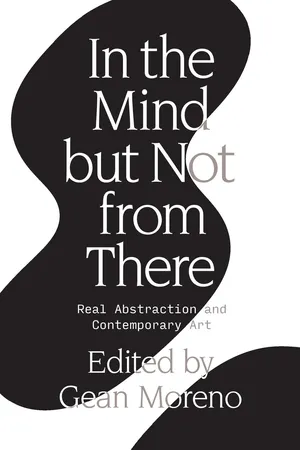
In the Mind, But Not From There: Real Abstraction and Contemporary Art considers how the Marxian concept of Real Abstraction--originally developed by Alfred Sohn Rethel, and recently updated by Alberto Toscano--might help to define the economic, social, political, and cultural complexities of our contemporary moment. In doing so, this volume brings together noted contemporary artists, literary critics, curators, historians, and social theorists who connect the concept of Real Abstraction with contemporary cultural production. Theoretical and artistic contributions from Benjamin Noys, Paul Chan, Joao Enxuto and Erica Love, Marina Vishmidt, Sven L?tticken, and many others help to map out the relationship between political economy and artistic production in the realm of contemporary, globalized cultural exchange.
This anthology places economic and social analyses alongside creative projects and visual essays to consider the many angles of contemporary art, and how inquiry into the the production of abstraction through material and social processes can be used to better understand, and hopefully change, the conditions under which art is made, seen, and circulated today.
Published in collaboration with [NAME] publications.
- 336 pages
- English
- ePUB (mobile friendly)
- Available on iOS & Android
eBook - ePub
About this book
Information
Topic
ArtSubtopic
Art & Politics1
The Open Secret of Real Abstraction
Alberto Toscano
As a rule, the most general abstractions arise only in the midst of the richest possible concrete development, where one thing appears as common to many, to all…Individuals are now ruled by abstractions, whereas earlier they depended on one another.Marx, Grundrisse
Whether we are concerned with unmasking commodity fetishism, the formalization of surplus value, or discourse on alienation, it is difficult to ignore that much of the force of the Marxian matrix—when compared to contemporary discourses of abstraction, with their frequent reliance on notions of complexity and information—is based on its depiction of capitalism as the culture of abstraction par excellence, as a society that, pace many of the more humanist denunciations of the dominant ideology, is often really driven by abstract entities traversed by powers of abstraction.1 A particular modality of social abstraction can thus be identified as the differentia specifica of capitalism vis-à-vis other modes of production. As Italian Marxist phenomenologist Enzo Paci wrote, “The fundamental character of capitalism…is revealed in the tendency to make abstract categories live as though they were concrete. Categories become subjects, or rather, even persons, though we must here speak of person in the Latin sense, that is, of masks…’Capitalist’ means a man transformed into a mask, into the person of capital: in him acts capital producing capital… The abstract, in capitalist society, functions concretely.”2
The debate on Marxian uses of abstraction often orbits around one of the few explicit methodological prescriptions bequeathed by the author of Capital, the 1857 Introduction to A Contribution to the Critique of Political Economy.3 Specifically, it centers on the interpretation of a passage on the dialectics of the abstract and the concrete, whose core is as follows:4
The seventeenth-century economists, for example, always took as their starting point the living organism, the population, the nation, the State, several States, etc., but analysis led them always in the end to the discovery of a few decisive abstract, general relations, such as division of labor, money, and value. When these separate factors were more or less clearly deduced and established, economic systems were evolved which from simple concepts, such as labor, division of labor, demand, exchange-value, advanced to categories like State, international exchange and world market. The latter is obviously the correct scientific method. The concrete concept is concrete because it is a synthesis of many definitions, thus representing the unity of diverse aspects. It appears therefore in reasoning as a summing up, a result, and not as the starting point, although it is the real point of origin, and thus also the point of origin of perception and imagination.5
The first point to note is that Marx promotes in these pages a theoretical break and an empiricist or neopositivist use of the terms “abstract” and “concrete.” He underscores a distinction between sensibility, perception and sense data, on the one hand, and speculative form or theoretical concept, on the other.6 Marx then reformulates the distinction such that the sensible and the empirical appear as a final achievement rather than a presupposition-less starting point.7 As I suggest, the Marxian stance on abstraction, as intimated in the 1857 Introduction, cannot easily be mapped onto customary distinctions between empiricism and rationalism, or even materialism and idealism. This is evident, too, in the “twisted” genesis of Marx’s concept of abstraction, which begins with a Feuerbachian critique of Hegel, moving through a Hegelian surpassing of Feuerbach, and finally resulting in a political and philosophical overcoming of the very terms of Hegel’s logic of abstraction.
To the extent that Marx’s methodological conception of abstraction is diagonal to Feuerbachian sensualism and Hegelian logicism, different authors have concurred in seeing the 1857 Introduction as a move to a generic, humanist or anthropological concept of abstraction: the passage to a notion of real abstraction—abstraction not as a mere mask, fantasy or diversion, but as a force operative in the world.8 Thus, Roberto Finelli writes of a “generic” abstraction that, prior to 1857, Marx inherited from Feuerbach. This generic abstraction presupposes the genus “humanity” and regards all political, religious and economic abstractions (the State, God and private property) as fictitious hypostases of a positive, underlying generic essence that is not itself prey to historical or logical becoming.9 The crucial theoretical revolution would then be the one that passes from this fundamentally intellectualist notion of abstraction—which presumes liberation as a “recovery” of the presupposed genus (putting man where God, qua distorted humanity, once stood)—to a vision of abstraction that, rather than depicting it as a structure of illusion, recognizes it as a social, historical and “transindividual” phenomenon.10
Commenting on the idea of the concrete as a synthesis of abstract determinations, as a totality of thought (Gedankenkonkretum), Finelli makes the following observation:
The abstract is not a product of the singular human being but of a social whole which reproduces itself in accordance with a determinate relation of production…the abstract as mental is the result of an individual practice that moves from a presupposed totality with a concomitant, and aporetic, theory of alienation; the abstract as real is instead coterminous with a theory of totalization as historical making, where totality is not presupposed but posited and where it can therefore be assumed as a real, and not an arbitrary, presupposition, only to the extent that it is given as result.11
This real abstract movement of totalization is the movement of capital qua substance becoming “Subject.” This argument for the synthetic character of the concrete (the process of capital’s “concrescence,” to borrow a term from Whitehead) is also an argument regarding the nature of production. According to Finelli, production qua concrete totality is in fact to be understood in terms of the interaction and combination (or totalization) of “simple” determinations (value, division of labor, property) into historically specific, complex configurations. While “production in general is only the offspring of bourgeois ideological abstraction,”12 the Marxian concept of production —which is, according to Finelli, a relational concept, first and foremost—is to be grasped, in Marx’s terms, as the concrete “unity of diverse aspects.” Society is above all a matter of relations: the role of these univocal simple abstractions—such as value, labor, private property—in the formation of the concrete must be carefully gauged so that they do not mutate back to those powerless and separate, not to mention mystifying, intellectual abstractions that occupied the earlier theory of ideology. But these abstractions are not mental categories that precede the concrete totality; they are real abstractions that are truly caught up in the social whole, the social relation.
Thus, against those who see abstraction as an intellectualist separation of general forms from concrete life or, conversely, as the extraction of an essential kernel of reality from the fleeting figures of historical development, Finelli identifies the specificity and uniqueness of the post-1857 Marx in a turn away from positing a real generic essence (which abstract forms would merely hypostasize by way of inversion) and, perhaps more interestingly, in the differential character of Marx’s notion of abstraction, which is no longer, as in classical theories of abstraction,13 a suspension of or subtraction from differences. Thus, he writes, “The real abstraction of capitalist society is not a logical abstraction, far away from differences, but rather an abstraction which is born from difference, from an entirely specific social determinateness, and it is therefore pregnant with difference, capable of articulating an entire society.”14
It is significant that Finelli pulls back from the ultra-Hegelian solution that would see in this ascending from the abstract to the concrete15 a strictly logical progression. Rather, the genesis of abstraction is historical.16 The foremost exemplar of this historicity of the abstract is located in the real genesis of the category of abstract labor, which is treated by bourgeois ideologists as an unproblematic and timeless abstraction that can simply be applied to “production in general.”17 On the contrary, the historical genesis of abstract labor, which is regenerated in concrete thought by the synthesis of simple determinations into an internally differentiated complex, is a paramount case of the manner in which Marx is able to delineate the reality of (concrete) universals in a manner that breaks radically with the history of the philosophical disputes between nominalists and realists:
In the society of capital, abstraction assumes the explicit contours of a matter of fact, of a state of affairs, it becomes a practically true abstraction, indicating that only here the universal is not mere form, whether logical or superficial, but, paradoxically, a universal capable of reality…The universal is real only when it is the fruit not of the logical intellect or even of theoretical ideation but of collective historical praxis.18
What has happened, one may ask, to the initial Feuerbachian cri de cœur that triggered the political theory of abstraction, taking its cue from the separateness of the individual? In the mature Marx, the theme of separation is withdrawn from the humanist and intellectualist matrix and reconfigured as an effect of the real abstraction of capital, of a capital that can only integrate and socialize via the atomization of workers, their separation from the means of production and their thoroughgoing domination.
Such an interpretation sees Marx moving beyond both the Feuerbachian theme of generic abstraction and the Hegelian notion of logical abstraction, and doing so by showing the properly ontological character of capitalist abstraction. This ontology of real abstraction—which is inextricably political, historical and economic—is, in Finelli’s view, a dual ontology to the extent that it both affirms concrete reality as a “specific articulation of differences”19 and reveals the void at the heart of Capital, as it were, the fact that the real of its abstraction—to speak in a Lacanian vein—is its absence of determinations, the fact that it has no historical or cultural content per se.20 This duplicity of capitalism’s ontological figure is founded on Marx’s theory of the concrete and on the formal determination of capitalism’s “reality principle”:
The peculiarity of the capitalist abstraction is…that precisely its absence of determinations makes it into a reality principle, a synthetic principle valid for constructing the whole out of its own partiality: as surplus-value generating the material survival of all the non-working classes…as value, constructing the social nexus of money and circulation…as surplus-value capable of producing the conditions for its own production.21
Though this dual ontology of abstraction might appear to slide into inconsistency by trying to hold together the differential character of capitalist society with its absence of determinations, Finelli is persuaded that capitalism as a totality is not a “generic essence, but is the historical result of a specific relation of production.”22 This is the crux of capitalism as a society of real abstraction for Finelli: it is woven of complex material and ideological differences, but the articulation of these differences gives rise to an impersonal “principle” that is devoid of determinations and cannot be led back to any of its constituents, and certainly not to the “economy” understood as a separate sphere whence abstraction would emerge.23 Finelli’s case for real abstraction as “the most original element of Marxian social theory”24 is potent. By moving beyond logicist, empiricist and inductivist notions of abstraction and making abstraction historically real—indeed, defining capitalist society by its power of abstraction—Finelli brings us face to face with Marx’s theoretical and methodological revolution, a revolution that ties the singularity of real abstraction to capitalism alone, a society “born from difference” but dominated by an empty reality principle.
In his contribution to the original edition of Reading Capital, Jacques Rancière had already indicated Feuerbach’s “anthropological critique” as the first theory of abstraction against which Marx measured himself. Here, too, the Feuerbachian idea of abstraction as separation is deemed not to attain the threshold of real abstraction because of its inherent ambivalence and ultimate inconsistency: “It refers both to a process which takes place in reality; and at the same time to the logical steps which belong to a certain type of discourse. Abstract is in fact taken here in the sense of separated. The abstraction (separation) takes place when the human essence is separated from man, and his predicates are fixed in an alien being.”25 By denying both the reality and the necessity of abstraction, the anthropological critique undermines the possibility of any positive or transformative characterization of discourse. To the extent that all abstraction from the generic essence is viewed as distortion, all discourse, Rancière argues, is condemned to the status of reduplication, and critique turns into a “process of transformation which transforms nothing,” “the caricature, the begrifflose [conceptless] form of theoretical practice.” How might we then eschew this “ideology of the concrete”26 that blights the elaboration of a Marxist science and attain the reality of abstraction?
This problem was, of course, the same one that, in his own take on the 1857 Introduction, Althusser had confronted in his theory of Generalities. Notwithstanding his later Leninist rectifications, much of Althusser’s work can be regarded as one of the boldest attempts, starting from a Marxian framework, to produce a materialist theory of thought. And since, following the arguments we’ve already encountered with Finelli, the materialist balks at a theory of “thought in general,” it is not surprising that Althusser’s investigation aims at discerning the reality and specificity of what he calls “theoretical practice.” How can we vouchsafe the truth and power of abstract thought without falling prey to an empiricist or reflexive image of thought? How can we formalize the labor of thinking when thought lays claim to the status of science? Using Marx’s methodological reflections to quell the empiricist temptation, Althusser begins with what may seem a provocatively “idealist” move, albeit one that he regards as the only guarantee of the reality of theoretical practice: what thought works on are not things, but thoughts. In other words, we always already begin from abstractions, though these first abstractions, which Althusser places under the rubric of Generalities I (GI), are ideological, particular and unprocessed, so to speak. These abstractions, in the pejorative sense, are the “raw material” of the theoretical production process. Following the indications of the 1857 Introduction, Althusser wishes to hold true to the Marxian claim that thought does not begin with immediacy, with the concrete, the sensual, the given.
Althusser’s ingenious solution, aimed at preempting any claim that Marx himself succumbs to empiricist temptation in the Introduction,27 is to split the concrete. Althusser’s interpretation of Marx’s crucial formulation in the 1857 Introduction explicitly seeks to offset the ide...
Table of contents
- Cover Page
- Halftitle Page
- Title Page
- Copyright Page
- Contents
- Introduction
- 1. The Open Secret of Real Abstraction
- 2. The Rules of Abstraction: Methods and Discourses of Finance
- 3. Artist’s Research Project: Extracts from The Market (2010–)
- 4. Art, Systems, Finance
- 5. Speculation in a Sense: Aesthetics and Real Abstraction
- 6. The Distribution of the Insensible
- 7. Concrete Abstraction— Our Common World
- 8. On Rendering the D/Recomposition of Context and the D/Recomposition of Form in (Global) Contemporary Art
- 9. When Zero Equals Affinity
- 10. Operationalizing Real Abstraction: Art and the General Abstract Image
- 11. Art and Abstraction in the Present Moment
- 12. Numbers
- 13. Day by Day
- 14. Visceral Abstractions
- Notes
- Acknowledgements
Trusted by 375,005 students
Access to over 1.5 million titles for a fair monthly price.
Study more efficiently using our study tools.
Frequently asked questions
Yes, you can cancel anytime from the Subscription tab in your account settings on the Perlego website. Your subscription will stay active until the end of your current billing period. Learn how to cancel your subscription
No, books cannot be downloaded as external files, such as PDFs, for use outside of Perlego. However, you can download books within the Perlego app for offline reading on mobile or tablet. Learn how to download books offline
Perlego offers two plans: Essential and Complete
- Essential is ideal for learners and professionals who enjoy exploring a wide range of subjects. Access the Essential Library with 800,000+ trusted titles and best-sellers across business, personal growth, and the humanities. Includes unlimited reading time and Standard Read Aloud voice.
- Complete: Perfect for advanced learners and researchers needing full, unrestricted access. Unlock 1.5M+ books across hundreds of subjects, including academic and specialized titles. The Complete Plan also includes advanced features like Premium Read Aloud and Research Assistant.
We are an online textbook subscription service, where you can get access to an entire online library for less than the price of a single book per month. With over 1.5 million books across 990+ topics, we’ve got you covered! Learn about our mission
Look out for the read-aloud symbol on your next book to see if you can listen to it. The read-aloud tool reads text aloud for you, highlighting the text as it is being read. You can pause it, speed it up and slow it down. Learn more about Read Aloud
Yes! You can use the Perlego app on both iOS and Android devices to read anytime, anywhere — even offline. Perfect for commutes or when you’re on the go.
Please note we cannot support devices running on iOS 13 and Android 7 or earlier. Learn more about using the app
Please note we cannot support devices running on iOS 13 and Android 7 or earlier. Learn more about using the app
Yes, you can access In the Mind But Not From There by Gean Moreno in PDF and/or ePUB format, as well as other popular books in Art & Art & Politics. We have over 1.5 million books available in our catalogue for you to explore.