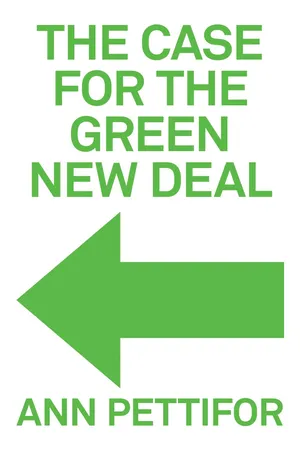
In 2008 the first Green New Deal was devised by Pettifor and a group of English economists and thinkers, but was ignored within the tumults of the financial crash. A decade later, the ideas were revived by the democratic socialists in the US, with Alexandria Ocasio-Cortez at the forefront. The Case for the Green New Deal demands a radical and urgent reversal of the current state of the global economy: including total de-carbonisation and a commitment to fairness and social justice.
Critics on all sides have been quick to observe that the GND is a pipe dream that could never be implemented, and would cost the earth. But, as Ann Pettifor shows, we need to rethink the function of money, and how it works within the global system. How can we bail out the banks but not the planet? We have to stop thinking about the imperative of economic growth - nothing grows forever. The program will be a long term project but it needs to start immediately.
- 208 pages
- English
- ePUB (mobile friendly)
- Available on iOS & Android
eBook - ePub
The Case for the Green New Deal
About this book
Information
1
System Change, Not Climate Change
We have been warned by climate scientists that to avoid the most dangerous impacts of climate breakdown and global heating, then humanity collectively has (starting from 1870) a ‘carbon budget’ of about 3,200 billion tonnes of carbon dioxide emissions to work with.1 At the current rate of global emissions, this budget would be used up within ten to twelve years. Worse, in 2019 another group of scientists, the UN’s Intergovernmental Science-Policy Platform on Biodiversity and Ecosystem Services (IPBES), warned that nature is declining globally at rates unprecedented in human history. The rate of species extinction is accelerating, with grave and immediate impacts on people around the world.2 The UN called for ‘a fundamental, systemwide reorganization across technological, economic and social factors, including paradigms, goals and values’.3
The Green New Deal (GND) is a blueprint for bringing about that urgent system-wide reorganization within a short time period.
The first question we should ask is, whose deal is this? Can the Green New Deal be a single global plan, implemented by a global authority, or can it be managed more locally?
As Herman Daly, pioneer of ecological economics and the architect of ‘steady state’ economics, has argued: the human economy is a subsystem sustained and contained by a delicately balanced global ecosphere, which in turn is fuelled by finite flows of solar energy.4 The earth’s life support systems do not recognise boundaries. So can the New Deal work on any lesser scale than the totality of the globe?
While the impacts of the current crisis are felt everywhere, the largest share of historical and current global emissions of greenhouse gases originated in rich countries. Meanwhile, per capita emissions in poor countries are still relatively low. Ecological justice therefore requires a major redistribution of wealth, from rich producers and emitters of toxic fossil-fuel emissions, to low-income countries.
Furthermore, as the Global Commons Institute (GCI) has argued, rich countries must reduce emissions until per capita emissions converge across the world. The proposal for ‘contraction and convergence’ has for some time now been advocated at the UN.5 It has failed to gain traction because global institutions are weak, are largely unaccountable and lack political leadership. It is clear we cannot rely on global initiatives as the only hope.
There is an alternative approach: international cooperation based not on global institutions, but on the authority of nation states. For the Green New Deal to be transformational, its implementation must be at the level of democratic accountability. Policies agreed at an international level would be implemented and enforced by locally and nationally accountable institutions that reflect domestic conditions.
But even if we can create policy at the level of the state or of local government, does this mean that those active in the markets of the global financial system will support the policies of different nation states? Will the existing dollarized financial system – no longer tethered to the real economy – support and finance a Green New Deal at national level? We have to get real and accept that, with some exceptions, the sector would not help finance a massive climate stabilisation project on terms that are acceptable and sustainable.
As things stand, those that operate in globalised capital markets behave as ‘masters of the universe’. They remain aloof and unaccountable to the governments and communities for whom the transformation of systems is an urgent task. If we are to mobilise the financial resources needed for the massive changes required to conserve, restore and sustain life on earth, then the globalised financial system must be subordinated to the needs of nations, and made servant to the task of transformation.
If the global sector is to be tamed, then a first challenge will be to tackle the hegemony of the currency that sustains globalised finance: the United States dollar.
Imperial Power and the US Dollar
The pre-eminence of the dollar came about as a result of the US strong-arming the rest of the world into adopting its currency as the world’s ‘money’ at the 1944 Bretton Woods conference. Keynes had argued for a global currency, not tied to any one country, and managed in the interests of the international community. He was defeated at Bretton Woods, as the US imposed its will on a weakened Europe. Today that decision still allows the US to enjoy a ‘free lunch’ at the expense of the rest of the world. Its ‘exorbitant privilege’ is a reward for the insurance it provides the rest of the world, especially in times of crisis. As the Federal Reserve acts as global lender of last resort, the US made trillions of dollars available to European and Asian banks during the Great Financial Crisis of 2007–09. This ‘insurance’ is valuable at times of crisis, but it could just as easily have been provided by an independent, international central bank working with, and answerable to, all nations, not just the most powerful.
The ‘exorbitant privilege’ enjoyed by the United States is remarkable given that the country sustains ever-rising external debt and deficits, because global demand for the dollar exceeds US production.6 In contrast to Britain’s imperialist role as a major exporter of capital, the US is a major capital importer. It uses its power to attract financial resources, surpluses of capital from Asia and the oilexporting countries.
A second great benefit the United States enjoys is the power to borrow in its own currency, over whose value it has some control. This means that the US avoids the exchange rate risks faced by other countries when they borrow and have to repay in a different currency. If the dollar were to depreciate, that would not matter to US authorities, as the nation does not own debt issued in euros, yen or sterling. When the dollar falls in value, the debts owed by the United States fall in value too. Thus the dollar as the world’s reserve currency regularly affords the US cheap, low-risk finance with which to sustain its large trade deficit and its exorbitant consumption of the world’s goods and services.
The hegemony of the dollar in global finance remains unchallenged despite the recent financial crisis, as the historian Adam Tooze has pointed out. In fact, the US dollar did not merely survive the 2008 crisis, but was reinforced by it.7 As a result of both the global financial crisis and the weakness of the Obama administration, Wall Street banks are bigger and more powerful than before the crisis. That outcome was not inevitable. It was largely due to a failure of progressive, global leadership by the Obama administration. Unlike Roosevelt, Obama had no direct experience of Wall Street and its ability to inflict systemic economic failure on millions of innocent Americans and their families. Instead his advisers, such as Alan Greenspan, Larry Summers and Robert Rubin, were themselves architects of the globalised and deregulated financial system. Under the Clinton administration they had teamed up to defeat a plan by Brooksley Born, the chair of a federal agency, for stronger regulation of derivatives. In 1999 Summers and Rubin together pushed through the repeal of the Roosevelt administration’s 1933 Glass–Steagall Act, which had prevented banks backed by taxpayer guarantees from being affiliated with investment banks that engaged in financial speculation.
The Obama administration’s support for Wall Street has been compounded by the Trump administration, dedicated to upholding and weaponising Wall Street power. To fortify its imperial overreach, the US budgeted $750 billion (3 to 4 per cent of US GDP) for defence in 2020, and stoked talk of further foreign invasions – what the US presidential candidate, Bernie Sanders, calls the ‘forever wars’.
Fuelling Consumption, Inciting Corruption
Backed by a great imperial power, the US dollar works hand in hand with ‘the invisible hand’ of the market – or, less abstractly, with the invisible hands of powerful agents active in financial markets. It is a globalised system committed to ‘the constant expansion of production and driven by the constant impetus to capital accumulation’, to quote Simon Pirani of the Oxford Institute for Energy Studies.8 It is a system that, enabled by the dollar’s power to breach regulatory barriers, has deliberately been detached from democratic oversight at the level of nation states. Its purpose is to accumulate wealth for the tiny minority that operate in the finance sector. This is achieved through the production of, and speculation in, intangible financial assets, most notably credit.
Credit is the main driver of economic expansion (defined by economists as ‘growth’) and consumption. It has stimulated the extraction of fossil fuels through industrialisation, urbanisation, motorisation and the growth of mass material consumption and consumerism by the affluent classes, in both high- and low-income countries.9
Deregulated credit in a world of mobile capital does not just fuel consumption, it also incites corruption, of both the political and finance sectors. Drug dealers, traffickers and gangsters engaged in a global trade responsible for roughly 450,000 deaths as a result of drug use in 2015, which has made them amongst the wealthiest beneficiaries of today’s system of unregulated, globalised, mobile capital.10
Credit is presumed to ‘grow’ exponentially as private finance enhances capitalism’s ability to, first, create society’s new ‘wants’, what J. K. Galbraith called our ‘psychologically grounded’ desires: ‘wants’ that do not ‘originate in the personality of the consumer’, but are ‘contrived by the process of production’.11
In this way, the spigot of easy credit denominated in dollars fuels global economic expansion and the constant impetus to capital accumulation by the already-rich. Consumption gorges in turn on fossil-fuel extraction, accelerating the growth of greenhouse gas emissions (GHGs).
From the perspective of the ecosystem, perhaps the most damaging aspect of globalised, largely deregulated credit-creation is the finance sector’s demand for high, real rates of return on a relatively effortless process: the creation of new money. If interest rates are higher than the capacity of the earth, or the economy, to renew itself, then interest rates become brutally extractive. People who are obliged by low or falling incomes to borrow are driven to work ever-longer hours to raise the money needed to repay the interest on their debt. Firms, too, cut costs and exploit labour more intensively in order to raise the finance needed to service their debts. Governments strip the forests, trawl the seas and exhaust the land to improve ‘efficiency’ and generate the returns needed to repay their obligations, including foreign debt service.
Bring Offshore Capital Onshore
It is my view – expanded in the next chapter – that to manage economic expansion, halt the impetus to capital accumulation and lower GHGs, it is essential to first manage the spigot of globalised credit creation. To that end, it will be necessary to bring offshore capital back onshore, and to subject the system to accountable management and regulation at the level of the state. Next, to manage the global crisis of earth systems breakdown we will need an international currency independent of the sovereign power of any single, imperial state. Finally, we will need to establish an international ‘clearing union’ for the settlement of credits and debits between nations as we go about sharing the burden of transformation.
Many will regard such proposals for radical global system change as utopian. And so they will be – until a global shock makes system change inevitable.
The plain fact is that societies have over time developed monetary systems that make the mobilisation of financial resources eminently possible for society’s urgent needs. Given the establishment of these systems, there need never be a shortage of money. But publicly backed monetary systems cannot be managed and deployed in the interests of society and the ecosystem as long as they remain ‘globalised’– captured and moved offshore, beyond the reach of regulatory democracy. In what is effectively the financial stratosphere, monetary systems serve the interests not of societies but of the global 1%. This has not happened by accident. As the result of a deliberate process, the financial system has been detached from the real economy of nation states and from governmental regulation. Following the logic of neoliberal economics, it has been ‘encased’ to protect the sector from democratic interference, as Quinn Slobodian shows in his book The Globalists. In other words, globalised, dollarized financial capitalism shifted offshore has undermined the power of democratic governments and local communities to develop economic policies to meet urgent needs.
We have been here before. Today’s globalised system harks back to the gold standard system of the 1930s when the private finance sector wrested control of publicly backed monetary systems away from democratic governments. At the time those that argued for ‘system change’ – the dismantling of the gold standard – were thought delusional. When the system did collapse, many economists were shaken to the core. Mistakenly, they had believed the gold standard was, like gold, immutable.
We Must Take Back Power
Given the vast power of dollarized globalisation over the world’s economies, can governments as rich as Germany’s or as poor as Mozambique’s mobilise the finance needed for the transition to a liveable planet? Could governments cooperate to mobilise the finance needed by the world’s poorest countries? We know there are ample financial resources (savings) to pay for the transition. But do societies and their governments have the power to realise these resources?
The straightforward answer is no. That fact presents Green New Dealers with the first grand mission: nothing less than global financial system change. If we are to support the campaigning efforts of Extinction Rebellion and the school strikes movement; if we are to fulfil the goal of a fundamental, system-wide transformation of the economy to save the ecosystem, then we must combine and cooperate at an international level to bring about a revolution in the power relations of the globalised and dollarized economic system.
As I explain below, cooperation and coordination between a progressive British economist and an American president and his administration brought about such transformation in 1933 and again, less successfully, at Bretton Woods in 1944. We can do so once more – equipped with sound economic theory and political practice to mobilise our collectively paralysed societies. The purpose will be to transform the globalised financial system within which the domestic economic systems of nation states are situated and integrated, and to which they are subordinated.
Given these challenges, and given today’s politics, the task of transforming the system may seem insurmountable. But, as David Roberts wrote in 2019: ‘We are not in an era of normal politics. There is no precedent for the climate crisis, its dangers or its opportunities. Above all, it calls for courage and fresh thinking.’12
Before we explore what must be done, we must first tell the correct story of how we got here. That is difficult because, as Rana Foroohar argues, ‘financialisation is the least studied and least explored reason behind our inability to create a shared prosperity.’13
So, how did the financial system globalise, and what can we learn from that?
2
Winning the Struggle with Finance
Thanks to globalisation, policy decisions in the US have been largely replaced by global market forces. National security aside, it hardly makes any difference who will be the next president. The world is governed by market forces.Alan Greenspan, former chair of the Federal Reserve
Today our financial system is governed by private, not public, authority, a fact which lies at the heart of our current global malaise. In the West, we have recently seen yet another period of global debt inflation yoked to deflationary austerity policies. The current rise in indebtedness exceeds that which predated the global financial crisis of 2007–9, and it may well lead to another catastrophic debt deflation. The impotence of elected governments in the face o...
Table of contents
- Cover Page
- Halftitle Page
- Title Page
- Copyright Page
- Dedication
- Contents
- Preface
- Introduction: What Is the Green New Deal?
- 1. System Change, Not Climate Change
- 2. Winning the Struggle with Finance
- 3. Global System Change
- 4. The Green New Deal Economy
- 5. A Steady State Economy
- 6. The Green New Deal: Transforming Our World
- 7. Afterword: Afterwards?
- Acknowledgements
- Notes
Trusted by 375,005 students
Access to over 1.5 million titles for a fair monthly price.
Study more efficiently using our study tools.
Frequently asked questions
Yes, you can cancel anytime from the Subscription tab in your account settings on the Perlego website. Your subscription will stay active until the end of your current billing period. Learn how to cancel your subscription
No, books cannot be downloaded as external files, such as PDFs, for use outside of Perlego. However, you can download books within the Perlego app for offline reading on mobile or tablet. Learn how to download books offline
Perlego offers two plans: Essential and Complete
- Essential is ideal for learners and professionals who enjoy exploring a wide range of subjects. Access the Essential Library with 800,000+ trusted titles and best-sellers across business, personal growth, and the humanities. Includes unlimited reading time and Standard Read Aloud voice.
- Complete: Perfect for advanced learners and researchers needing full, unrestricted access. Unlock 1.5M+ books across hundreds of subjects, including academic and specialized titles. The Complete Plan also includes advanced features like Premium Read Aloud and Research Assistant.
We are an online textbook subscription service, where you can get access to an entire online library for less than the price of a single book per month. With over 1.5 million books across 990+ topics, we’ve got you covered! Learn about our mission
Look out for the read-aloud symbol on your next book to see if you can listen to it. The read-aloud tool reads text aloud for you, highlighting the text as it is being read. You can pause it, speed it up and slow it down. Learn more about Read Aloud
Yes! You can use the Perlego app on both iOS and Android devices to read anytime, anywhere — even offline. Perfect for commutes or when you’re on the go.
Please note we cannot support devices running on iOS 13 and Android 7 or earlier. Learn more about using the app
Please note we cannot support devices running on iOS 13 and Android 7 or earlier. Learn more about using the app
Yes, you can access The Case for the Green New Deal by Ann Pettifor in PDF and/or ePUB format, as well as other popular books in Política y relaciones internacionales & Economía política. We have over 1.5 million books available in our catalogue for you to explore.