The biography of Carlos Slim, one of the richest people of all time, is not just the tale of the first man from a developing country to ever reach the top of the Forbes list of billionaires. It is the story of a character who represents the neoliberal mentality of our times, who mistrusts politicians, believes that the market is the most efficient mechanism for everything (even to combat corruption), and sees philanthropy as a social investment with businesses as the exclusive form of collective wealth.
In this new book, produced through years of thorough investigation, Osorno examines this symbol of twenty-first-century capitalism and of Mexico. Similar surreal dimensions lead Osorno to openly ask whether a man as rich as him can also be a good person.
eBook - ePub
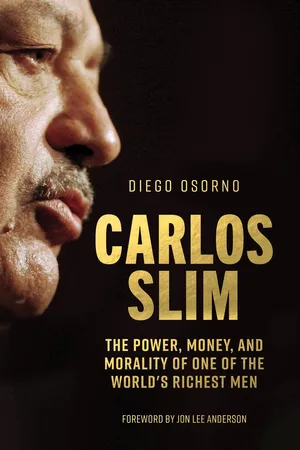
Carlos Slim
The Power, Money, and Morality of One of the World's Richest Men
- 336 pages
- English
- ePUB (mobile friendly)
- Available on iOS & Android
eBook - ePub
About this book
Information
VII
23
Philanthropy
Bill and Melinda Gates are the main promoters of “The Giving Pledge,” an initiative for the richest people in the world to give philanthropically at least half of what they’ve accumulated in their lifetime. Mexican journalist Katia Dartigues asked Melinda Gates in 2015 whether she thought Carlos Slim would join this crusade. “There are people who start giving and then join the Pledge,” Gates replied. “I don’t know if Carlos will decide to do that in the future, but there is no doubt that he gives a lot (through his foundations) in Mexico. And he has done it for twenty years. I have a lot of respect for him because of that.”
“Yes, he has done so, but there aren’t any Mexicans on this list,” said the journalist.
“Well, there may be one day. I hope there will,” Gates responded, smiling faintly.
When Slim announced that he would donate $40 million to health research, he spoke about his ideas regarding altruism: “Our concept focuses on realizing and resolving things, rather than giving. We don’t go around like Santa Claus.” The money he donated that day has allowed his Instituto Carso to send doctors to indigenous communities in the Sierra Tarahumara and in Chiapas to help with women giving birth. Or to oversee 6,500 transplants and research kidney diseases such as the one his wife had.
“When it comes to philanthropy,” Slim says with enthusiasm, “what I’m most interested in is education and health, and I see it more or less like this: we start with the mother’s nutrition during pregnancy, then perinatal care, supporting the child through the birth, preventing hypoxia; the child’s nutrition during those two years when their brain grows, child malnutrition and schooling, including early education. Then, you won’t have solved the problem, but here and there you have social spending or social investment, however you want to call it, it’s the same, it can be done by the state or it can be done privately. At the end of the day, to end poverty, you need to create the jobs for that person to have a job in the future. To make sure that child will have a job when he grows up. And that job should be important, not only for society, but for the dignity of the person. The reality is that work is not just a social responsibility; it is an emotional necessity. Sometimes you work because you need to, because you feel the need to be active. Work gives you an identity, and dignity. It forms a part of the vital interests of human beings.”
Slim’s money has also been used to train 5,000 staff in addiction treatment facilities and to create psychosocial care teams for the terminally ill at public hospitals. His health institute has financed the study of the genetic basis of diabetes and several kinds of cancer, in addition to research on vaccines against Chagas disease and Leishmaniasis. But while Slim is not interested in the work of full-time giving, Warren Buffett, the businessman who competes with him on the Forbes list, investor in endless companies, from Nike to Coca-Cola, believes in philanthropy on another scale and has signed up to Gates’s “Giving Pledge.” Buffett has donated $31 billion, more than a third of his fortune. While Buffet stopped administering his businesses to dedicate himself to philanthropy, the Mexican magnate takes a completely different perspective. “Slim doesn’t even like the word ‘philanthropy.’ He prefers to call it ‘social investment,’” a former Telmex executive told me, saying that from his point of view, Slim “is not generous even toward himself.”
The main criticism of Slim has been that he has turned his philanthropy into a pastime, unlike other wealthy people in the world who take the radical action of donating a significant portion of their fortunes, such as Ted Turner, David Rockefeller, George Soros, Michael Bloomberg, Mark Zuckerberg and Oprah Winfrey.
These ultrarich people believe they can save Western civilization from its demise. Moreover, they want the members of the new generation who earn more than $1 billion to be radical philanthropists and to share their earnings during their lifetime. “I don’t know anyone who can’t live on just $500 million,” Buffett often jokes, with a wink to the Occupy protesters, who took over a square in Wall Street as spokespeople for the demands of the 99 percent of the population of the United States who are not multimillionaires. In New Delhi, during the presentation of their campaign addressing Indian millionaires, Warren Buffett, next to Bill Gates, who accompanies him in the crusade, said, with a lot of conviction: “You can create jobs at the same time as being Santa Claus.” Slim still denies his place in the ranks of the global philanthropic revolution.
A hundred years ago, Santa Claus didn’t have that much money. At the end of the nineteenth century, the richest man in the world had accumulated $30 million, barely a morsel if we compare it to what Slim now owns. Andrew Carnegie, the Scottish immigrant who created a steel empire in the United States, published in 1889 The Gospel of Wealth, an essay that founded modern philanthropy. Carnegie defended the existence of a new species of rich people: the first multimillionaires of the industrialized world. He said that it was essential to the progress of the species for the homes of some men to also be the homes of the greatest examples of literature, the arts, and all the refinements of civilization. “Much better this great irregularity than universal squalor,” wrote Carnegie. “Without wealth there can be no Maecenas,” or patrons of the arts. In the vision of the father of philanthropy, the poor of the nineteenth century enjoyed what the richest of the past could not afford. What used to be luxury, according to him, had become items of basic necessity: “The laborer has now more comforts than the landlord had a few generations ago. The farmer has more luxuries than the landlord had, and is more richly clad and better housed. The landlord has books and pictures rarer, and appointments more artistic, than the King could then obtain.”
The name Carnegie is now a synonym of art and knowledge. The best musicians in the world perform at Carnegie Hall. Artists such as Andy Warhol have had residencies at the Carnegie Museum of Art. Andrew Carnegie, a man who started as a telegraphist, frequently went to productions of Shakespeare’s plays.
For his part, paying bail for poor Mexican prisoners has been one of Slim’s most praised charitable initiatives: up to 2010, over the course of a decade and a half, Slim financed the liberation of over 100,000 people accused of petty crimes. He has also donated 416,000 bicycles to workers in remote villages, 87,833 wheelchairs to convalescents, 127,000 pairs of glasses, and 15 million bags of nutritional sweets, while a million pregnant women have received care through his special health networks. Among the foundation’s most publicized initiatives is Aldea Digital, an event that holds the Guinness world record for gathering 258,896 participants in 2014. Slim also gifted a lifetime pension of $500 per month to twenty-two retired world boxing champions. Other donations that Slim’s PR team publicize are those made to the foundations of Bill Clinton and Shakira, who invest in health and education. All in all, according to his own reports, Slim’s philanthropy has benefited over 36.2 million people around the world. Slim’s most interesting public initiative since he became one of the wealthiest in the world, although it has more to do with work than philanthropy, has been well received in some social circles. Slim has spoken at a number of international forums about the need to reduce the current work week, which is between five and six days, to only three or four days per week. We are facing a new civilization that needs to change certain paradigms, including retirement age, according to the magnate. However, to building his arguments in favour of the reduced working week, Slim explains that in the mid twentieth century, retirement age was sixty-five years, while life expectancy was between fifty-five and sixty. Now that life expectancy is between eighty-five and ninety years, despite pensions being reduced, there is a great debt. In an interview with Larry King, he stated:
I think it’s a bad solution to problems; they are using only political and fiscal policies that were used in the ’20s and ’30s that don’t work now. In the past, for underdeveloped countries, they used a very strong fiscal policy. That means that the crisis was paid by the consumers, decreasing consumption. And in developed countries the crisis was paid by the savers, reducing the interest rates. Now they are affecting both, with negative interests and restrictions in economic policies, mainly in Europe. I think they are making many mistakes.
With this diagnosis, Slim supports further privatization of public resources as well as the reduction of the working day. According to the magnate, governments should sell assets such as highways and airports for them to be administered privately.
“You think government should sell its assets to private initiative?” asked King.
“Yes, that’s one point, and the other is that the public investment that they are not doing because they have a big deficit, they should look for the private initiative to make those investment through public-private partnership or other kinds of concession. There are many concessions, let’s say in highways, for twenty years. Well, it is private during twenty years, and every day it is an asset for the government. In twenty years, it is 100 percent owned by the government. I think it’s the best formula. And what is not acceptable is to have this high unemployment.”
In addition to more radical privatizations, Slim proposes that the age of retirement should be seventy-five and the normal working week should be three days with eleven hours per day, so as to allow others to work the remaining three days.
“Machines must work twenty-four hours and people should work fewer hours.” Slim explains that in the past it was necessary to have slaves and more people working long days to achieve efficiency, but now people need money and the time to spend it, “so that they can be part of the economy that helps feed back into countries’ development and growth.”

“I am going to ask you a simple question. In your life so far, who has been the most generous person toward you?”
“What do you mean by generous?”
“Well, that they’ve given you something that’s important to you.”
“My dad, of course. My family, my dad, my mom. Generous? Giving me what? It’s just that you enrich yourself from everyone. We are talking about people, because material things are secondary. You learn from everyone, but not just people, also from what you read, what you see. Then you often learn from the bad experiences or bad examples.”
“You even learn from enemies?”
“Yes, of course. For example, a year and a half ago I was with the kids, with the interns at Telmex, in the auditorium, and they asked me something about education. I wanted to tell them that the marvelous thing, the most important thing, is that human beings can discern when a person’s a good teacher, we recognize them, we learn from them, we love them, etcetera, and the bad teachers remain as an anecdote, as an example of what we should not do. Even bad teachers don’t damage you. I’m not sure if I’m being clear.”
“Yes.”
“I mean: you lose out in terms of the subject they taught, because you lost interest, but at the same time you learn from those people, because you say: blimey, this dude never even showed up to teach, or was always late, he had a drinking problem, he couldn’t communicate, he was no good at explaining things.”
“My son was complaining to me this morning about a terrible and unfair Spanish teacher…”
“That’s where he learns he shouldn’t be like that in life. I was very close, for a large part of my life, to older people. I learned from them: people with certain capabilities as businesspeople or politicians I admire. I really admire these presidents: Sanguinetti, Cardoso. I admire Cardoso, but I also believe that Lula did very well in many senses. Lagos, Felipe González…”
“And what do you think of the ex-president of Uruguay, José Mujica?”
“I’ve never had anything to do with him, I don’t really know him.”
“Of all your philanthropy, what’s your favorite thing you’ve done?”
“Whatever we do next,” he jokes. “No, I think we have huge potential to do more things.”
“Do you remember your first act of philanthropy?”
“The foundation began formally in ’86, but look, perhaps the first thing I did was when I started teaching. I was getting paid and I didn’t need that money. I was in third year and I gave out two scholarships.”
“To whom?”
“Two kids at the Faculty of Engineering.”
“And how did you choose those students to benefit?”
“I asked someone to choose them. I don’t choose the 18,000 kids we have. That was in ’59.”
“Can you remember who they were?”
“No, there were two of them.”
“You don’t know who are all the people who get your money?”
“I don’t do it for them to get it. Did I tell you about Khalil Gibran? Shall I read you the poem that talks about giving?”
“Thank you, you already read it to me.”
24
Press
In the early hours one day in the ’90s, a phone call woke up journalist Julio Scherer García, the patriarch of Mexican journalism: “If you don’t deliver 300,000 pesos by dawn, we will kill your son.” The founder of Proceso, the most important left-wing weekly magazine in Mexico, only had 4,000 pesos at home. At 4 a.m., he called Slim asking for help. Around that time Soumaya Domit was already being treated for renal failure.
“I’ll get everything I have in my safe right now. Also, Sumi and I will get in touch with some friends in case you need anything else. I’m sorry, and so is Sumi. As you know, she’s very fond of you,” Slim told Scherer. Moments later, one of Slim’s messengers arrived to Scherer’s house with the money in cash and the instruction to remain by Scherer’s side. The money was delivered to the kidnappers and Scherer’s son was freed.
Scherer himself tells this story in his book Secuestrados (Kidnapped):
Carlos Slim’s messenger arrived and delivered a small plastic box.“How much is it?” Elena Guerra demanded.“I don’t know. Mr. Slim gave me this and instructed me to stay to help with whatever was needed.”Without any further explanation I went with him to get his car, parked in the square opposite the development where he lived, in the borough of Contreras. What I wanted, more than anything, was to look at the sky, scrutinize it. I watched the blackness of the stifling night slowly giving way. Dawn was closing in, inexorable. I returned to the library at the same time as my mobile phone rang. I listened to Pedro’s dry words:“Tell him yes, that we have the money.”Together with Elena Guerra I had counted the pesos, dollars, and gold bullion coins that Carlos Slim had sent us. The price of the rescue had been covered by everyone.
The flirtation between journalism and power has always been a story of pacts, hidden interests and betrayals. The story of Scherer and Slim has been, additionally, a turbulent one. In that same decade the main criticisms against Slim for the purchase of the telephone monopoly during president Salinas de Gortari’s term were penned by journalists working for Scherer’s magazine. One of them, Rafael Rodríguez Castañeda—today editor-in-chief of Proceso—wrote Operación Telmex: contacto en el poder (Operation Telmex: Contact in Power), a book in which Slim is scrutinized for benefiting from government corruption when the Mexican economy was opening up to the foreign market. Around those years the businessman Juan Antonio Pérez Simón, a friend of Slim’s and Scherer’s, intervened to reconcile them. It was during that period when Scherer made that phone call in the middle of the night. In recent years the relationship between the magnate and the journalist has deteriorated further, though, over a series of articles criticizing Slim for buying so many properties in the historical center of Mexico City that it seemed as if he were playing Monopoly with the capital.
Slim has also been generous toward other independent intellectuals and Mexican writers. He gave Carlos Monsiváis four stories and the terrace of the Esmeralda, a building in the city center that was the most exclusive jewelry store in the nineteenth century and which, before it became Slim’s property, was at some point also a nightclub called La Opulencia. Monsiváis housed some 12,000 objects there: paintings, comics, indigenous toys and lucha libre masks, among other rare objects and personal belongings collected over decades. The museum is managed by a trust: its name is El Estanquillo, which is what the erstwhile corner stores used to be called.
However, Slim is in no way a gratuitous man. After journalist Miguel Ángel Granados Chapa launched the magazine Mira in 1990, he was never able to convince Slim to place adverts for his businesses. “We had a cordial relationship that was not contaminated by business relations, since I never succeeded in my intention to get him to advertize in my publication,” Granados Chapa told me. Slim’s fortune gives him the opportunity to become the cover star in the newspapers we still care about in the world. In two of them, one in Europe and another in America, he holds a percentage of shares that he does not use to influenc...
Table of contents
- Cover Page
- Halftitle Page
- Title Page
- Copyright Page
- Dedication
- Contents
- Foreword
- Preface
- I
- II
- III
- IV
- V
- VI
- VII
- VIII
- IX
- X
- Acknowledgements
Trusted by 375,005 students
Access to over 1.5 million titles for a fair monthly price.
Study more efficiently using our study tools.
Frequently asked questions
Yes, you can cancel anytime from the Subscription tab in your account settings on the Perlego website. Your subscription will stay active until the end of your current billing period. Learn how to cancel your subscription
No, books cannot be downloaded as external files, such as PDFs, for use outside of Perlego. However, you can download books within the Perlego app for offline reading on mobile or tablet. Learn how to download books offline
Perlego offers two plans: Essential and Complete
- Essential is ideal for learners and professionals who enjoy exploring a wide range of subjects. Access the Essential Library with 800,000+ trusted titles and best-sellers across business, personal growth, and the humanities. Includes unlimited reading time and Standard Read Aloud voice.
- Complete: Perfect for advanced learners and researchers needing full, unrestricted access. Unlock 1.5M+ books across hundreds of subjects, including academic and specialized titles. The Complete Plan also includes advanced features like Premium Read Aloud and Research Assistant.
We are an online textbook subscription service, where you can get access to an entire online library for less than the price of a single book per month. With over 1.5 million books across 990+ topics, we’ve got you covered! Learn about our mission
Look out for the read-aloud symbol on your next book to see if you can listen to it. The read-aloud tool reads text aloud for you, highlighting the text as it is being read. You can pause it, speed it up and slow it down. Learn more about Read Aloud
Yes! You can use the Perlego app on both iOS and Android devices to read anytime, anywhere — even offline. Perfect for commutes or when you’re on the go.
Please note we cannot support devices running on iOS 13 and Android 7 or earlier. Learn more about using the app
Please note we cannot support devices running on iOS 13 and Android 7 or earlier. Learn more about using the app
Yes, you can access Carlos Slim by Diego Osorno in PDF and/or ePUB format, as well as other popular books in Social Sciences & Social Science Biographies. We have over 1.5 million books available in our catalogue for you to explore.