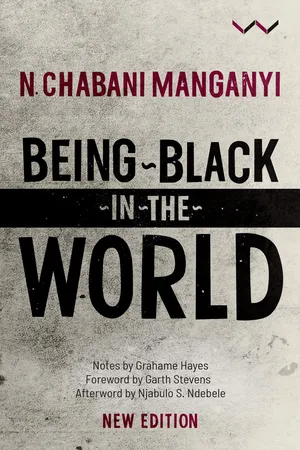
An annotated edition of a classic text by South Africa's first black psychologist, a collection of essays reflecting on what it meant to be black during the apartheid years
Being-Black-in-the-World, one of N. Chabani Manganyi's first publications, was written in 1973 at a time of global socio-political change and renewed resistance to the brutality of apartheid rule and the emergence of Black Consciousness in the mid-1960s. Manganyi is one of South Africa's most eminent intellectuals and an astute social and political observer. He has written widely on subjects relating to ethno-psychiatry, autobiography, black artists and race. In 2018 Manganyi's memoir, Apartheid and the Making of a Black Psychologist was awarded the prestigious ASSAf (The Academy of Science of South Africa) Humanities Book Award. Publication of Being-Black-in-the-World was delayed until the young Manganyi had left the country to study at Yale University. His publishers feared that the apartheid censorship board and security forces would prohibit him from leaving the country, and perhaps even incarcerate him, for being a 'radical revolutionary'. The book found a limited public circulation in South Africa due to this censorship and original copies were hard to come by.
This new edition is an invitation to a younger generation of citizens to engage with early decolonialising thought by an eminent South African intellectual. While the essays in this book are clearly situated in the material and social conditions of that time, they also have a timelessness that speaks to our contemporary concerns regarding black subjectivity, affectivity and corporeality, the persistence of a racial (and racist) order and the possibilities of a renewed de-colonial project. Each of these short essays can be read as self-contained reflections on what it meant to be black during the apartheid years. Manganyi is a master of understatement, and yet this does not stop him from making incisive political criticisms of black subjugation under apartheid. The essays will reward close study for anyone trying to make sense of black subjectivity and the persistence of white insensitivity to black suffering. Ahead of its time, the ideas in this book are an exemplary demonstration of what a thoroughgoing and rigorous de-colonial critique should entail. The re-publication of this classic text is enriched by the inclusion of a foreword and annotation by respected scholars Garth Stevens and Grahame Hayes respectively, and an afterword by public intellectual Njabulo S. Ndebele.
- English
- ePUB (mobile friendly)
- Available on iOS & Android
eBook - ePub
Being Black in the World
About this book
Information
Topic
PhilosophySubtopic
Philosophy History & Theory1 | Who Are the Urban Africans?
The problem of effective communication in commerce and industry is not unique to the South African situation. Even in countries with fairly homogenous populations and long histories of industrialisation and urbanisation, this problem continues to constitute a thorny issue for industrial psychologists and communication specialists. This fact in itself is a very clear index of the complexity of the problem.
In the case of South Africa, the complexity of the communication process is compounded by our singular history and the existence of an intricate politico-economic structure. This problem cannot but be complex, since South Africa's economy must continue to move in the direction of economic integration (multiracialism) while politically moving more in the direction of multinationalism (separate development). This unhappy marriage between the economy and political or ideological demands is leading to a surfacing of a developing debate. The local press has carried a number of articles relating to whether Africans should become members of organised labour (trade unions) or not. This debate appears to be related to a growing fear of possible future labour unrest. This concern about the adequate representation of African workers was highlighted by an observation attributed to Grobbelaar (1972), who said that about 30 000 Africans had been involved in illegal strikes between 1959 and 1969. The reasons for the increase in the number of illegal strikes are possibly highly complicated. One thing stands out very clearly and it is that this is a very serious indictment of commerce and industry. Here we have the most dramatic expression of a communication problem par excellence.
This essay is an attempt to deal with some aspects of the socio-economic processes of industrialisation and urbanisation as these have affected the African population. This treatment is bound to be sketchy, since particular attention is to be directed at the possible factors which tend to militate against effective communication and to suggest those factors which I consider to promise better organisational hygiene.
Another way of posing the question of the identity of the urban Africans is to ask: Who are the Africans now living in South Africa's urban and industrialised areas? This way of asking the question is for the simple reason that the first question tends to generate more heat than light. Responses to this question have been many and varied. Some observers will tell us that the African is a superstitious simpleton with very little initiative; some will tell us with an air of expertise that his psychology and culture are so different that an elementary course in cultural anthropology would help us out of our particular difficulties; yet others will talk in terms of the ‘detribalised’, the ‘transitional’ or the ‘attention-getting elites’. If we persisted in asking the question, we would probably be reminded that a Motswana carrying an executive briefcase is a Motswana at heart. There are those who would tell us that the urban African is a myth or a monster created by nihilistic anarchists. The truth of the matter is that none of these people knows who we are. Perhaps this is an ideal time to make the point that it is not the white ‘experts’ who are going to provide the answers to this question. It is, I submit, the black scholars of this country who will first of all ask the right sort of questions with a greater probability of arriving at the best answers.
Attempts directed at understanding the African response to industrialisation and urbanisation may be characterised as having been of two types. There have been simplistic and paternalistic explanations represented in prototype by the contributions of Silberbauer (1968). Not so simplistic but equally naive in conception is the study of the so-called personality of the urban African in South Africa by De Ridder (1961). The second type of contributions has been less ambitious in both design and intention. These contributions will be referred to a little later in this discussion.
A meaningful way of attempting to answer this question appears to be one which recognises its complexity. It seems most useful always to say whether one is attempting a sociological analysis, a cultural-anthropological one, or a social-psychological one, among others, with the added recognition that all these facets are part of a complex existential experience.
The Great Fish River in 1770 and Beyond
South Africa's controversial history tells us that the first recorded encounter between Africans and whites was on the banks of the Great Fish River in 1770. That in many respects tragic and historic event was followed by a history of conflict and disputes whose fallout is still part and parcel of the South African socio-political fabric. After those deeply distressing years came Kimberley and Johannesburg to initiate the denouement of the South African drama.
As a part result of that history, Moolman (1971) estimates,1 by 1970, 55% and 85% (Africans and whites respectively) were living and/or working in the urban areas of South Africa, and 10% of the then African population was in the urban areas by the turn of the present century. What emerges from this last observation is the fact that Africans have been exposed to the influences of urbanisation and industrialisation for well over half a century. Since it is to be expected that these people came into these areas with their own cultural heritage, it becomes relevant to try to understand the extent to which Africans have responded to the existence of other socio-cultural alternatives or what Pauw (1963) describes as the ‘triangle of forces’ (Western culture, traditional culture and urbanisation). Perhaps it should be pointed out that to ask how Africans have responded to these forces should always be qualified by adding that there has always been compulsory encapsulation of the various racial groups, which has tended to create artificial response patterns.
The question relative to the identity of the urban African is one which is not amenable to full scientific treatment at this stage. It is noteworthy that the first full-scale study of Africans in town is represented by the trilogy Xhosa in Town, edited by Mayer.2 Another important contribution is a volume edited by Holleman et al. (1964) with contributions by such leading scholars as Mayer, Glass, Wilson and Biesheuvel. What has emerged from these contributions is a recognition that changes have been and are taking place in urban populations.
For example, it has been frequently pointed out that the African in the urban industrialised cities of South Africa may be grouped into two broad categories, with some variations in between. There are the real ‘townsmen’ and there are the migrants. If we were to characterise the townsmen briefly, we could say that these are the people who have no important links with the rural areas. Their network of significant personal relationships is to be found in the urban areas. The migrants, on the other hand, consist of those people who are generally rural area-oriented (their networks of personal relationships are rurally based) and are more traditionalist in outlook.
One could take this opportunity to comment on the general limitations of studies of Africans by white South Africans. The first of these limitations is an obvious one. It amounts to the fact that the white experience is so existentially distant from the black experience that white workers have to abstract to a very unhealthy extent in order to move beyond the level of mere description to that of analysis and understanding (interpretation). The second limitation arises out of the fact that the economic motive has generally been very active in the decisions relating to the areas of the black experience which whites have chosen for study. Studies have been considered valuable to the extent that they have offered clues relevant to the possible harnessing of the black labour force for the benefit of industry and commerce. The recurrence of the themes ‘African abilities’, ‘motivation’ and ‘attitudes’ is a very clear index of this preoccupation.
Currently, the majority of Africans live in residential areas known variously as ‘locations’, ‘townships’ or ‘Bantoedorpe’. These are satellite complexes which are dependent on the white city area for their existence. While many people live in family accommodation settings, there are thousands, about 13 000 for Soweto, according to Hellman (1971), who are on the waiting list for family housing. Another group of Africans are those who lead what Prof. Seftel of the Wits Medical School has described as a ‘wifeless existence’ – the occupants of closed and total institutions such as the controversial Alexandra hostels. Yet another group of Africans live in the backyards of suburbia. The mental health problems associated with these areas of social disengagement are too well known to require detailed documentation. It should suffice to point out that these problems in their day-to-day manifestations require the most vigilant attention of the employers of African labour.
The adaptational lifestyle which has developed as a result of the black experience in South Africa is something which has not yet been studied in depth and must await a future generation of black scholars. In this essay I limit myself to a few observations which I consider relevant to the problem under discussion. My own experience in both clinical and industrial settings has led to the germination of some tentative ideas and formulations (Manganyi, 1972a). These may be stated as follows: The most predominant feature of all the groups I studied was a form of endemic, chronic sense of insecurity coupled with an ideation characterised by helplessness. Even in clinical practice, as I reported in 1970, this anxiety is the most dramatic expression of the sense of existential insecurity. In the absence of statistics, it may confidently be stated that anxiety states and reactive depression with anxiety features tend to be the most common presenting complaints among African psychiatric patients.
From a mental health point of view, the communities within which Africans have to live are some of the most unhygienic. This is easily appreciated since it has become commonplace to observe that they are characterised by a high morbidity rate, featuring alcoholism and other related forms of overindulgence, crime, a spiralling divorce rate and associated problems in the sphere of parent–child relationships. It is also necessary to point out that in the majority of cases the work situations are just as unhygienic. There are decided indications that most organisations are not geared towards the growth and self-fulfilment of individual employees.
Indeed we find that in the life experience of the African, there is hardly any situation in which his sense of self-esteem is nourished. His wife and children may have been forced by conditions beyond his control to lose the modicum of respect which they may have had for him as an effective, self-steering agent in his psychosocial environment. If we were to formulate his psychic status in a phenomenological way, we could say that his subjective experience is one of feeling emasculated. There are other, more positive sides to this picture, such as the Africans’ will to survive (resilience).
At this point in the discussion I would like to make the following submission: Some observers have never tired of pointing out that the African is ‘by nature’ without initiative, that he has a low aspiration level, that he will always say ‘yes’ when he should have said ‘no’, that he is emotional and hedonistic, and that he has the uncanny habits of not keeping time and talking around the point. The stock explanation for this lifestyle is that it is in the nature of Africans, that we just have to understand this and we will have made the great discovery.
It may well be that these traits are to be found in some Africans. Does this in itself suggest that these traits reflect a natural, almost genetic predisposition? Some of us are saying that this is not African nature. That there is no such a thing as African nature. We are saying that these traits and many others are patterns of adaptation to an unfriendly, always threatening environment. We are saying that the best human potential, given the black existential experience, would in all probability develop similar adjustment manoeuvres. Reality demands that we conceptualise the problem as one essentially involving human nature, one involving a universal tendency to adapt to circumstances, however gruesome.
The first part of this essay has presented a fairly sketchy account of some aspects of the processes of urbanisation and industrialisation as these have affected the African in South Africa. This account was intended as a backdrop for some ideas relating to the African response to these processes as well as the discussion of communication problems per se.
Communication and the South African Scene
I pointed out at the outset that communication in industrial and commercial organisations continues to be a thorny problem. I said at that stage that this is a problem of unusual complexity. But it remains true to say that the maximum exploitation of this country's human and other resources will depend in large measure on how problems in this area are understood and tackled. A general comment on the problems of communication in the South African context cannot be out of place.
In order to understand the communication potential of black–white interaction, it is necessary to reconstruct the prototype of this communicative relational possibility. This relationship is very well known to Africans of all types. Let me reconstruct it as follows: Mr Hlungwani and his wife and children are on a Saturday shopping spree for Christmas. They walk into a large departmental store in Johannesburg. They are all in high spirits. Mr Hlungwani wants to give his wife the gift of his dreams: a very lovely frock which he had always promised to buy her. They approach the white store assistant. Even before Mr Hlungwani can initiate a conversation (relay a message), Mrs du Pont responds by mouthing an obviously rude ‘Ja?’ Surging with repressed anger and resentment, Mr Hlungwani goes on to explain that he is interested in a particular dress for his wife. Mrs du Pont, in the same contemptuous and indifferent tone, tells Mr Hlungwani to go to that other ‘Missus’ or ‘Madam’.
Here we have the prototype of the master–servant communication complex. Let us look at what has actually happened. Mrs du Pont has not succeeded, strictly speaking, in communicating ideas. She has not succeeded in telling Mr Hlungwani that he is welcome to buy whatever he wishes. He has continued to buy out of necessity or habit, or both. She has in fact communicated an emotion (tonal communication) and Mr Hlungwani should have understood the message to mean that he should walk out of the shop. Most South African communication across the colour line is of this nature.
This kind of communication complex is contrary to the ideal kind of communication complex, namely, one which Van den Berg (1971) exposes in his discussion of the psychotherapy relationship. The essential feature of this communication complex is ‘communicative equality’. This means, in effect, that the two people involved in the dialogue should experience and recognise themselves as essentially two ‘equal’ human beings. Neither of them should be condescending in the relationship. It is only when this condition is satisfied that communicative equivalence can be achieved – talking about the same tree, table or what you will. It is not an overstatement to say that our race relations are not of the kind that promote this kind of communication complex.
After these general remarks about the problem of communication in South Africa, we may now direct our attention to problems specific to industry and commerce. In this part of the essay, some ideas are formulated relating first to the important question of the factors which militate against effective communication with African workers. A second set of ideas is concerned with some approaches which may help reduce unhygienic management strategies in the area of communication. The first set of factors are as follows:
- The ardent search for simple solutions evidenced by the perpetuation of racial myths. This tendency results in the general development of stereotyped kinds of interpersonal relationships with tonal types of communication and poor communication possibilities.
- The erstwhile fad of developing separate personnel departments and policies specifically for African labour. In most of these departments African personnel administrators are given token executive status while remaining on the executive fringe of an organisation.
- The existence of unsatisfactory employee-representation machinery. In cases where such machinery has been created, it is again created as a token and not seriously integrated into the total organisational posture.
- The existence of an unlimited number of unrewarding, frustrating conditions in the work situation vis-à-vis the worker's psychological and other needs.
- The absence in many large organisations of well-structured employee-counselling services for employees who must be burdened with problems.
In ending this discussion of factors which are not favourable to effective communication, I would like to single out the question of the status of personnel officers for special comment. It is my impression that some organisations have no clear notions (notions that are clearly spelt out) about the status and function of black personnel officers. It is not uncommon to see an advertisement in the local press mentioning that familiarity with legislation governing the employment of Africans will be an important consideration in qualifying for the job. Granted, this, in the nature of South African society, may be an important consideration. I think that in our unique situation, this kind of employer is likely to have communication difficulties with his personnel officer, let alone his other workers. This is the type of employer who is likely to turn his personnel man into a glorified clerk whose main responsibility is to prepare labour turnover returns and extinguish local fires. Surely, one does not require a university degree in the social sciences to do this sort of thing. I will come back to this issue a little later.
It is not particularly difficult to make a social diagnosis. What is diffi...
Table of contents
- Cover
- Title
- Copyright
- Contents
- Foreword by Garth Stevens
- Introduction
- 1 Who Are the Urban Africans?
- 2 Black Consciousness
- 3 Us and Them
- 4 Being-Black-in-the-World
- 5 Nausea
- 6 Reflections of a Black Clinician
- 7 The Meaning of Change
- 8 Postscriptum – ‘African Time’
- Glossary
- Afterword by Njabulo S. Ndebele
- Index
- Other Works
Trusted by 375,005 students
Access to over 1.5 million titles for a fair monthly price.
Study more efficiently using our study tools.
Frequently asked questions
Yes, you can cancel anytime from the Subscription tab in your account settings on the Perlego website. Your subscription will stay active until the end of your current billing period. Learn how to cancel your subscription
No, books cannot be downloaded as external files, such as PDFs, for use outside of Perlego. However, you can download books within the Perlego app for offline reading on mobile or tablet. Learn how to download books offline
Perlego offers two plans: Essential and Complete
- Essential is ideal for learners and professionals who enjoy exploring a wide range of subjects. Access the Essential Library with 800,000+ trusted titles and best-sellers across business, personal growth, and the humanities. Includes unlimited reading time and Standard Read Aloud voice.
- Complete: Perfect for advanced learners and researchers needing full, unrestricted access. Unlock 1.5M+ books across hundreds of subjects, including academic and specialized titles. The Complete Plan also includes advanced features like Premium Read Aloud and Research Assistant.
We are an online textbook subscription service, where you can get access to an entire online library for less than the price of a single book per month. With over 1.5 million books across 990+ topics, we’ve got you covered! Learn about our mission
Look out for the read-aloud symbol on your next book to see if you can listen to it. The read-aloud tool reads text aloud for you, highlighting the text as it is being read. You can pause it, speed it up and slow it down. Learn more about Read Aloud
Yes! You can use the Perlego app on both iOS and Android devices to read anytime, anywhere — even offline. Perfect for commutes or when you’re on the go.
Please note we cannot support devices running on iOS 13 and Android 7 or earlier. Learn more about using the app
Please note we cannot support devices running on iOS 13 and Android 7 or earlier. Learn more about using the app
Yes, you can access Being Black in the World by N. Chabani Manganyi,N Chabani Manganyi in PDF and/or ePUB format, as well as other popular books in Philosophy & Philosophy History & Theory. We have over 1.5 million books available in our catalogue for you to explore.