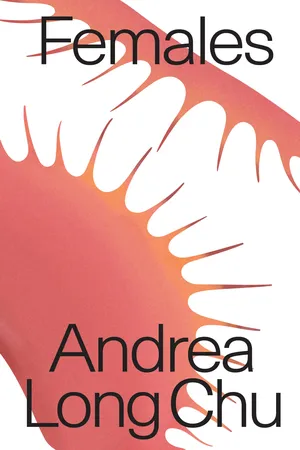
"Everyone is female, and everyone hates it."
So begins Andrea Long Chu's genre-defying investigation into sex and lies, desperate artists and reckless politics, the smothering embrace of gender and the punishing force of desire.
Drawing inspiration from a forgotten play by Valerie Solanas-who wrote the SCUM Manifesto and shot Andy Warhol-Chu aims her searing wit and surgical intuition at targets ranging from performance art to psychoanalysis, incels to porn, and even feminists like herself. Each step of the way she defends the indefensible claim that femaleness is less a biological state of women and more a fatal existential condition that afflicts the entire human race-men, women, and everyone else. In a new afterword, Chu reflects on the book's reception, the growing anti-trans movement in America, and the continuing need for a radical theory of desire.
eBook - ePub
Females
About this book
Information
Everyone is female.
The worst books are all by females. All the great art heists of the past three hundred years were pulled off by a female, working solo or with other females. There are no good female poets, simply because there are no good poets. A list of things invented by females would include: airplanes, telephones, the smallpox vaccine, ghosting, terrorism, ink, envy, rum, prom, Spain, cars, gods, coffee, language, stand-up comedy, every kind of knot, double parking, nail polish, the letter tau, the number zero, the H-bomb, feminism, and the patriarchy. Sex between females is no better or worse than any other kind of sex, because no other kind of sex is possible. Shark attacks exclusively target females. All the astronauts were female, which means the moon is a female-only zone. The 1 percent is 100 percent female. The entire Supreme Court is female. The entire United States Senate is female. The president is, obviously, a female.
Females dominate the following professions: zookeeping, haberdashery, landscaping, investment banking, long-distance trucking, lutherie, consulting, talent management, tort law, taxidermy, real estate development, orthodontia, prison administration, and the mafia. Not all females are serial killers, but all serial killers are female, including the necrophiles. The entire incarcerated population is female. All rape survivors are females. All rapists are females. Females masterminded the Atlantic slave trade. All the dead are female. All the dying, too. The hospitals of the world are full of them: females in beds or gingerly walking about, full of pain, recovering, slipping away. All the guns in the world are owned by females.
I am female. And you, dear reader, you are female, even—especially—if you are not a woman. Welcome. Sorry.
BONGI. I’m so female I’m subversive.
This book began life as an essay on a forgotten play by Valerie Solanas called Up Your Ass. Solanas is mainly remembered for two things: self-publishing the SCUM Manifesto in 1967, a darkly funny polemic against the government, the money system, all men, and most women; and shooting artist Andy Warhol at his studio, the Factory, then located on Union Square West in Manhattan, in 1968. The play usually appears as a possible motive for the shooting: Since sending him a copy of the script in 1965, Valerie had been nagging Andy to produce Up Your Ass, and her paranoia that he was playing her increased in tandem with his indifference. As Breanne Fahs writes in her biography of Solanas, Valerie’s anxieties “were both based in fact and somewhat bizarre; Andy had lost the play … in part because of frank disinterest, in part because of Andy’s sloppiness, and in part because he generally neglected everyone in his sphere who felt passionately about anything.”
Up Your Ass, or, From the Cradle to the Boat, or, The Big Suck, or, Up from the Slime is a weird, fascinating play. The unpublished manuscript reads like a very enjoyable undergraduate one-act—rough, raunchy, highly narcissistic, and so blatantly irreverent that its tone can feel impossible to parse. “I dedicate this play to me,” Valerie writes on the first page, “a continuous source of strength and guidance and without whose unflinching loyalty, devotion, and faith this play would never have been written.” Two additional acknowledgments follow: “Myself—for proofreading, editorial comment, helpful hints, criticism, and suggestions, and an exquisite job of typing. I—for independent research into men, married women, and other degenerates.” This is vintage Valerie: impossibly serious, seriously impossible. It’s one of the reasons I love her.
The antihero of Up Your Ass, Bongi Perez, is a caustic, wisecracking panhandler in tennis shoes and a “loud, plaid sports jacket” who spends the play catcalling broads, turning tricks, and grumbling about the coming destruction of the male sex. Indeed, Bongi, equal parts man-hater and chauvinist pig, is a clear stand-in for Valerie, who wrote Up Your Ass while grifting her way around Greenwich Village in the early sixties, poor, often homeless, doing sex work, hanging with street queens, loitering in cheap automats—“shooting the shit,” as she liked to say. Up Your Ass reflects this lifestyle: angry, gross, delighting in its own wit; a mostly plotless, often pornographic burlesque populated by broad sexual and racial stereotypes (a shit-eating secretary, a pompous male intellectual, a white-and-black pair of pickup artists). It’s a fascinating read, but difficult to imagine performing without wearing an audience thin. The first full staging of Up Your Ass, devised by experimental theater director George Coates in 2000, seems to have compensated for the script’s shortcomings by setting most of the dialogue to sixties pop songs. The same production also featured an all-female cast.
Up Your Ass might be most interesting as a precursor to the SCUM Manifesto, copies of which Valerie would start handing out around the Village in 1967. Several times during the play, Bongi longs aloud for the end of the male sex, suggesting in one instance that men be eliminated through technology-assisted fetal sex selection—a bloodless genocide. The idea horrifies Russell, a white-collar worker who fancies himself a sophisticate. “The two-sex system must be right,” he protests, “it’s survived hundreds of thousands of years.” “So has disease,” Bongi shoots back. The exchange will make its way into SCUM almost to the letter. “It doesn’t follow that because the male, like disease, has always existed among us that he should continue to exist,” Valerie writes there. “When genetic control is possible—and soon it will be—it goes without saying that we should produce only whole, complete beings, not physical defects.”
But Valerie would go further than that. If Up Your Ass only hinted at the coming male extinction, the SCUM Manifesto advanced the thesis that men are already female to begin with. “The male is a biological accident,” Solanas declares in her opening salvo. “The Y (male) gene is an incomplete X (female) gene … In other words, the male is an incomplete female, a walking abortion, aborted at the gene stage.” In fact, she suggests, the entire history of human civilization consists of man’s sublimated attempts to fulfill his repressed desire “to complete himself, to become female.” On its own, this claim might provide the basis for a formidable theory of gender, but Valerie adds another wrinkle. The traditional division of male and female traits—brave, assertive men and weak, dependent women—is an enormous scam perpetrated by men. In truth, the opposite is the case: women are cool, forceful, dynamic, and decisive, while it is men who are vain, frivolous, shallow, and weak. The male has done a “brilliant job,” Valerie admits, “of convincing millions of women that men are women and women are men.”
The irony here is that Solanas is proposing the annihilation of the male sex on the basis of some of the very things for which men have historically maligned women: vanity, submission, narcissistic anxiety, and most of all sexual passivity. (The title Up Your Ass, after all, is basically a joke about sodomy; in the play, the teacher of a homemaking class recommends that wives integrate their sex lives with their domestic duties by taking the brushes they use to clean their baby bottles and ramming them “right up’’ their husbands’ assholes.) By gender-swapping the sexes, in other words, the SCUM Manifesto effectively proposes misogyny against men. The truth is that Valerie, so remembered for her man-hating, hates most women even more. The manifesto’s real enemy is what Solanas calls the Daddy’s Girl: a female who is conned into adopting male—that is, traditionally feminine—traits as her own, devolving into niceness, self-absorption, and insecurity. The true political conflict, Valerie concludes, lies not between males and females but between “insecure, approval-seeking, pandering male-females” and “self-confident, swinging, thrill-seeking female-females” like her. In fact, the mission of SCUM—a select group of “dominant, secure, self-confident, nasty, violent, selfish, independent, proud, thrill-seeking, free-wheeling, arrogant females”—is not simply to kill men and smash the government but ultimately to defeminize the human race altogether. It is only through the genocide of man that the Daddy’s Girls will be liberated from “his maleness, that is, his passivity and total sexuality, his femininity.”
If you’re confused, good. So was Valerie, I think—not because she didn’t know what she was talking about, but because of her fierce commitment to her own ambivalence: a sex worker who claimed to be asexual, a lesbian who slept with men, a satirist without a sense of humor, a man-hater who behaved, as often as not, like the men she hated. The radical feminist Ti-Grace Atkinson, a contemporary, reports that Solanas “had a habit of exposing herself,” having apparently unzipped her jeans and played with her clitoris at one of the SCUM “recruitment” meetings she was holding at the Chelsea Hotel in 1967. It’s simply impossible to square the SCUM Manifesto’s inclusion of “men who intrude themselves in the slightest way on any strange female” on the same list as rapists, cops, and landlords with Valerie’s alter ego, Bongi Perez, a shameless misogynist who opens and closes Up Your Ass by aggressively propositioning women on the street. (“Give me a kiss and I’ll let you pass,” Bongi tells one broad, blocking her path.) One could be forgiven for wondering if Solanas’s art, not unlike that of the great male artists she despised (and occasionally shot), might have represented its own kind of attempt to repress the very femaleness she hoped to unleash, like a biological weapon, on the entire world.
In fact, while the SCUM Manifesto is often taught in university courses as a feminist text, it’s not at all clear whether this label is appropriate. Valerie sometimes ran with feminists, sometimes with downtown art types, sex workers, drag queens—but she was beholden to none. There are the makings of a recognizable political program in SCUM (the destruction of men, the end of the money system, full automation), but Solanas never describes this program or herself as feminist. Years later, Valerie would be gravely insulted when someone referred to her as “the founder of a group called SCUM.” “This reduces me to the level of Redstockings, Radical Feminists, and the members of 1000’s of other totally worthless, insignificant, pathetic little ‘feminist’ groups,” she wrote in an angry letter, brushing off a decade of feminist organizing like a fat, drunk tick. Valerie was nothing if not an individual—“always selfish, always cool,” as the Manifesto puts it. Politics, in the sense of protest, strikes, and demonstrations, meant little to her; the Act was supreme. “If SCUM ever strikes,” Valerie promises, “it will be in the dark with a six-inch blade.”
For the record, I’m not sure if what you’re reading is a feminist text, either. I’m not sure if I want it to be.
BONGI. Eventually the expression “female
of the species” ’ll be a redundancy.
of the species” ’ll be a redundancy.
The thesis of this little book is that femaleness is a universal sex defined by self-negation, against which all politics, even feminist politics, rebels. Put more simply: Everyone is female, and everyone hates it.
Some explanations are in order. For our purposes here, I’ll define as female any psychic operation in which the self is sacrificed to make room for the desires of another. These desires may be real or imagined, concentrated or diffuse—a boyfriend’s sexual needs, a set of cultural expectations, a literal pregnancy—but in all cases, the self is hollowed out, made into an incubator for an alien force. To be female is to let someone else do your desiring for you, at your own expense. This means that femaleness, while it hurts only sometimes, is always bad for you. Its ultimate toll, at least in every case heretofore recorded, is death.
Clearly, this is a wildly tendentious definition. It’s even more far-fetched if you, like me, are applying it to everyone—literally everyone, every single human being in the history of the planet. So it’s true: When I talk about females, I am not referring to biological sex, though I’m not referring to gender, either. I’m referring instead to...
Table of contents
- Cover Page
- Halftitle Page
- Title Page
- Copyright Page
- Contents
- Females
- Acknowledgements
- Acknowledgements
- Notes
Trusted by 375,005 students
Access to over 1.5 million titles for a fair monthly price.
Study more efficiently using our study tools.
Frequently asked questions
Yes, you can cancel anytime from the Subscription tab in your account settings on the Perlego website. Your subscription will stay active until the end of your current billing period. Learn how to cancel your subscription
No, books cannot be downloaded as external files, such as PDFs, for use outside of Perlego. However, you can download books within the Perlego app for offline reading on mobile or tablet. Learn how to download books offline
Perlego offers two plans: Essential and Complete
- Essential is ideal for learners and professionals who enjoy exploring a wide range of subjects. Access the Essential Library with 800,000+ trusted titles and best-sellers across business, personal growth, and the humanities. Includes unlimited reading time and Standard Read Aloud voice.
- Complete: Perfect for advanced learners and researchers needing full, unrestricted access. Unlock 1.5M+ books across hundreds of subjects, including academic and specialized titles. The Complete Plan also includes advanced features like Premium Read Aloud and Research Assistant.
We are an online textbook subscription service, where you can get access to an entire online library for less than the price of a single book per month. With over 1.5 million books across 990+ topics, we’ve got you covered! Learn about our mission
Look out for the read-aloud symbol on your next book to see if you can listen to it. The read-aloud tool reads text aloud for you, highlighting the text as it is being read. You can pause it, speed it up and slow it down. Learn more about Read Aloud
Yes! You can use the Perlego app on both iOS and Android devices to read anytime, anywhere — even offline. Perfect for commutes or when you’re on the go.
Please note we cannot support devices running on iOS 13 and Android 7 or earlier. Learn more about using the app
Please note we cannot support devices running on iOS 13 and Android 7 or earlier. Learn more about using the app
Yes, you can access Females by Andrea Long Chu in PDF and/or ePUB format, as well as other popular books in Social Sciences & Feminism & Feminist Theory. We have over 1.5 million books available in our catalogue for you to explore.