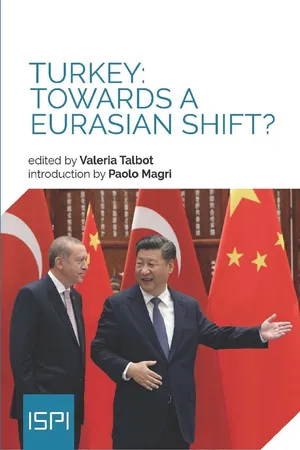
Over the last few years, Turkey seems to have embraced the East again. Ankara's closer relations with Eurasian countries go hand in hand with the global shift eastwards, towards the ever-growing and most dynamic region in the world. It is therefore the result of an increasing differentiation of Turkey's foreign relations, driven by strategic, economic and energy interests. Stronger ties with Eurasian countries, i.e. Russia and China, are also the litmus test for the ups and downs in relations with Washington and Brussels. While Ankara still retains strong ties with the West, it is laying the groundwork to further widen its interests to the East. This report aims to analyse the multi-faceted aspects of Ankara's Eurasian shift, highlighting the domestic drivers of Turkey's "Eurasianism", the interests at stake, the areas of cooperation and competition, and last but not least the implications for the EU.
- English
- ePUB (mobile friendly)
- Available on iOS & Android
eBook - ePub
Turkey: Towards a Eurasian Shift?
About this book
Trusted by 375,005 students
Access to over 1 million titles for a fair monthly price.
Study more efficiently using our study tools.
Information
Notes
1 M.W. Lewis and K.E. Wigen, The Myth of Continents: A Critique of Metageography, Berkeley, University of California Press, 1997.
2 Ibid.
3 V. Samokhvalov, “The New Eurasia: Post-Soviet Space between Russia, Europe and China”, European Politics and Society, vol. 17, no. 1, 2016, pp. 82-96.
4 N.S. Trubetskoi, Legacy of Genghis Khan and Other Essays on Russia’s Identity, trans. Kenneth Brostrom, Ann Arbor: Michigan Slavic Publications, 1991, pp. 164-165 cited in S. Wiederkehr, “Eurasianism as a Reaction to Pan-Turkism”, in D. Shlapentokh (Ed.), Russia between East and West: Scholarly Debates on Eurasianism, Leiden, E.J. Brill, 2007, pp. 39-60 (p. 53).
5 O.F. Tanrısever, “Turkey and Russia in Eurasia”, in L.G. Martin and D. Kerides (Eds.), The Future of Turkish Foreign Policy, Cambridge, MA, MIT Press, 2004, pp. 127-155.
6 M. Rosenberg, “What is Eurasia? Defining the World’s Largest Continent”, Thought.com, 17 March 2017.
7 I. Torbakov, “Neo-Ottomanism versus Neo-Eurasianism?”, Utrikes Magasinet, 17 January 2017.
8 M. Bassin, S. Glebov and M. Laruelle, “Introduction: What Was Eurasianism and Who Made It?”, in M. Bassin, S. Glebov, and M. Laruelle (Eds.), Between Europe and Asia: The Origins, Theories, and Legacies of Russian Eurasianism, Pittsburgh, University of Pittsburgh Press, 2015, p. 1.
9 For a critique of this view of Eurasianism see, M. Bassin and G. Pozo (Eds.), The Politics of Eurasianism: Identity, Popular Culture and Russia’s Foreign Policy, London and New York, Rowman and Littlefield, 2017.
10 For a textbook example of the geo-political and strategic version of Eurasianism see, A.G. Dugin, Osnovy Geopolitiki. Geopoliticheskoe budushchee Rossii, Moscow, Arktogeia, 1999.
11 See M. Schmidt, “Is Putin Pursuing a Policy of Eurasianism?”, Demokratizatsiya, vol. 13, no. 1, 2005, pp. 87-99.
12 H. Inalcik, The Ottoman Empire; The Classical Age, 1300-1600, London, Weidenfeld and Nicholson, 1973.
13 W. Hale, Turkish Foreign Policy 1774-2012, London, Frank Cass Publishers, 2012.
14 Ibid.
15 G. Gleason and O.F. Tanrısever, “A Bridge to Central Asia”, per Concordiam, vol. 4, no. 3, 2013, pp. 10-15.
16 O.F. Tanrısever (2004), pp. 127-155.
17 Ibid.
18 B. Toprak, “Islam and the Secular State in Turkey”, in C. Balım et al. (Eds.), Turkey: Political, Social and Economic Challenges in the 1990s, Leiden, E.J. Brill, 1996, pp. 87-118.
19 D. Trenin, “Russia and Turkey: A Cure from Schizophrenia”, Perceptions: Journal of International Affairs, vol. 2, no. 2, 1997, p. ...
Table of contents
- Cover
- Turkey: Towards a Eurasian Shift?
- Colophon
- Table of Contents
- Introduction
- Discourses and Politics of Eurasianism in Turkey During the 2000s
- Turkey’s Main Security Drivers in Eurasia
- The Russo-Turkish Entente
- Turkey’s Geo-Economic Projection and Energy Interests in Central Asia
- Turkey and China
- Policy Recommendations for the EU
- Notes
- The Authors
Frequently asked questions
Yes, you can cancel anytime from the Subscription tab in your account settings on the Perlego website. Your subscription will stay active until the end of your current billing period. Learn how to cancel your subscription
No, books cannot be downloaded as external files, such as PDFs, for use outside of Perlego. However, you can download books within the Perlego app for offline reading on mobile or tablet. Learn how to download books offline
Perlego offers two plans: Essential and Complete
- Essential is ideal for learners and professionals who enjoy exploring a wide range of subjects. Access the Essential Library with 800,000+ trusted titles and best-sellers across business, personal growth, and the humanities. Includes unlimited reading time and Standard Read Aloud voice.
- Complete: Perfect for advanced learners and researchers needing full, unrestricted access. Unlock 1.4M+ books across hundreds of subjects, including academic and specialized titles. The Complete Plan also includes advanced features like Premium Read Aloud and Research Assistant.
We are an online textbook subscription service, where you can get access to an entire online library for less than the price of a single book per month. With over 1 million books across 990+ topics, we’ve got you covered! Learn about our mission
Look out for the read-aloud symbol on your next book to see if you can listen to it. The read-aloud tool reads text aloud for you, highlighting the text as it is being read. You can pause it, speed it up and slow it down. Learn more about Read Aloud
Yes! You can use the Perlego app on both iOS and Android devices to read anytime, anywhere — even offline. Perfect for commutes or when you’re on the go.
Please note we cannot support devices running on iOS 13 and Android 7 or earlier. Learn more about using the app
Please note we cannot support devices running on iOS 13 and Android 7 or earlier. Learn more about using the app
Yes, you can access Turkey: Towards a Eurasian Shift? by Valeria Talbot in PDF and/or ePUB format, as well as other popular books in Politics & International Relations & Middle Eastern Politics. We have over one million books available in our catalogue for you to explore.