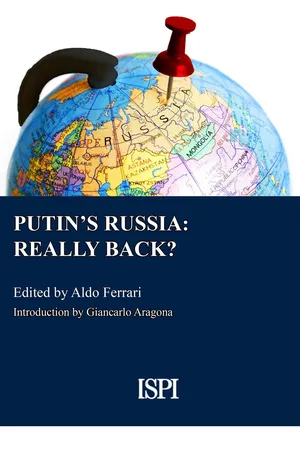
Attempts by Washington and Brussels to push Russia to the fringes of global politics because of the Ukrainian crisis seem to have failed. Thanks to its important role in mediating the Iranian nuclear agreement, and to its unexpected military intervention in Syria, Moscow proved once again to be a key player in international politics. However, Russia's recovered assertiveness may represents a challenge to the uncertain leadership of the West. This report aims to gauging Russia's current role in the light of recent developments on the international stage. The overall Russian foreign policy strategy is examined by taking into account its most important issues: Ukraine and the relationship with the West; the Middle East (intervention in Syria, and ongoing relations with Turkey, Iran and Saudi Arabia); the development of the Eurasian Economic Union; the Russian pivot towards Asia, and China in particular. The volume also analyzes if and to what extent Moscow can fulfill its ambitions in a context of falling oil prices and international sanctions.
- English
- ePUB (mobile friendly)
- Available on iOS & Android
eBook - ePub
Putin's Russia: Really Back?
About this book
Trusted by 375,005 students
Access to over 1 million titles for a fair monthly price.
Study more efficiently using our study tools.
Information
1. Russia’s Global Strategy: Is It Economically Sustainable?
Philip Hanson
The world order has been “reshaped by Vladimir Putin’s ambition”1. So far as Putin’s2 political ambitions are concerned, this judgement is rather persuasive. Russia is once more seen as a threat to Europe and as a power whose views count in the Middle East. That must go some way to satisfying the Kremlin aspiration to be seen as an indispensable power in world affairs. But Russian leaders have long entertained economic aspirations as well: above all, the aspiration to catch up with the levels of productivity and real incomes of the most advanced economies. Both the foreign-policy and the economic ambitions are part of Russia’s global strategy, and both will be considered in this chapter.
The economic aspiration is not at present being achieved. Russia is stuck at a level of labour productivity about two-fifths that of Germany; its share of global output has lately been edging downwards, and its growth prospects are seen as poor by both Russian and Western economists.
The questions I shall attempt to address here are the following. What are the maximum and minimum ambitions of Putin and those around him? Can what is at present an enfeebled economy support the ambition for Russia to be a crucial player in global affairs? What are the longer-term possibilities for the Russian economy as the leadership strives to pursue both political and economic ambitions? By what channels, if any, could economic weakness lead to changes in Russia’s political agenda?
These questions will be pursued in that order. I treat 2018 and 2020 as the relevant medium-term horizons. Looking further ahead is a purely sporting activity.
Maximum and minimum ambitions
So far as foreign policy is concerned, Russian actions support the view that the leadership wants to see Russia restored to something like the position once held by the USSR: that of a global superpower. Relative economic weakness did not prevent the Soviet Union from maintaining that status. Despite the further proliferation of nuclear weapons and the rise of China, the Kremlin seems to see Russia as destined to be more than a regional power and to be globally indispensable in the sense that Russia’s interests must be taken into account in all internationally-significant disputes.
One can perhaps guess at a minimum foreign-policy ambition: for Russia to be unchallenged in its role as a regional power in the territory of the former Soviet Union. In this lesser ambition the Baltic States are probably not included, but the power to challenge them over the affairs of their ethnic Russian residents probably is3.
In pursuit of both the maximum and minimum foreign-policy ambitions, Putin has presided over a major strengthening of Russia’s armed forces. One approach to the sustainability of these ambitions, therefore, is to ask how sustainable the recent growth of military spending is.
We can posit a minimum domestic-politics ambition as well: for the existing leadership to remain in place without having to face any substantial threat to its authority from domestic sources. This probably entails preserving the system, or what Alena Ledeneva calls simply “sistema”, the network of informal understandings and top-down relations that allow Russia to function without a rule of law4.
One feature of the system is that middle and lower-level officials take bribes and otherwise “feed” off their official positions, while tycoons know that their ownership is conditional on their service (when called upon) to those in power, so that the most senior officials are looked after in a material sense by big business5. This means that radical reform (above all, the introduction of the rule of law, protecting property rights) is probably incompatible with the present social and political system.
If it is the case – and the evidence for this will be reviewed below – that the maintenance of the present system precludes radical reform and potential growth is severely ...
Table of contents
- Cover
- Contents
- Introduction
- 1. Russia's Global Strategy: Is It Economically Sustainable?
- 2. Washington and Brussels: Rethinking Relations with Moscow?
- 3. The Myth and reality of Russia's China Pivot
- 4. Russia, the New Protagonist in the middle East
- 5. Does Ukraine Still Matter?
- 6. Russia and the Eurasian Economic Unoin. A Failed Project?
- 7. Conclusions. Policy Implication for the EU
- Authors
Frequently asked questions
Yes, you can cancel anytime from the Subscription tab in your account settings on the Perlego website. Your subscription will stay active until the end of your current billing period. Learn how to cancel your subscription
No, books cannot be downloaded as external files, such as PDFs, for use outside of Perlego. However, you can download books within the Perlego app for offline reading on mobile or tablet. Learn how to download books offline
Perlego offers two plans: Essential and Complete
- Essential is ideal for learners and professionals who enjoy exploring a wide range of subjects. Access the Essential Library with 800,000+ trusted titles and best-sellers across business, personal growth, and the humanities. Includes unlimited reading time and Standard Read Aloud voice.
- Complete: Perfect for advanced learners and researchers needing full, unrestricted access. Unlock 1.4M+ books across hundreds of subjects, including academic and specialized titles. The Complete Plan also includes advanced features like Premium Read Aloud and Research Assistant.
We are an online textbook subscription service, where you can get access to an entire online library for less than the price of a single book per month. With over 1 million books across 990+ topics, we’ve got you covered! Learn about our mission
Look out for the read-aloud symbol on your next book to see if you can listen to it. The read-aloud tool reads text aloud for you, highlighting the text as it is being read. You can pause it, speed it up and slow it down. Learn more about Read Aloud
Yes! You can use the Perlego app on both iOS and Android devices to read anytime, anywhere — even offline. Perfect for commutes or when you’re on the go.
Please note we cannot support devices running on iOS 13 and Android 7 or earlier. Learn more about using the app
Please note we cannot support devices running on iOS 13 and Android 7 or earlier. Learn more about using the app
Yes, you can access Putin's Russia: Really Back? by Aldo Ferrari in PDF and/or ePUB format, as well as other popular books in Politics & International Relations & International Relations. We have over one million books available in our catalogue for you to explore.