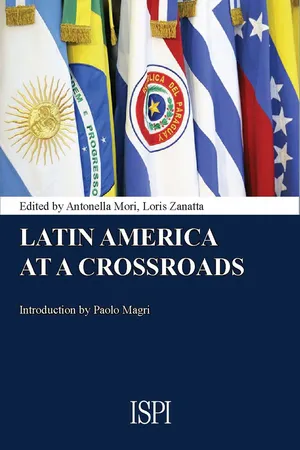
Latin America is at a crossroads. The "golden age" inaugurated with the turn of the new millennium seems a faint memory. Economies that had grown at a steady pace are now slowing down, while some are in freefall. Politically, the "pink tide" of populist movements is now ebbing. From Brazil to Venezuela, from Argentina to Bolivia, left-leaning leaders across the region seem to have lost their bond with the people. Their promises of an equitable society through an apparently never-ending redistribution of wealth crashed against the reality of shortsighted and unsustainable policies. Political and social turmoil are heralding an era of changes and – maybe – of new opportunities for Latin America. And this 'great transformation' is precisely what this volume is all about. Where is it leading to? Does it mark the beginning of a new age? Which lessons can be learnt from the past? Leading international scholars and experts scratch beneath the surface of Latin America's current crisis to have a clearer glimpse of what the future holds and draw policy recommendations, especially for the EU.
eBook - ePub
Latin America at a crossroads
- English
- ePUB (mobile friendly)
- Available on iOS & Android
eBook - ePub
Latin America at a crossroads
About this book
Trusted by 375,005 students
Access to over 1.5 million titles for a fair monthly price.
Study more efficiently using our study tools.
Information
1. The Pink Tide Recedes: Latin America Turns a Page
Loris Zanatta
Stuck midstream, or at a crossroads; on a ridge: that is where Latin America stands today. What is the meaning of all this? Where is the region heading? One can only wonder. As always happens, change is not affecting the whole area at the same time, or in the same way. Yet Latin America is at a political turning point. Facts speak for themselves: after two decades, the much- celebrated pink tide is now in full ebb. Never mind the validity of the definition itself: I never subscribed to it. However, there is no doubt that Chávez’s 1998 triumph in Venezuela, Lula’s 2002 in Brazil, together with the 2001 Argentine crisis and the attempt to institute a Bolivarian area shattered the Washington Consensus1 that some regarded as the meeting point between a free market economy and a social democratic model. The political significance of all this was obvious: many in Latin America felt straitjacketed by representative or liberal democracy, or they fully outgrew it. As in the past, an anti-liberal reaction followed the spread of liberal values to the region within a single decade. People called for an alternative form of democracy: a direct and participatory one, in a word, a populist one. Such democracy claimed to include the pueblo as a shared community, the keeper of an eternal, unanimous identity. As such, the pueblo was impervious to political and ideological pluralism, which it saw as a threat to its integrity and virtue. Of course, not all governments have been equally hostile to the ideal of liberal democracy and its institutional features. Lula and the Brazilian Workers Party, just to name the most important example, never questioned it. Nevertheless, this new era was marked by the return of anti-liberal tropes, as its key players strived to follow in the footsteps of the great Latin American populist regimes, from Peronism to Castroism.
Such was the predominant – albeit not unique – mark of the first decade of the century. Today’s landscape is totally different: a dense chain of events points at a new swing of the regional political pendulum, this time from a national popular pole to a liberal democratic one. It is not a one-way movement, and it is possible that some countries will move in the opposite direction. There is even the chance that, in the future, the pendulum will swing back. But the main trend is the decline of populism. Just like the Argentine crisis appeared to be signaling the end of the neoliberal era to many, the everlasting Venezuelan crisis is the death-knell for populist governments. Evidence of this trend keeps piling up. Chavism is drowning and to remain afloat it can only disregard elections (the tool of people’s sovereignty), which in the past were its main claim to legitimacy. The remaining members of the Bolivarian front are trying not to sink as well. But the main trend is the decline of populism. In Ecuador, social conflicts and electoral defeats in a number of cities have convinced Rafael Correa not to attempt being reelected in 2017 and to hand his power over to a successor. In Nicaragua, Daniel Ortega is now behaving as a typical caudillo drawing on a powerful familial and clientelistic network. Even in Bolivia, where Evo Morales’ success is undeniable and the leader still enjoys widespread popularity, the end of the cycle may be drawing nearer, as evidenced by unforeseen electoral defeats, both in municipal elections and in the referendum with which Morales hoped to open up a path to reelection. And then there is Cuba, where the stale political regime pales in comparison to the stamina of its people, all the more so as the country opens up and the private sector grows2.
However, it was the major South American countries to have set the tone for the latest regional political trends. In Argentina, Mauricio Macri defeated the Peronists and is now trying to restore credibility in republican values and the liberal democratic system, undermined by years of Kirchnerism. In Brazil, meanwhile, the Workers’ Party was brought down by corruption. While it never identified itself as a populist party, it often lent populist governments in other nations support and protection. While one can doubt that the series of events that brought down Dilma Rousseff was either juridically legitimate or politically wise, subsequent local elections dealt a heavy blow to Lula’s party, sanctioning its loss of consensus and its political crisis, pushing Brazil away from the national popular front. Add to this the outcome of the latest Peruvian elections, where Pedro Pablo Kuczynski, the candidate most committed to liberal-democratic values, emerged as the winner. Furthermore, consider Colombia’s failed peace agreement referendum that, on the one hand, jeopardized the peace process, but on the other revealed Colombians’ unambiguous hostility towards the Revolutionary Armed Forces of Colombia (FARC), a movement that constantly flirted with populism.
An underlying trend runs through this long chain of events. Regardless of one’s opinion, it signals the crisis of populism3 and the opening of a new era. Liberal democracy, ever the Cinderella of Latin American history, and the “sick man” of our times, has finally the chance to put down new roots in a region where it seldom enjoyed solid ground.
Why the wind veers
So why did the political wind shift? Why are populist regimes in crisis? Populism is such a well-rooted feature in regional political systems that its crisis makes one wonder whether we are witnessing a physiological decline or long-run, structural change. It would be tempting to play down the scale of the phenomenon and trace everything back to well-known and tangible reasons. First of all, the abrupt turn of the economic cycle. It would be understandable and somewhat legitimate. As the década dorada draws to a close, one can only expect a political change. It was long overdue for Latin American governments to prepare for the fall in commodity prices, after their long-lasting stellar performance thanks to Chinese demand. Thus, the most robust economic growth the region ever experienced for a century fizzled out and died, as the recession set in: regional GDP was down in 2016, and economists do not foresee an outstanding recovery. At the same time, to argue that populist regimes suffer from anemic growth like any other government would be simplistic. It would be only fair to say that populist regimes pay a harsh toll for squandering the huge resources at their disposal. When one removes Venezuela and Argentina from regional aggregates, macroeconomic indicators turn from negative to mildly positive. It is not surprising that voters punished those two governments’ awful performances4.
To really gauge the extent of the crisis, we must judge populist regimes on political and social grounds, where they have always proved stronger. Since its inception, populism pitted the liberal concept of democracy based on the separation of powers, individual rights, and an open society against the defense of “social justice”. A powerful concept, albeit vague and controversial. Such a noble purpose called for the use of any means necessary, including the violation of the rights of minorities, the concentration of power, the inhibition of free and fair electoral competition. Moreover, the price of present consensus-building was unloaded upon future generations through recourse to unsustainable redistributive policies. In the face of frail liberal democracies, with a narrow social base, populism had an easy time proclaiming its pueblo as the only legitimate pueblo, the vessel of national identity, the personification of virtue against oligarchs imbued with foreign ideas. For a long time this was a winning argument: it managed to turn the normal political dialectic into a Manichean fight between the people and the oligarchs, the nation and the anti-nation, good and evil, and it allowed populist regimes to win election after election. This was both due to its actual ability to give voice to the huge share of the population who felt left out by liberal democratic parties and to the fact that, once in power, populists concentrated financial and political resources and thwarted the opposition. This same pattern was followed by Peronism, by the Mexican Institutional Revolutionary Party, by Cuban Castroism (to the point that it banned competitive elections), by Chavism, and so on. This often led to an inextricable dilemma: where populists won, democratic institutions were distorted to the point that they could not ensure fair political competition; where populists lost, sometimes via coups, no liberal democracy could muster sufficient popular support to stand on its own. This gave rise to a chronic swing between populism and militarism5. However, this time the very core of the populist narrative appears to be falling apart at the seams. It would be a momentous change, albeit a change that could take decades.
What is weakening the longstanding populist narrative, once so powerful in defeating liberal democratic discourses, to the point of derailing it? Briefly, it could be argued that over the past thirty years Latin America went through a number of changes that little by little chipped away at the populist narrative’s credibility and its ability to explain the world. These changes are multidimensional: it is, therefore, key to expand upon the political and social sides of the equation, and their impact on political culture. Taken together, all these help explain the progressive inadequacy of this narrative, and its increasing and unprecedented exposure to resounding defeats.
Populism without the people
Let’s start from political changes. The first and most important – so glaring, and thus often overlooked – is the diffusion and the stable preservation of representative democracy systems by Latin America as a whole (except for Cuba). It would be shortsighted to deny that these democracies are often marred by mediocre or even insufficient institutional quality, and that there is a deep chasm between Chile’s and Uruguay’s long-run, high-quality democratic systems and the inefficient and arbitrary systems of so many other countries6. To be clear: the liberal democratic system has come a long way in the whole region, but way too often it only acts as an unstable façade under which ancient patrimonialistic habits, of remote Hispanic heritage, thrive. As the story goes, if you rule in the name of the people, those same people validate your use of power to reward who is loyal and punish who is not. Limiting this power is tantamount to an attack on the sovereignty of the people that are governing through you. Widespread corruption is nothing but the innate reflex of this heritage. These forms of democracy have been kept afloat in times of abundance, when there were enough resources to coopt clients and buy consensus. But now that resources are scarce the day of reckoning has come. We are now able to tell who took advantage of those times of abundance to lay solid, institutional foundations, and who simply tried to bottle up political abuse and sell it as democratic wine. Now more than ever, Latin American democracies must prove their worth: their mere existence is not enough anymore.
On the other hand, the institutional dynamic of representative democracy triggered a virtuous inertia that slowly but steadily shaped the behavior of political actors. This is the key change. Such inertia often prevented populist governments from amassing as much power as they did in the past. It ensured a higher degree of autonomy at different state institutions, so that they could exert greater control on government power itself. It favored a more pluralistic public debate that governments could not suppress without having to deal with the consequences. Finally, it sanctioned the multi-party system as the only legitimate political system and established the need for elections to be free and fair. It may not seem much, but it is, and it explains why populist movements had to change, so much so that today they cannot dismiss liberal democracy and, by living within it, they end up internalizing some of it7.
Such inertia partially eroded some tenets of the populist mantra. First of all, it challenged the idea of democracy as a social reality, independent from the political and institutional framework, its “pure form” denounced as a misleading superstructure. Liberal democracy bestowed upon politics the autonomy and dignity that populism used to deny it. The very concept of “social justice”, over which populists always claimed a sort of monopoly, moved from being a dogma to a subject for debate. Secondly, the daily practice of liberal democracy, with its customs and networks, its constant recourse to negotiation and compromise, partly defused populism’s Manichean penchant. It juxtaposed new actors to the classic narrative opposing the pueblo to oligarchs, it added new colors to its stale black-and-white palette, it nuanced the political debates that populism reduced to crude religious wars, and by doing so it laid the foundations for a more complex and rational political life. Finally, as liberal democracy endured, it pushed populism to play its own game. This was most evident in Venezuela, where populism’s authoritarian tension violated both the letter and the spirit of democracy8. But even there, Chavism stopped short of totally eradicating democratic institutions, so much so that it suffered electoral defeats. In most other cases, the customs and institutions of representative democracy forced populist movements to recognize constitutional boundaries and rules. All this brings us to a simple but important conclusion: while populist movements grew up believing themselves different from everybody else (not just parties among parties but the repositories of the people’s morality, and therefore superior), by taking part in the liberal democracy game, such movements lost their one-of-a-kind quality to become political actors like any other. Willingly or not.
But there is more. In the past, when populist regimes seized power, they used to ring-fence it in order to prevent others from challenging it. Alternatively, they were overruled by the army. This way, what they would lose in power, they would gain in prestige. Given that their downfall wasn’t due to an electoral defeat, but to an abuse of power by the military, this strengthen...
Table of contents
- Contents
- 1. The Pink Tide Recedes: Latin America Turns a Page
- 2. Latin America and the World. The Right Time for Engagement?
- 3. After the Commodity Boom: Towards a New Economic Model?
- 4. Is Inequality Declining in Latin America?
- 5. Oil and Commodities: The End of the "Age of Abudance"
- 6. Organized Crime and Drug Trafficking, a Never-Ending Threat
- Conclusions. Policy Implications for the EU
- The authors
Frequently asked questions
Yes, you can cancel anytime from the Subscription tab in your account settings on the Perlego website. Your subscription will stay active until the end of your current billing period. Learn how to cancel your subscription
No, books cannot be downloaded as external files, such as PDFs, for use outside of Perlego. However, you can download books within the Perlego app for offline reading on mobile or tablet. Learn how to download books offline
Perlego offers two plans: Essential and Complete
- Essential is ideal for learners and professionals who enjoy exploring a wide range of subjects. Access the Essential Library with 800,000+ trusted titles and best-sellers across business, personal growth, and the humanities. Includes unlimited reading time and Standard Read Aloud voice.
- Complete: Perfect for advanced learners and researchers needing full, unrestricted access. Unlock 1.5M+ books across hundreds of subjects, including academic and specialized titles. The Complete Plan also includes advanced features like Premium Read Aloud and Research Assistant.
We are an online textbook subscription service, where you can get access to an entire online library for less than the price of a single book per month. With over 1.5 million books across 990+ topics, we’ve got you covered! Learn about our mission
Look out for the read-aloud symbol on your next book to see if you can listen to it. The read-aloud tool reads text aloud for you, highlighting the text as it is being read. You can pause it, speed it up and slow it down. Learn more about Read Aloud
Yes! You can use the Perlego app on both iOS and Android devices to read anytime, anywhere — even offline. Perfect for commutes or when you’re on the go.
Please note we cannot support devices running on iOS 13 and Android 7 or earlier. Learn more about using the app
Please note we cannot support devices running on iOS 13 and Android 7 or earlier. Learn more about using the app
Yes, you can access Latin America at a crossroads by AA.VV., Antonella Mori,Loris Zanatta, Antonella Mori, Loris Zanatta in PDF and/or ePUB format, as well as other popular books in Politics & International Relations & Global Politics. We have over 1.5 million books available in our catalogue for you to explore.