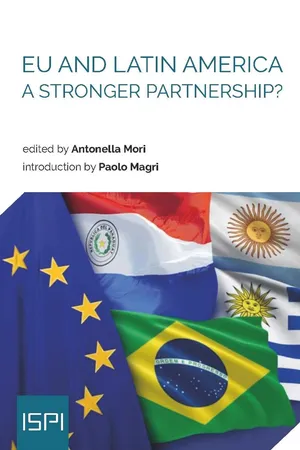
Despite a stop-and-go policy, over the past twenty years the European Union, Latin America, and the Caribbean Region have joined forces to scale-up their partnership. Today, the time seems ripe for the EU to give new impetus to bi-regional relations as the US interest in the region appears to be decreasing, and China quickly steps in. The near future will indicate whether the political will to bolster relations between the EU and the region is actually stronger than before: how will the agreements between the EU and Mexico, Chile, and the Caribbean be updated? Will the EU-MERCOSUR Association Agreement be completed?If so, the EU will be able to enact free trade agreements with all the countries in the region, except Bolivia, Venezuela and Cuba. The latter is already involved in its first ever negotiation with the EU to strengthen bilateral cooperation. This volume provides an overview and wide-ranging analyses on the ongoing negotiations, viable options and possible results.
- 138 pages
- English
- ePUB (mobile friendly)
- Available on iOS & Android
eBook - ePub
EU and Latin America. A Stronger Partnership?
About this book
Trusted by 375,005 students
Access to over 1.5 million titles for a fair monthly price.
Study more efficiently using our study tools.
Information
6. EU and Caribbean: Towards the Reconfiguration of the Inter-Regional Landscape
Jessica Byron, Jacqueline Laguardia Martinez
European Union-Caribbean relations have been in constant evolution since the Economic Partnership Agreement (EPA) negotiations were concluded at the end of 2007. The pace of change speeded up thereafter with greater convergence within the Latin American and Caribbean (LAC) region, and the emergence of an EU-Celac inter-regional partnership by 2012. Nonetheless, the Caribbean remains a zone with a dual system of linkages with the EU through EU-LAC and also through the EU-ACP (Africa-Caribbean-Pacific Group) historical partnership. The years 2018-2019 feature three significant developments: the launch of the post-Cotonou talks in July 2018 in preparation for the expiry of the ACP-EU Cotonou Partnership Agreement (CPA) in February 2020; the formalisation of a new EU-Cuba relationship based on expanded cooperation and political dialogue; the withdrawal of the United Kingdom from the European Union (Brexit) with inevitable repercussions for EU-Caribbean and UK-Caribbean relations. The chapter discusses these three topics and also explores the Caribbean’s place within Celac and the directions of the EU-Celac relationship.
The Caribbean region stands out in the LAC because of its historical linkages with at least four major EU member states, and the large number of EU territories that are located within the Caribbean-North Atlantic zone45. Many are associate members of Caribbean regional organisations while others are seeking accession46. Paradoxically, despite the strong social and political links with the EU and its Overseas Territories, trade and economic exchanges with the European Union have declined since the coming into effect of the Economic Partnership Agreement. This chapter recognises the continued significance of social and cultural ties between Europe and the Caribbean that have been consolidated and deepened by Caribbean diasporas in Europe. However, these are likely to suffer some disruption from Brexit with the probable reduced visibility of the English-speaking Caribbean diaspora within the EU zone. We argue that trade and investment flows as well as the shared legacy of norms and values remain indispensable elements of regional and inter-regional relations. Extracting more value from the EPA and rendering its mechanisms more effective are imperatives for the future of the Caribbean and EU relationship. Likewise, the Caribbean Community (Caricom) members of the regional equation need to invest more resources in strengthening relations with other EU member states beyond the Brexiting United Kingdom. The European territories in the Caribbean may be important players in this process, as are the joint institutions of the Economic Partnership Agreement (EPA). Finally, the chapter argues that deepening LAC relations and building consensual approaches on key common areas of interest will be crucial to the Caribbean dimension of the EU-LAC relationship.
The End of an Era? Africa-Caribbean-Pacific Group (ACP) – EU Relations Post-Cotonou
In the mid-1970s, as the European Community began expanding its membership beyond its founding countries, relations with former colonial territories in Africa, the Caribbean and the Pacific were also restructured with the negotiation of the Lome Convention (1975) that guaranteed preferential access to EU markets and development cooperation. The Lome Conventions lasted for 25 years before succumbing to a changed global political and economic landscape at the end of the 1990s. The successor CPA (2000) was intended as a development partnership between the ACP and the EU which would facilitate the formers’ gradual integration into the global economy governed by the terms and conditions of the World Trade Organization.
Art. 37 of the CPA stipulated that negotiations towards regional trade agreements with the EU should begin by 2004. Cariforum was the first ACP group to conclude a comprehensive agreement with the EU, its second largest trade partner, on the gradual liberalisation of trade in goods and services and on trade related issues between their two regions. The EU-Cariforum Economic Partnership Agreement was signed and began provisional operation in 200847. It was hoped that an EPA might stimulate competitiveness and provide increased market opportunities for Caribbean service industries. Thus far it has brought mixed results, with the Cariforum market share in the EU continuing to decline from 3.8% (2004-2008) to 2.8% between 2010 and 2014. It is worth noting that the Dominican Republic’s EU exports grew on average 7% per annum 2007-2013 but Caricom’s EU exports declined by 23%48. Since 2007, the overall value of ACP Caribbean exports to the EU has risen above €5,000 million only twice, in 2008 and 2013 and the average growth rate of ACP Caribbean exports to the EU between 2013 and 2017 is - 6.4%49.
EPA reviews attribute the lacklustre performance to a variety of factors, the leading one being the global recession 2007- 2010. During that time, Cariforum exports to the EU declined by one third50. Negative growth, falling government revenues combined with rising public debt, unemployment and social decline were major concerns especially for the Cariforum but also for EU parties, diverting po...
Table of contents
- EU and Latin America
- Colophon
- Table of Contents
- Introduction
- Towards the Complation of a Stronger Bi-Regional Partnership
- The Eternal Myth of Latin American Unity and the Global World
- The "Modernisation" of the Global Agreenebt between Mexico and the EU
- The EU's Relations with Cuba from a Regional Perspective
- The Long Road Towards a FTA Between Mercosur and the EU
- EU and Caribbean: Towards the Reconfiguration of the Inter-Regional Landscape
- References
- The Authors
- Footnotes
Frequently asked questions
Yes, you can cancel anytime from the Subscription tab in your account settings on the Perlego website. Your subscription will stay active until the end of your current billing period. Learn how to cancel your subscription
No, books cannot be downloaded as external files, such as PDFs, for use outside of Perlego. However, you can download books within the Perlego app for offline reading on mobile or tablet. Learn how to download books offline
Perlego offers two plans: Essential and Complete
- Essential is ideal for learners and professionals who enjoy exploring a wide range of subjects. Access the Essential Library with 800,000+ trusted titles and best-sellers across business, personal growth, and the humanities. Includes unlimited reading time and Standard Read Aloud voice.
- Complete: Perfect for advanced learners and researchers needing full, unrestricted access. Unlock 1.5M+ books across hundreds of subjects, including academic and specialized titles. The Complete Plan also includes advanced features like Premium Read Aloud and Research Assistant.
We are an online textbook subscription service, where you can get access to an entire online library for less than the price of a single book per month. With over 1.5 million books across 990+ topics, we’ve got you covered! Learn about our mission
Look out for the read-aloud symbol on your next book to see if you can listen to it. The read-aloud tool reads text aloud for you, highlighting the text as it is being read. You can pause it, speed it up and slow it down. Learn more about Read Aloud
Yes! You can use the Perlego app on both iOS and Android devices to read anytime, anywhere — even offline. Perfect for commutes or when you’re on the go.
Please note we cannot support devices running on iOS 13 and Android 7 or earlier. Learn more about using the app
Please note we cannot support devices running on iOS 13 and Android 7 or earlier. Learn more about using the app
Yes, you can access EU and Latin America. A Stronger Partnership? by Antonella Mori in PDF and/or ePUB format, as well as other popular books in Politics & International Relations & Diplomacy & Treaties. We have over 1.5 million books available in our catalogue for you to explore.