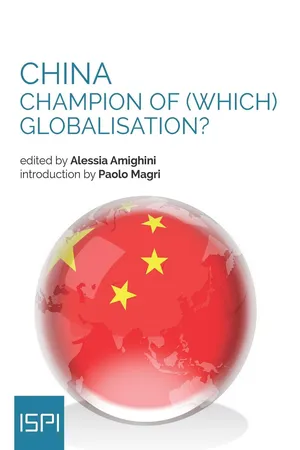
This year marks the 40th anniversary of China's reforms and opening up. In four decades, China has learned how to grasp the benefits of globalisation and has become a world economic champion. As the world's second-largest economy, today China is no longer the factory of the world but an industrial power aiming at the forefront of major high-tech sectors, in direct competition with Europe and the US. In sharp contrast with Trump's scepticism on multilateralism, President Xi has renewed his commitment to growing an open global economy. But what does globalisation with Chinese characteristic look like? Is Beijing offering more risks or more opportunities to both mature and emerging economies? To what extent is China willing to comply with international rules and standards? Is Beijing trying to set its own global rules and institutions? Is the world destined to a new model of economic globalisation detached from political and cultural openness?
- English
- ePUB (mobile friendly)
- Available on iOS & Android
eBook - ePub
China: Champion of (Which) Globalisation?
About this book
Trusted by 375,005 students
Access to over 1.5 million titles for a fair monthly price.
Study more efficiently using our study tools.
Information
2. Free Trade with Chinese Characteristics
Shannon Tiezzi
With the emergence of “America First” protectionism in the United States, China under Xi Jinping has sought to position itself as the world’s foremost defender of globalisation and free trade. This is something of a paradox, as China has many market restrictions of its own that have long plagued foreign investors. With that in mind, what exactly is the Chinese definition of free trade, and what sort of globalisation is the Chinese government supporting?
Speaking at the 2017 World Economic Forum in Davos, Switzerland, Xi pledged that:
China will vigorously foster an external environment of opening-up for common development. We will advance the building of the Free Trade Area of the Asia Pacific and negotiations of the Regional Comprehensive Economic Partnership to form a global network of free trade arrangements1.
That follows a similar promise in the communiqué issued after the Third Plenary Session (or Third Plenum) of the 18th Central Committee of the Chinese Communist Party (CCP). According to the communiqué, “To adapt to the new trend of economic globalisation, we must promote domestic openness together with openness to the outside world… and foster new advantages in participating in and leading international economic cooperation and competition at a faster pace, to promote reform through opening up”2. To this end, the communiqué listed “speeding up the construction of free trade zones” as a “major task”3.
China is in the midst of a new wave of free trade negotiations. Six of China’s 13 FTAs with external partners were signed after the Third Plenum communiqué was issued in 20134. China’s goals in pursuing these FTAs are often more political than economic. Even China’s financial goals are in many ways unique, and sometimes at odds with the free trade aspirations of developed economies.
China’s Free Trade Agreements: An overview
As of April 2018, China has signed bilateral Free Trade Agreements (FTAs) with 12 other states, as well as an agreement linking China with the ten member states of the Associations of Southeast Asian Nations (ASEAN). Beijing began its foray into FTAs soon after acceding to the World Trade Organization (WTO) in 2001; its first, the Framework Agreement on China-ASEAN Comprehensive Economic Cooperation, was inked in 2002 (although the establishment of the China-ASEAN free trade area would not come until 2010). From 2006-2011, China signed six more FTAs (with Pakistan, Chile, New Zealand, Singapore, Peru, and Costa Rica). Since Xi Jinping came to power in late 2012, China has signed an additional six agreements (with Switzerland, Iceland, the Republic of Korea, Australia, Georgia, and the Maldives). Eight more are under negotiation.
China is currently negotiating upgrades to its FTAs with Pakistan, Singapore, and New Zealand. It is also pursuing multilateral agreements, most notably the Regional Comprehensive Economic Partnership (RCEP) (a 16 party framework involving the ten ASEAN member states and the six countries that have separate FTAs with ASEAN), but also a trilateral FTA with Japan and the Republic of Korea. Other negotiating partners in...
Table of contents
- Cover
- China: Champion of
- Colophon
- Table of Contents
- Introduction
- China’s New Economic Powerhouse
- Free Trade with Chinese Characteristics
- Is China a Market Economy?
- China in Global Technology Governance
- Chinese Global Climate Change Leadership
- China’s New Energy Sourcing
- Policy Recommendations for the EU
- The Authors
Frequently asked questions
Yes, you can cancel anytime from the Subscription tab in your account settings on the Perlego website. Your subscription will stay active until the end of your current billing period. Learn how to cancel your subscription
No, books cannot be downloaded as external files, such as PDFs, for use outside of Perlego. However, you can download books within the Perlego app for offline reading on mobile or tablet. Learn how to download books offline
Perlego offers two plans: Essential and Complete
- Essential is ideal for learners and professionals who enjoy exploring a wide range of subjects. Access the Essential Library with 800,000+ trusted titles and best-sellers across business, personal growth, and the humanities. Includes unlimited reading time and Standard Read Aloud voice.
- Complete: Perfect for advanced learners and researchers needing full, unrestricted access. Unlock 1.5M+ books across hundreds of subjects, including academic and specialized titles. The Complete Plan also includes advanced features like Premium Read Aloud and Research Assistant.
We are an online textbook subscription service, where you can get access to an entire online library for less than the price of a single book per month. With over 1.5 million books across 990+ topics, we’ve got you covered! Learn about our mission
Look out for the read-aloud symbol on your next book to see if you can listen to it. The read-aloud tool reads text aloud for you, highlighting the text as it is being read. You can pause it, speed it up and slow it down. Learn more about Read Aloud
Yes! You can use the Perlego app on both iOS and Android devices to read anytime, anywhere — even offline. Perfect for commutes or when you’re on the go.
Please note we cannot support devices running on iOS 13 and Android 7 or earlier. Learn more about using the app
Please note we cannot support devices running on iOS 13 and Android 7 or earlier. Learn more about using the app
Yes, you can access China: Champion of (Which) Globalisation? by Alessia Amighini in PDF and/or ePUB format, as well as other popular books in Politics & International Relations & International Relations. We have over 1.5 million books available in our catalogue for you to explore.