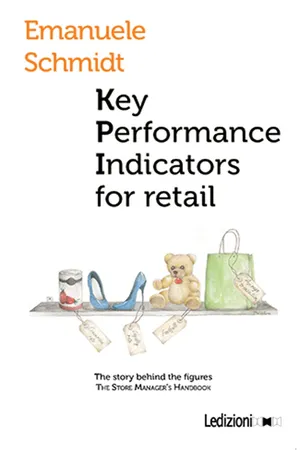
What works well in my store? Where can I make improvements? How can I get more people to visit my store? How can I sell more? How can I sell "better"? Stores come in all shapes and sizes: large and small, food and non-food, department and speciality, mono-brand and multi-brand, independent and franchisees… Each business, each product category, and each strategy has its own specific characteristics but all stores operate under the same "basic laws" of commerce. This book was written in the belief that "trading" is a profession that demands some skills that always apply irrespective of the type of business formula used. One of these is the ability to understand and use key performance indicators for retail so that we can: Interpret store results; Make decisions to improve them; Monitor the efficacy of these decisions. A real operational handbook, written for real people who manage stores on a daily basis, that describes the key performance indicators most commonly used in retail: footfall, transactions, conversion rate, sales, average sale per transaction, average selling price, average units per transaction, percentage of revenue from promotions and markdowns, sales per category, penetration, margins, loyalty, customer satisfaction and mystery shopping, inventory turnover and stock coverage, damaged items, shrinkage, returns, personnel costs, sales per FTE, and direct operating costs. This book also explains: What an indicator is and how to calculate it; What the indicator measures; Which factors influence the indicator; Which decisions will steer the indicator in the desired direction. Practical exercises help the reader to master these concepts and apply them immediately in his or her store.
- English
- ePUB (mobile friendly)
- Available on iOS & Android
eBook - ePub
Key performance Indicators for retail
About this book
Trusted by 375,005 students
Access to over 1 million titles for a fair monthly price.
Study more efficiently using our study tools.
Information
Subtopic
Business GeneralIndex
Business1. FOOTFALL
The first indicator we meet on our journey into the world of KPIs is “footfall”. Not all stores uses this indicator but it is very useful nevertheless. So what is footfall?
A store’s footfall is the number of people who enter that store, for whatever reason, during a given period of time (an hour, day, week, month, or year).
What does this indicator measure?
Footfall measures how attractive a store is to shoppers, i.e. its ability to convince customers to choose the store and come through the door. The more people that enter the store, the higher the probability that the store has characteristics considered positive by its potential customers.
Footfall also allows us to learn more about the customers’ buying habits: which days of the week attract more customers? Which are the quiet days? Which times of the day do customers prefer? So, footfall gives us information that is vital for planning the staff’s shifts.
How do I calculate this indicator?
To measure footfall, we just need to count how many people come through the door. We usually use automatic systems to do this, which statistically adjust the figures. For example, some systems adjust down by a small percentage (between 3% and 6%) to deduct the number of times staff members enter and exit the store.
Footfall can be counted manually in stores that have a limited number of customers (for example, boutiques or furniture stores in which sales assistants accompany the customer) and someone who always monitors the entrance.
| What is this indicator called in your business? |  |
| Where can you find this data? | |
| The benchmark for your store | |
Now, some initial information about the “twin stores”. The following number of people entered the two stores during the last given period of time:
| Store A | Store B | |
| Footfall | 1,200 | 900 |
What do you think may have caused this difference?
What can the store managers do to increase the number of people that come through the door?
Have you written your answers? Before checking them with the answers in the appendix, take a closer look at this indicator on the following pages.
WHICH VARIABLES INFLUENCE THE FOOTFALL?
These are the main variables that influence footfall.
1. The store’s location: when all other conditions are the same, a store in a location with a lot of traffic whereby it is easy to stop and go in, will be visited by more people (this type of footfall is sometimes referred to as being “caught” because the store has generated this footfall just by being where it is).
2. The neighbouring competition: a store without any nearby competitors (“one-of-a-kind”) has a relative monopoly and therefore has a higher probability of getting customers through the door. However, we cannot say that the opposite is true, i.e. a store surrounded by many similar stores will not have many customers; there is a concept known as “economies of agglomeration”. This relates to areas that contain clusters of many similar stores which increase footfall and thereby benefit them all (for example, the shopping streets in many city centres).
3. The recognition of the brand and all the marketing actions implemented by the brand to attract customers: the launch of new products, new collections, contests, advertising, etc.
4. The reputation of the store (which will also depend on how many years the store has been open) and all the actions implemented by the store to attract customers: for example, the service rendered to the customers, events organised in the store, local advertising and discount policies agreed with other local operators.
5. The initial impact from the storefront and window displays (the quality of the store’s exterior, displays in the store windows, the store sign): if customers are “amazed” by what they see from the outside, they are much more likely to enter a store.
6. The overall quality of the shopping experience: customers return and speak highly about the store (generating positive word of mouth) if they find quality products at reasonable prices, swift, satisfactory service, and a pleasant environment.
7. Loyalty programmes: effective loyalty programmes make it worth for customers to come back and buy from the same store.
WHAT ARE THE STORE MANAGER'S ACTIONABLE LEVERS FOR INCREASING FOOTFALL?
Many of the variables on which footfall depends cannot be directly controlled by the store manager. But this does not mean that you should fail to tackle or passively “put up with” this indicator as if it represented a sort of destiny.
There are many things managers can do to have a positive influence on footfall:
1. Attend to the entrance (its design, the store windows, cleaning, an open door, etc.) and avoid “scaring away” customers. For example, customers may be discouraged from entering the store if sales assistants stand too close to the door;
2. Look after every step of the selling process so that customers feel motivated to return and speak highly about the store;
3. Increase the store’s attractiveness by using:
• Local advertising (radio, posters and billboards, local newspapers);
• Agreements with other local operators that are relevant to the store’s target market (transports companies, local hotels, sports clubs, schools and other organisations in the area);
• Organise your own in-store events.
4. Develop long-term relations with the customers to increase their “loyalty”. If a store’s sales assistants can build personal relations with some of the customers, that store will then have a group of loyal customers that visit on a regular basis and whereby they can also be invited to special occasions.
2. THE BUYING CUSTOMER: NUMBER OF TRANSACTIONS AND THE CONVERSION RATE
Some people who enter...
Table of contents
- Copertina
- Frontespizio
- PREFACE
- INTRODUCTION
- 1. FOOTFALL
- 2. THE BUYING CUSTOMER: NUMBER OF TRANSACTIONS AND THE CONVERSION RATE
- 3. THE SALES RESULTS
- 4. BENCHMARKS
- 5. THE AVERAGE SALE PER TRANSACTION
- 6. UNDERSTANDING THE AVERAGE SALE PER TRANSACTION: AVERAGE SELLING PRICE AND AVERAGE UNITS PER TRANSACTION
- 7. SALES PER CATEGORY
- 8. CROSS-SELLING INDICATORS: NUMBER OF CATEGORIES PER TRANSACTION AND PENETRATION
- 9. DIFFERENT TYPES OF MARGINS
- 10. PERCENTAGE OF INCOME FROM PROMOTIONS
- 11. LOYALTY: PUTTING A NAME TO A TRANSACTION
- 12. THE CUSTOMER'S POINT OF VIEW: CUSTOMER SATISFACTION SURVEYS AND MYSTERY SHOPPING
- 13. STOCK: TURNOVER AND COVERAGE
- 14. THE LINK BETWEEN WHAT COMES IN AND WHAT GOES OUT: DAMAGED ITEMS, SHRINKAGE AND RETURNS
- 15. PERSONNEL COSTS AND SALES PER HOUR
- 16. DIRECT OPERATING COSTS
- 17. SUMMARY: THE PROFIT AND LOSS STATEMENT
- SOLUTION TO EXERCISES
Frequently asked questions
Yes, you can cancel anytime from the Subscription tab in your account settings on the Perlego website. Your subscription will stay active until the end of your current billing period. Learn how to cancel your subscription
No, books cannot be downloaded as external files, such as PDFs, for use outside of Perlego. However, you can download books within the Perlego app for offline reading on mobile or tablet. Learn how to download books offline
Perlego offers two plans: Essential and Complete
- Essential is ideal for learners and professionals who enjoy exploring a wide range of subjects. Access the Essential Library with 800,000+ trusted titles and best-sellers across business, personal growth, and the humanities. Includes unlimited reading time and Standard Read Aloud voice.
- Complete: Perfect for advanced learners and researchers needing full, unrestricted access. Unlock 1.4M+ books across hundreds of subjects, including academic and specialized titles. The Complete Plan also includes advanced features like Premium Read Aloud and Research Assistant.
We are an online textbook subscription service, where you can get access to an entire online library for less than the price of a single book per month. With over 1 million books across 990+ topics, we’ve got you covered! Learn about our mission
Look out for the read-aloud symbol on your next book to see if you can listen to it. The read-aloud tool reads text aloud for you, highlighting the text as it is being read. You can pause it, speed it up and slow it down. Learn more about Read Aloud
Yes! You can use the Perlego app on both iOS and Android devices to read anytime, anywhere — even offline. Perfect for commutes or when you’re on the go.
Please note we cannot support devices running on iOS 13 and Android 7 or earlier. Learn more about using the app
Please note we cannot support devices running on iOS 13 and Android 7 or earlier. Learn more about using the app
Yes, you can access Key performance Indicators for retail by Emanuele Schmidt in PDF and/or ePUB format, as well as other popular books in Business & Business General. We have over one million books available in our catalogue for you to explore.