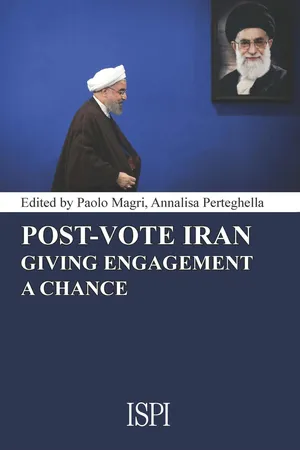
2017 is a crucial year for Iran. In January, while the Joint Comprehensive Plan of Action (JCPOA) entered the second year of implementation, in Washington the Trump Administration took office, with the promise to "renegotiate a disastrous deal". In May, in Tehran, the incumbent President Hassan Rouhani won re-election by a wide margin.This Report intends to trace what lies ahead for Iran after the May 2017 Rouhani's re-election. The analysis builds upon the assumption that Iran does not act in a vacuum: the US, as well as the EU actions, will inevitably help define the future trajectory of the country. A trajectory which is set domestically also by the generational transition Tehran is going through. The inter-factional struggle affecting Iran since the early years of the Revolution is now revived by what is actually at stake: the very future of the Islamic Republic.
- English
- ePUB (mobile friendly)
- Available on iOS & Android
eBook - ePub
About this book
Trusted by 375,005 students
Access to over 1.5 million titles for a fair monthly price.
Study more efficiently using our study tools.
Information
1. The Struggle for Iran: Rouhani’s Difficult Path to Reform
Pejman Abdolmohammadi
In the next two decades, Iran could exercise a crucial role in the stability and the peace process in the Middle East. First, because of its significant geographical collocation (between the Caspian Sea and the Persian Gulf and between Asia and Europe), Iran has the makings to act as both mediator and peace builder within and between the Middle East and the West. Second, Iran is one of the major powers in the Middle East in terms of economic and military resources. Its foreign policy and the strategies it will adopt in the next two decades will influence the balance of power in the region significantly. Third, Iran has an important symbolic role, as it represents the major Islamic Shiite political system in the Middle East and consequently exercise relevant influences in its strategic areas, which are somehow affiliated to the Islamic Republic of Iran. Tehran has a voice in the matters of countries such as Lebanon, Yemen, Bahrain, Syria, and Iraq.
Finally, on the domestic level, Iran represents an important “political laboratory” for the democratization process in the Middle East. The modern political history of this country shows that, since the early Twentieth century, there had been significant socio-political movements which demanded constitutionalism and modernity and moved towards the creation of a pluralistic political system. It is worth to note that the first Constitutional Revolution in the Middle East happened in Iran in 1906 and the 1979 Revolution, under the leadership of Ayatollah Khomeini, and the consequent institution of an Islamic Republic in Iran, have been anticipating the rise of political Islam, which started to gain importance after the “Arab Spring” in 2010-2011.
A thorough analysis of Iran’s domestic politics, highlighting its main internal factions and players, is thus key. The Islamic Republic of Iran is a sophisticated political system which is neither a pure authoritarian system nor a pluralistic political regime. According to this paper, the Islamic Republic is a peculiar hybrid regime which combines Islamic principles with Republican ones. It means that Iran’s political system is composed of institutional bodies which are the expression both of the Islamic and the Republican sides. It can be seen as a sort of cohabitation between two worlds: the Institute of the Supreme Leader, the Council of Guardians, the Assembly of Experts, the Expediency Discernment Council, and the Judiciary represent the body of the Islamic State, while the President of the Republic and the Parliament constitute the heart of the Republic.
In such a complicated institutional system, the political factions and players have played a relevant role in determining the internal balance of power within the Islamic Republic. The various political players coming from the religious, military, paramilitary, and economic spheres of the society made several alliances and alignments during the last 38 years of the Islamic Republic’s life, influencing both the Iranian domestic politics and its foreign policy.
In such context, the last presidential election in May 2017 could be seen as one of the most important moments in the political history of the Islamic Republic. The victory of the incumbent President Hassan Rouhani with almost 24 million votes represented an important moment in the Iranian political life. The main outcome of such victory has been the confirmation of Rouhani’s foreign policy based on the pragmatic idea of opening the country to free market and liberalization. Moreover, the Iranian voters pinned once again their hopes on a government which promised economic progress and development. To better understand the importance of the last election, this paper will devote a brief section to the electoral process.

Iran’s presidential election took place last 19 May, and President Hassan Rouhani was re-elected for a second mandate.
Five official candidates ran for the presidency, all of whom were preselected by the Council of Guardians from among 1,653 registered candidates. This means that, according to the Council of Guardians, these five candidates had all the requirements, in accordance with the Constitution, to eventually become the President of the Islamic Republic. It also meant they had met with the approval of the Supreme Leader, Ayatollah Ali Khamenei.
The President of the Republic is the second highest official after the Supreme Leader, who functions as the country’s head of state. The Supreme Leader (rahbar-e mo’azzam-e enghelab-e eslami) is the most important constitutional body of the Islamic Republic. It was introduced into the Iranian legal system in order to guarantee the application of sharia (Islamic law) in the Islamic Republic of Iran.
The President of the Islamic Republic is the head of the government. The executive power is responsible for implementing the Constitution and maintaining order among the three branches of the state. During the first nine years of the Islamic Republic, the Prime Minister exerted the greatest influence on the executive branch. However, following the revision of the Constitution in 1988 and the abolition of the office of Prime Minister, the President became the highest office of executive power, absorbing all the authority previously shared with the Prime Minister. After the constitutional amendment, almost concurrent with the death of former Supreme Leader Ayatollah Ruhollah Khomeini, the office of the President became the fundamental center of power of the institutional framework of the country after the Supreme Leader. The President appoints and supervises the Cabinet and the Vice Presidents who, by appointment, oversee the ministries they are assigned. In terms of foreign policy, the President can sign treaties, conventions, and international agreements, subject to approval by the Parliament. On a domestic level, the President determines government policies, in consultation with the ministers. The Council of Guardians is the institution tasked with preselecting presidential candidates and verifying their requirements to participate in the elections. Iran has universal suffrage, and the President must obtain an absolute majority of the votes. If no candidate obtains it, there will be a runoff between the two candidates who received the highest number of votes in the first round. The elected President must receive the approval of the Supreme Leader before entering the presidential office1.
The last electoral competition was quite challenging, particularly between the conservative front and the pragmatist one.
The five candidates who competed for the presidency were: the incumbent, President Hassan Rouhani; Ebrahim Raisi; Eshaq Jahangiri; Mostafa Mirsalim; and Mostafa Hashemitaba. The last three were not among the main competitors as they were lesser known figures or quite marginalized within the main factions of the Islamic Republic. Mirsalim, for example, comes from a traditional conservative front and served as Minister of Culture and Islamic Guidance in the mid-1990s. Hashemitaba comes from a more pragmatist front; he was the Minister of Industries and Mining in the 1980s and head of the National Olympic Committee of Iran. Jahangiri’s candidacy was more strategic and likely on behalf of Rouhani, as he is one of his main allies. He was supportive of Rouhani during the electoral campaign, particularly during the televised debates as the candidates challenged each other in front of the public. Jahangiri performed well during the television debates and supported President Rouhani against the conservative front.
The real challenge has been between Rouhani and Raisi, who were the main competitors. Rouhani comes from the pragmatist faction of the Islamic Republic, while Raisi comes from the conservative front. Rouhani also had the endorsement of the reformist front and the support of a part of the opposition groups which are open to a negotiated and gradual political change, the so-called Melli-Mazhabi (Religious-Nationalist) faction, which is affiliated with the unrecognized Nehzat-e Azadi (Freedom Movement) party. Moreover, Rouhani relied on certain traditional conservatives who are supportive of his foreign and economic policies.
Rouhani enjoys a high standing among both international and domestic audiences since he negotiated the nuclear deal with the United States and five other countries in 2015, and some Iranian voters support him for this. However, the economic crisis in Iran has also grown during his first term as has the gap between the rich and the poor, while inflation and unemployment are still high. Moreover, Rouhani did not keep his electoral promise to increase civil liberties in Iran. These issues could have damaged his popularity in the last election and lead to a lack of consensus among Iranians compared with the 2013 election. However, the result of the 2017 election showed that Rouhani’s policy had success among Iranians as almost 24 million citizens voted for his reconfirmation.
Rouhani’s campaign tried to emphasize that the economic initiatives of his first term would be realistically felt by the population in the long term, and not in the short term, and that during his second term he would focus on guaranteeing more civil liberties and creating a more open society. It will not be easy for him to stake out this position as a part of the population is living in poverty, and society continues to experience limitations on civil liberties.
On the conservative front, Raisi had different affiliations and supporters. Raisi is supported by the so-called deep state and has close ties with Khamenei. He is among the most loyal clergy of the Supreme Leader, has taken relevant positions within Iran’s judiciary system, and has filled strategic roles in the national security apparatus. Finally, Raisi was appointed as head of one of the most important and wealthy religious foundations, Astan-e Quds-e Razavi, in Mashhad, with responsibility to oversee the country’s holiest Shia shrine of Imam Reza.
Moreover, Raisi had and continues to have the endorsement of the conservatives and hardliners of the Shia clergy in the holy cities of Qom and Mashhad. He is also supported by a part of the Islamic Revolutionary Guard Corps (IRGC) and the Supreme Leader’s office. However, Raisi has not been a very public figure in recent decades, and for this reason not many Iranians know him well. Furthermore, his public image was damaged by his conduct as an Islamic judge in the so-called death commission during the 1980s: he was responsible for sentencing to death many political prisoners opposing the Islamic Republic.
The victory of President Rouhani in May 2017 election has been very significant. Two crucial elements set the 2017 presidential election apart from the previous one.
First, the candidacy of former President Mahmoud Ahmadinejad was blocked by the Council of Guardians. Ahmadinejad registered as a presidential candidate, together with one of his loyal collaborators, Hamid Baghaei, ignoring the recommendation of Ayatollah Khamenei, who had suggested that he should not run in this election. Khamenei had warned him not to create tension in the Iranian political arena with his candidacy, but Ahmadinejad did not listen. The Council of Guardians, determined by Khamenei, stopped Ahmadinejad from running because his candidacy represented a challenge on two levels: it would reveal a deep fissure within the elite of the Islamic Republic, particularly among the IRGC and part of the conservative Shia clergy; and it would have proved that the Supreme Leader’s power has diminished, as normally no politician in the Islamic Rep...
Table of contents
- Cover
- Title
- Colophon
- Contents
- Introduction
- Section I
- Chapter 1
- Chapter 2
- Chapter 3
- Section I Notes
- Section II
- Chapter 4
- Chapter 5
- Chapter 6
- Section II Notes
- Conclusions
- The Authors
Frequently asked questions
Yes, you can cancel anytime from the Subscription tab in your account settings on the Perlego website. Your subscription will stay active until the end of your current billing period. Learn how to cancel your subscription
No, books cannot be downloaded as external files, such as PDFs, for use outside of Perlego. However, you can download books within the Perlego app for offline reading on mobile or tablet. Learn how to download books offline
Perlego offers two plans: Essential and Complete
- Essential is ideal for learners and professionals who enjoy exploring a wide range of subjects. Access the Essential Library with 800,000+ trusted titles and best-sellers across business, personal growth, and the humanities. Includes unlimited reading time and Standard Read Aloud voice.
- Complete: Perfect for advanced learners and researchers needing full, unrestricted access. Unlock 1.5M+ books across hundreds of subjects, including academic and specialized titles. The Complete Plan also includes advanced features like Premium Read Aloud and Research Assistant.
We are an online textbook subscription service, where you can get access to an entire online library for less than the price of a single book per month. With over 1.5 million books across 990+ topics, we’ve got you covered! Learn about our mission
Look out for the read-aloud symbol on your next book to see if you can listen to it. The read-aloud tool reads text aloud for you, highlighting the text as it is being read. You can pause it, speed it up and slow it down. Learn more about Read Aloud
Yes! You can use the Perlego app on both iOS and Android devices to read anytime, anywhere — even offline. Perfect for commutes or when you’re on the go.
Please note we cannot support devices running on iOS 13 and Android 7 or earlier. Learn more about using the app
Please note we cannot support devices running on iOS 13 and Android 7 or earlier. Learn more about using the app
Yes, you can access Post-Vote Iran by Paolo Magri,Annalisa Perteghella in PDF and/or ePUB format, as well as other popular books in Politics & International Relations & International Relations. We have over 1.5 million books available in our catalogue for you to explore.