Viral Video. Content is king, distribution is queen. Social video advertising: discover the most advanced industry techniques to make a Youtube video go viral
Viral Video. Content is king, distribution is queen. Social video advertising: discover the most advanced industry techniques to make a Youtube video go viral
Viral Video, Content is King, Distribution is Queen is the first publication that examines the techniques and the methodologies to be used to become experts in online advertising, but above all reveals what are the 7 golden rules that you must follow to make a video become viral: to make sure it spreads, it propagate through the network attracting an increasing number of contacts, views and shares.From the choice of content, distribution channel, the right engagement time to reachdifferent audiences to the confidential "Techniques Jedi" and the ingredients of the "Mojito Mix" this book offers five valuable tips for optimizing video distribution and to reach that tipping point beyond which one can speak of viral-hit and interaction between brands, messages, and online and offline public Viral Video is a user manual for media agencies, clients and creative or just curious who want to understand what are the secrets to promote a branded content on the Internet or to understand the World of Viral Videos.
Trusted by 375,005 students
Access to over 1.5 million titles for a fair monthly price.
From analogue television to programmes on smartphones and tablets; from Magic Roundabout to videos on YouTube: the new frontiers of Internet Advertising are set to carry on growing
1. Online Advertising Today
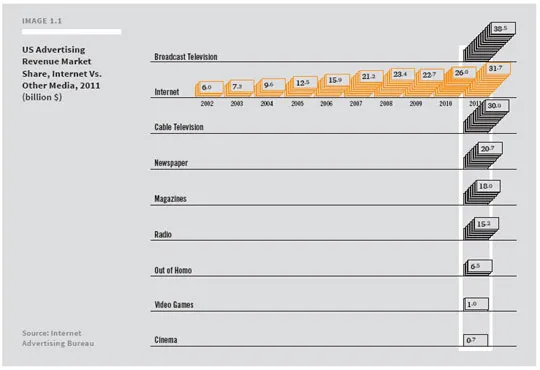
According to the most recent Internet Advertising Revenue Report from the IAB, in the United States, total revenues from internet advertising in 2011 amounted to $31.7 billion, up 22% on 2010.
1.1 Randall Rothenberg, President and CEO of the IAB, noted that the constant increase in digital investment demonstrates that advertisers are increasingly recognising digital’s potential (especially since the arrival of mobile) and are more likely to opt for online to engage users.
Search, display and video offer brands interested in digital significant opportunities, thanks to a marketing mix which is becoming more complex and rich, and therefore potentially more effective.
1.2
#BUDGET #MARKET #INVESTMENTS
And it doesn’t look like margins will settle down in the near future: in fact 90% of investment comes from the top 50 companies in terms of turnover. But even small and medium sized businesses are starting to understand the importance of digital and, after a few experiments, have started to allocate increasingly substantial budgets to online development. In particular the pricing model for digital advertising is moving towards performance parameters, a sign that it’s not just the tools themselves which have improved, but that advertisers are more familiar with the medium, they understand it and are starting to propose more precise and results-linked metrics.
Internet share, in terms of turnover, has exceeded both press and cable television, coming second after digital TV. The US leads the field in terms of online advertising with $154.9 billion spend in 2011, with Japan, China, Germany, the UK, Brazil, France, Australia, Canada and Italy making up the rest of the top 10 for largest investments.
The industries most active in digital are: retail (which represents 23% of total spending on online advertising), telecommunications (14%), financial services (13%) and technology (10%).
The Nielsen Global AdView Pulse report for Q1 2012 confirms that, in spite of worldwide economic problems, the internet grew substantially. Digital adspend increased 12% year on year, the only media to grow in double figures.
But what is the “weighting” of online in overall advertising spend? According to a study by GroupM (part of the WPP Group) published in April 2012, total investments in the internet is set to reach 16% of total spend. Considering how young the medium is the figure is remarkable.
2. From TV to YouTube
Television has always played a very important role in Western countries, particularly Italy where it was television, not printed press or radio, which brought about mass literacy. According to an Istat (Italian National Office of Statistics) study 94% of Italians watched television in 2011. But even for a country as traditional as Italy, habits change quickly. Traditional television hasn’t just abandoned all things analogue; it has also transferred part of its schedule to smartphones and tablets. Television is reinventing itself. In the US many people have transitioned from being passive viewers to active users thanks to connectedtv, interactive screens, on-demand and a permanent internet connection. In this way video formats continue to appeal to both advertisers and consumers.
1.3
#TV #VIDEO #SMARTPHONE
Technological innovation and the evolution of the media distribution landscape has led, according to the Nielsen Economic And Media Outlook of June 2012, to a sea change in the consumption of video content: today watching content on the computer has become just as popular (perhaps even more so) as watching it on the television screen.
So video has found a new lease of life online.
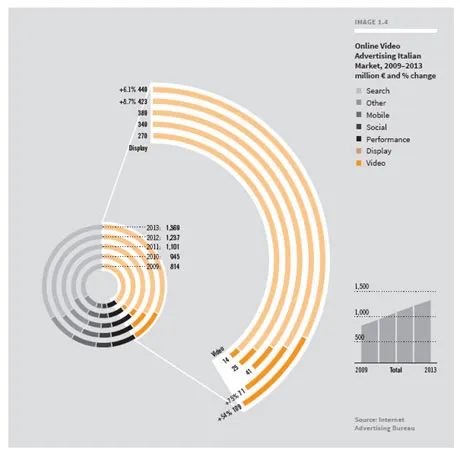
1.4 If when the internet first dawned it was just seen by advertisers as another channel where TV ad spots could be shown it is no longer the case. It has become more separate from television media, finding its unique place, offering interactive solutions which are increasingly different from traditional adverts and metrics which are constantly moving away from simple impressions.
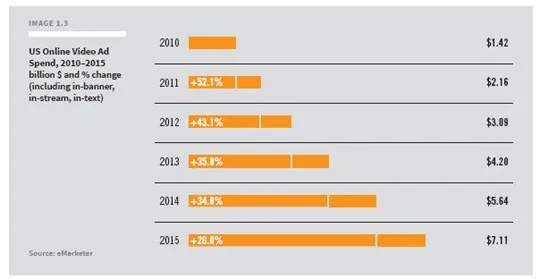
So it’s no surprise that, according to a study published by eMarketer,
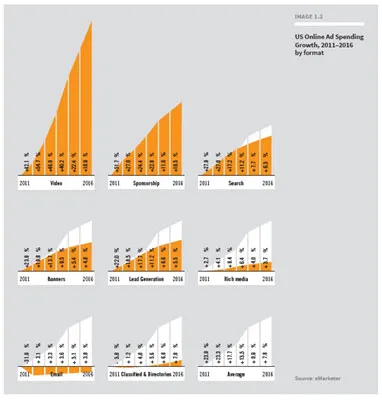
1 growth prospects for online video are impressive: +54.7% in 2012 compared to 2011, +46% in 2013, +40.2% in 2014.
1. marketingcharts.com US Online Ad Spend to Grow 23.3% in 2012
3. The Viral Video Phenomenon
First let’s eradicate any doubts.
There is no such thing as a viral video in absolute terms. A video may be called viral when it manages to rack up a high number of views thanks to word of mouth from one user to another. So, as brilliantly put by the ReelSEO guide - The Social Video Blueprint:
“Where viral video is more of a destination («We did it, we’ve gone viral!») […] Viral is the end product… a video that gets a ton of view has reached viral status”
So going viral, as you will see in more detail over the course of the following chapters, is a mix of creativity (by which we mean not just video content but also choosing titles, tags and categories associated with a video uploaded to YouTube), planning, distribution and promotion.
2
2. smartblogs.com What really makes a video g...
Table of contents
Cover
Title
Copyright
Contents
Introduction
1. The explosion of online video
2. Online Video Advertising
3. Social Video Advertising: Introduction to Jedi techniques
4. The King: Content
5. The Queen: Distribution
6. Advanced techniques and Jedi Tricks
7. Monitoring and results analysis
8. Anatomy of a viral video
9. Audience buying, Is the future already here?
Conclusions
Glossary
Pinterest Board
Webliography
Link index
Index of tag_words
Acknowledgement
Frequently asked questions
Yes, you can cancel anytime from the Subscription tab in your account settings on the Perlego website. Your subscription will stay active until the end of your current billing period. Learn how to cancel your subscription
No, books cannot be downloaded as external files, such as PDFs, for use outside of Perlego. However, you can download books within the Perlego app for offline reading on mobile or tablet. Learn how to download books offline
Perlego offers two plans: Essential and Complete
Essential is ideal for learners and professionals who enjoy exploring a wide range of subjects. Access the Essential Library with 800,000+ trusted titles and best-sellers across business, personal growth, and the humanities. Includes unlimited reading time and Standard Read Aloud voice.
Complete: Perfect for advanced learners and researchers needing full, unrestricted access. Unlock 1.5M+ books across hundreds of subjects, including academic and specialized titles. The Complete Plan also includes advanced features like Premium Read Aloud and Research Assistant.
Both plans are available with monthly, semester, or annual billing cycles.
We are an online textbook subscription service, where you can get access to an entire online library for less than the price of a single book per month. With over 1.5 million books across 990+ topics, we’ve got you covered! Learn about our mission
Look out for the read-aloud symbol on your next book to see if you can listen to it. The read-aloud tool reads text aloud for you, highlighting the text as it is being read. You can pause it, speed it up and slow it down. Learn more about Read Aloud
Yes! You can use the Perlego app on both iOS and Android devices to read anytime, anywhere — even offline. Perfect for commutes or when you’re on the go. Please note we cannot support devices running on iOS 13 and Android 7 or earlier. Learn more about using the app
Yes, you can access Viral Video. Content is king, distribution is queen. Social video advertising: discover the most advanced industry techniques to make a Youtube video go viral by Dario Caiazzo,Andrea Febbraio,Umberto Lisiero in PDF and/or ePUB format, as well as other popular books in Computer Science & Digital Marketing. We have over 1.5 million books available in our catalogue for you to explore.