This compact volume offers a broad selection of the most important documents in American history: the Declaration of Independence, the Constitution, and the Emancipation Proclamation as well as presidential speeches, Supreme Court decisions, Acts and Declarations of Congress, essays, letters, and much more.
The compilation of more than 150 documents, dating from 1606 to 1865, starts with the First Charter of Virginia, issued by King James I, and concludes with the abolition of slavery, as stated in the Thirteenth Amendment to the Constitution. Many of the selections recapture the voices of great Americans, from Powhatan's speech to Captain John Smith at Jamestown and the Pilgrims' Mayflower Compact to Benjamin Franklin's Plan of Union, Tecumseh's address to the Choctaws and Chickasaws, Frederick Douglass' "What to the Slave Is the Fourth of July?", and several orations by Abraham Lincoln. Brief introductions to each document place the works in historical context.
eBook - ePub
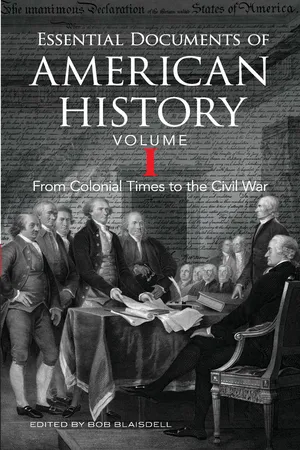
Essential Documents of American History, Volume I
From Colonial Times to the Civil War
- 528 pages
- English
- ePUB (mobile friendly)
- Available on iOS & Android
eBook - ePub
About this book
Information
President George Washington, First Inaugural Address
April 30, 1789
Under the framework of the new Constitution, the first Congress was scheduled to convene in New York on March 4, 1789, but it wasn’t until April 5th that enough members were present to comprise a quorum in both the House and Senate. The following day the electoral votes for president were counted. There were no candidates for the office other than George Washington, and no other name received a single vote; at the same time, John Adams was designated the first vice president. Charles Thomson, secretary of Congress, was dispatched to Mount Vernon to notify Washington officially of his election, arriving there on April 14th. Washington left two days later for New York, reaching the city on April 23rd. His progress north from Virginia to take office was marked by continuous fanfare and ceremony; but nothing could match the final leg of the journey, when he was rowed on a barge from Elizabethtown, New Jersey, to Murray’s Wharf at the foot of New York’s Wall Street by a contingent of thirteen sailors—one for each state—and saluted as they passed scores of other boats and ships in the harbor. Arriving in New York, the president-elect was greeted by New York’s governor George Clinton and other dignitaries, and proceeded to the Franklin House on Cherry Street, which would be his official residence during his first administration.
On April 30, 1789, Washington took the oath of office as prescribed by the Constitution. It was administered by New York State chancellor Robert Livingston, Chief Justice of the New York Judiciary, on the balcony of Federal Hall, not far from where the Ward statue of Washington still stands. The first president then entered the building, and in a low and nervous voice read the new Congress his brief inaugural address. One of those present later commented, “The great man was agitated and embarrassed more than ever he was by the loaded cannon or pointed musket.”
– Note by John Grafton
FELLOW-CITIZENS OF the Senate and of the House of Representatives:
Among the vicissitudes incident to life no event could have filled me with greater anxieties than that of which the notification was transmitted by your order, and received on the 14th day of the present month. On the one hand, I was summoned by my country, whose voice I can never hear but with veneration and love, from a retreat which I had chosen with the fondest predilection, and, in my flattering hopes, with an immutable decision, as the asylum of my declining years—a retreat which was rendered every day more necessary as well as more dear to me by the addition of habit to inclination, and of frequent interruptions in my health to the gradual waste committed on it by time. On the other hand, the magnitude and difficulty of the trust to which the voice of my country called me, being sufficient to awaken in the wisest and most experienced of her citizens a distrustful scrutiny into his qualifications, could not but overwhelm with despondence one who (inheriting inferior endowments from nature and unpracticed in the duties of civil administration) ought to be peculiarly conscious of his own deficiencies. In this conflict of emotions all I dare aver is that it has been my faithful study to collect my duty from a just appreciation of every circumstance by which it might be affected. All I dare hope is that if, in executing this task, I have been too much swayed by a grateful remembrance of former instances, or by an affectionate sensibility to this transcendent proof of the confidence of my fellow-citizens, and have thence too little consulted my incapacity as well as disinclination for the weighty and untried cares before me, my error will be palliated by the motives which mislead me, and its consequences be judged by my country with some share of the partiality in which they originated. Such being the impressions under which I have, in obedience to the public summons, repaired to the present station, it would be peculiarly improper to omit in this first official act my fervent supplications to that Almighty Being who rules over the universe, who presides in the councils of nations, and whose providential aids can supply every human defect, that His benediction may consecrate to the liberties and happiness of the people of the United States a Government instituted by themselves for these essential purposes, and may enable every instrument employed in its administration to execute with success the functions allotted to his charge. ... No people can be bound to acknowledge and adore the Invisible Hand which conducts the affairs of men more than those of the United States. Every step by which they have advanced to the character of an independent nation seems to have been distinguished by some token of providential agency; and in the important revolution just accomplished in the system of their united government the tranquil deliberations and voluntary consent of so many distinct communities from which the event has resulted can not be compared with the means by which most governments have been established without some return of pious gratitude, along with an humble anticipation of the future blessings which the past seem to presage. ...
By the article establishing the executive department it is made the duty of the President “to recommend to your consideration such measures as he shall judge necessary and expedient.” The circumstances under which I now meet you will acquit me from entering into that subject further than to refer to the great constitutional charter under which you are assembled, and which, in defining your powers, designates the objects to which your attention is to be given. It will be more consistent with those circumstances, and far more congenial with the feelings which actuate me, to substitute, in place of a recommendation of particular measures, the tribute that is due to the talents, the rectitude, and the patriotism which adorn the characters selected to devise and adopt them. In these honorable qualifications I behold the surest pledges that as on one side no local prejudices or attachments, no separate views nor party animosities, will misdirect the comprehensive and equal eye which ought to watch over this great assemblage of communities and interests, so, on another, that the foundation of our national policy will be laid in the pure and immutable principles of private morality, and the preeminence of free government be exemplified by all the attributes which can win the affections of its citizens and command the respect of the world. I dwell on this prospect with every satisfaction which an ardent love for my country can inspire, since there is no truth more thoroughly established than that there exists in the economy and course of nature an indissoluble union between virtue and happiness; between duty and advantage; between the genuine maxims of an honest and magnanimous policy and the solid rewards of public prosperity and felicity; since we ought to be no less persuaded that the propitious smiles of Heaven can never be expected on a nation that disregards the eternal rules of order and right which Heaven itself has ordained; and since the preservation of the sacred fire of liberty and the destiny of the republican model of government are justly considered, perhaps, as deeply, as finally, staked on the experiment entrusted to the hands of the American people.
Besides the ordinary objects submitted to your care, it will remain with your judgment to decide how far an exercise of the occasional power delegated by the fifth article of the Constitution is rendered expedient at the present juncture by the nature of objections which have been urged against the system, or by the degree of inquietude which has given birth to them. ...
To the foregoing observations I have one to add, which will be most properly addressed to the House of Representatives. It concerns myself, and will therefore be as brief as possible. When I was first honored with a call into the service of my country, then on the eve of an arduous struggle for its liberties, the light in which I contemplated my duty required that I should renounce every pecuniary compensation. From this resolution I have in no instance departed; and being still under the impressions which produced it, I must decline as inapplicable to myself any share in the personal emoluments which may be indispensably included in a permanent provision for the executive department, and must accordingly pray that the pecuniary estimates for the station in which I am placed may during my continuance in it be limited to such actual expenditures as the public good may be thought to require.
Having thus imparted to you my sentiments as they have been awakened by the occasion which brings us together, I shall take my present leave; but not without resorting once more to the benign Parent of the Human Race in humble supplication that, since He has been pleased to favor the American people with opportunities for deliberating in perfect tranquility, and dispositions for deciding with unparalleled unanimity on a form of government for the security of their union and the advancement of their happiness, so His divine blessing may be equally conspicuous in the enlarged views, the temperate consultations, and the wise measures on which the success of this Government must depend.
[DI]
Secretary of the Treasury Alexander Hamilton, Report on the Subject of a National Bank
December 13, 1790
Hamilton’s state papers are the measure by which the value of all subsequent efforts on the same subject is estimated. The law establishing the bank did not differ from Hamilton’s plan in any essentials, except that the life of the bank was limited to twenty years.
– Note by Albert Bushnell Hart
[…] THE ESTABLISHMENT OF banks in this country seems to be recommended by reasons of a peculiar nature. Previously to the revolution, circulation was in a great measure carried on by paper emitted by the several local governments. […] This auxiliary may be said to be now at an end. And it is generally supposed, that there has been for some time past, a deficiency of circulating medium. ...
If the supposition of such a deficiency be in any degree founded, and some aid to circulation be desirable, it remains to inquire what ought to be the nature of that aid.
The emitting of paper money by the authority of government, is wisely prohibited to the individual states, by the national constitution; and the spirit of that prohibition ought not be disregarded by the government of the United States. [….]
Among other material differences between a paper currency, issued by the mere authority of government, and one issued by a bank, payable in coin, is this: that in the first case, there is no standard to which an appeal can be made, as to the quantity which will only satisfy, or which will surcharge the circulation; in the last, that standard results from the demand. If more should be issued than is necessary, it will return upon the bank. Its emissions […] must always be in a compound ratio to the fund and the demand:—Whence it is evident, that there is a limitation in the nature of the thing; while the discretion of the government is the only measure of the extent of the emissions, by its own authority. […]
The payment of the interest of the public debt, at thirteen different places, is a weighty reason, peculiar to our immediate situation, for desiring a bank circulation. Without a paper, in general currency, equivalent to gold and silver, a considerable proportion of the specie of the country must always be suspended from circulation, and left to accumulate, preparatory to each day of payment; and as often as one approaches, there must in several cases be an actual transportation of the metals at both expense and risk, from their natural and proper reservoirs, to distant places. […]
Assuming it then as a consequence, from what has been said, that a national bank is a desirable institution, two inquiries emerge—is there no such institution, already in being, which has a claim to that character, and which supersedes the propriety or necessity of another? If there be none, what are the principles upon which one ought to be established?
There are at present three banks in the United States: that of North-America, established in the city of Philadelphia; that of New-York, established in the city of New-York; that of Massachusetts, established in the town of Boston. Of these three, the first is the only one which has at any time had a direct relation to the government of the United States. […]
The directors of this bank, on behalf of their constituents, have since accepted and acted under a new charter from the state of Pennsylvania, materially variant from their original one; and which so narrows the foundation of the institution, as to render it an incompetent basis for the extensive purposes of a national bank. […]
The order of the subject, leads next to the inquiry into the principles upon which a national bank ought to be organized.
The situation of the United States naturally inspires a wish that the form of the institution could admit of a plurality of branches. But various considerations discourage from pursuing this idea. [...]
Another wish, dictated by the particular situation of the country, is, that the bank could be so constituted as to be made an immediate instrument of loans to the proprietors of land; but this wish also yields to the difficulty of accomplishing it. Land is alone an unfit fund for a bank circulation. If the notes issued upon it were not to be payable in coin, on demand, or at a short date, this would amount to nothing more than a repetition of the paper emissions, which are now exploded by the general voice. If the notes are to be payable in coin, the land must first be converted into it, by sale or mortgage. The difficulty of effecting the latter, is the very thing which begets the desire of finding another resource; and the former would not be practicable on a sudden emergency, but with sacrifices which would make the cure worse than the disease. Neither is the idea of constituting the fund partly of coin and partly of land, free from impediments. These two species of property do not, for the most part, unite in the same hands. […]
Considerations of public advantage suggest a further wish, which is, that the bank could be established upon principles that would cause the profits of it to redound to the immediate benefit of the state. This is contemplated by many who speak of a national bank, but the idea seems liable to insuperable objections....
Table of contents
- Cover
- Title Page
- Copyright Page
- Contents
- Colonial America
- The Fight for Independence
- The Early Republic and the Constitution
- The New Nation
- Source and Author Guide
- Bibliography
Trusted by 375,005 students
Access to over 1.5 million titles for a fair monthly price.
Study more efficiently using our study tools.
Frequently asked questions
Yes, you can cancel anytime from the Subscription tab in your account settings on the Perlego website. Your subscription will stay active until the end of your current billing period. Learn how to cancel your subscription
No, books cannot be downloaded as external files, such as PDFs, for use outside of Perlego. However, you can download books within the Perlego app for offline reading on mobile or tablet. Learn how to download books offline
Perlego offers two plans: Essential and Complete
- Essential is ideal for learners and professionals who enjoy exploring a wide range of subjects. Access the Essential Library with 800,000+ trusted titles and best-sellers across business, personal growth, and the humanities. Includes unlimited reading time and Standard Read Aloud voice.
- Complete: Perfect for advanced learners and researchers needing full, unrestricted access. Unlock 1.5M+ books across hundreds of subjects, including academic and specialized titles. The Complete Plan also includes advanced features like Premium Read Aloud and Research Assistant.
We are an online textbook subscription service, where you can get access to an entire online library for less than the price of a single book per month. With over 1.5 million books across 990+ topics, we’ve got you covered! Learn about our mission
Look out for the read-aloud symbol on your next book to see if you can listen to it. The read-aloud tool reads text aloud for you, highlighting the text as it is being read. You can pause it, speed it up and slow it down. Learn more about Read Aloud
Yes! You can use the Perlego app on both iOS and Android devices to read anytime, anywhere — even offline. Perfect for commutes or when you’re on the go.
Please note we cannot support devices running on iOS 13 and Android 7 or earlier. Learn more about using the app
Please note we cannot support devices running on iOS 13 and Android 7 or earlier. Learn more about using the app
Yes, you can access Essential Documents of American History, Volume I by Bob Blaisdell in PDF and/or ePUB format, as well as other popular books in History & Early American History. We have over 1.5 million books available in our catalogue for you to explore.