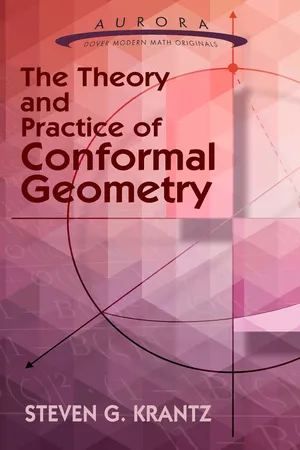
In this original text, prolific mathematics author Steven G. Krantz addresses conformal geometry, a subject that has occupied him for four decades and for which he helped to develop some of the modern theory. This book takes readers with a basic grounding in complex variable theory to the forefront of some of the current approaches to the topic. "Along the way," the author notes in his Preface, "the reader will be exposed to some beautiful function theory and also some of the rudiments of geometry and analysis that make this subject so vibrant and lively."
More up-to-date and accessible to advanced undergraduates than most of the other books available in this specific field, the treatment discusses the history of this active and popular branch of mathematics as well as recent developments. Topics include the Riemann mapping theorem, invariant metrics, normal families, automorphism groups, the Schwarz lemma, harmonic measure, extremal length, analytic capacity, and invariant geometry. A helpful Bibliography and Index complete the text.
- 304 pages
- English
- ePUB (mobile friendly)
- Available on iOS & Android
eBook - ePub
The Theory and Practice of Conformal Geometry
About this book
Information
Subtopic
GeometryIndex
MathematicsChapter 1
The Riemann Mapping Theorem
Prologue: There is hardly a more profound theorem from nineteenth century complex analysis than the Riemann Mapping theorem. Even to conceive of such a theorem is virtually miraculous. Although Riemann’s original proof was flawed, it pointed in the right direction. Certainly a great deal of modern complex function theory has been inspired by the Riemann Mapping theorem (RMT).
Throughout this book, we shall use the term domain to mean a connected, open set. While the Riemann Mapping theorem gives us a complex-analytic classification of simply connected planar domains, a theory (in fact several theories) has developed for multiply connected domains. This includes the Ahlfors map, the canonical representation, and the uniformization theorem. We treat all of these in the present chapter. Although we do not treat the topic here, Riemann surface theory is an outgrowth of the study of conformal mappings.
Perhaps the most important modern concept in this circle of ideas is Teichmüller theory, which creates a moduli space for Riemann surfaces. It is beyond the scope of the present book, but it provides a pointer for further reading.
1.0Introduction
Capsule: It is natural to think of the Riemann Mapping theorem in the context of simply connected domains. However, from the point of view of analysis, it is more convenient to have a different formulation of the topological condition. In this section we introduce the notion of holomorphic simple connectivity: A domain U is holomorphically simply connected if any holomorphic function on U has a holomorphic antiderivative.
It is easy to verify that any topologically simply connected domain is holomorphically simply connected. So we certainly suffer no loss of generality to use this substitute idea. It also streamlines our treatment.
In thinking about the topology of the plane, it is natural to ask which planar open sets are homeomorphic to the open unit disc. The startling answer is that the Riemann Mapping theorem tells us that any connected, simply connected open set (except the plane) is not only homeomorphic to the disc but conformally equivalent to the disc. One can verify separately, by hand, that the entire plane is also homeomorphic to the disc (but certainly not conformally equivalent).
Riemann’s astonishing theorem has many different proofs, and we shall consider some of them here. Some of the proofs are “existence proofs,” and some constructive. Some are geometric and some are analytic. The book [BIS] covers ideas connected to the Riemann Mapping theorem comprehensively.
We end this section with a formal enunciation of the Riemann mapping theorem:
Theorem (RMT):...
Table of contents
- Cover
- Title Page
- Copyright Page
- Contents
- Preface
- 1 The Riemann Mapping Theorem
- 2 Invariant Metrics
- 3 Normal Families
- 4 Automorphism Groups
- 5 The Schwarz Lemma
- 6 Harmonic Measure
- 7 Extremal Length
- 8 Analytic Capacity
- 9 Invariant Geometry
- 10 A New Look at the Schwarz Lemma
- Bibliography
- Index
Trusted by 375,005 students
Access to over 1.5 million titles for a fair monthly price.
Study more efficiently using our study tools.
Frequently asked questions
Yes, you can cancel anytime from the Subscription tab in your account settings on the Perlego website. Your subscription will stay active until the end of your current billing period. Learn how to cancel your subscription
No, books cannot be downloaded as external files, such as PDFs, for use outside of Perlego. However, you can download books within the Perlego app for offline reading on mobile or tablet. Learn how to download books offline
Perlego offers two plans: Essential and Complete
- Essential is ideal for learners and professionals who enjoy exploring a wide range of subjects. Access the Essential Library with 800,000+ trusted titles and best-sellers across business, personal growth, and the humanities. Includes unlimited reading time and Standard Read Aloud voice.
- Complete: Perfect for advanced learners and researchers needing full, unrestricted access. Unlock 1.5M+ books across hundreds of subjects, including academic and specialized titles. The Complete Plan also includes advanced features like Premium Read Aloud and Research Assistant.
We are an online textbook subscription service, where you can get access to an entire online library for less than the price of a single book per month. With over 1.5 million books across 990+ topics, we’ve got you covered! Learn about our mission
Look out for the read-aloud symbol on your next book to see if you can listen to it. The read-aloud tool reads text aloud for you, highlighting the text as it is being read. You can pause it, speed it up and slow it down. Learn more about Read Aloud
Yes! You can use the Perlego app on both iOS and Android devices to read anytime, anywhere — even offline. Perfect for commutes or when you’re on the go.
Please note we cannot support devices running on iOS 13 and Android 7 or earlier. Learn more about using the app
Please note we cannot support devices running on iOS 13 and Android 7 or earlier. Learn more about using the app
Yes, you can access The Theory and Practice of Conformal Geometry by Steven G. Krantz in PDF and/or ePUB format, as well as other popular books in Mathematics & Geometry. We have over 1.5 million books available in our catalogue for you to explore.