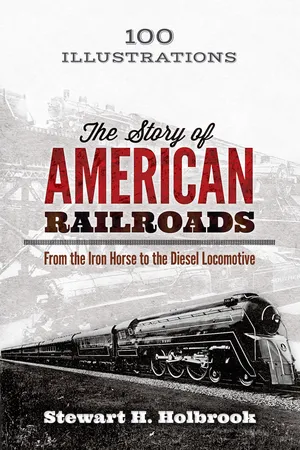
This richly comprehensive history by a self-proclaimed "low-brow" historian features more than 100 photographs and contemporary prints of America's railway system. Stewart H. Holbrook presents a dramatic, highly readable chronicle of the development of the backbone of the country's commerce and industry. Abounding in episodes of ingenuity and achievement, the growth of the railway system required constant improvements in techniques, devices, and machines, from the first wood burner that traveled on wooden rails to modern streamliners and diesel-powered giants.
In addition to technological innovations, the colossal enterprise required courage and resolve to battle challenges posed by nature as well as by political maneuvering and corruption. This fascinating survey draws upon many hitherto unknown original sources and new data, in addition to firsthand accounts from hundreds of brakemen, conductors, engineers, and other railroad employees. Sound and authoritative, it constitutes a definitive history of America's railroads.
eBook - ePub
The Story of American Railroads
From the Iron Horse to the Diesel Locomotive
- 528 pages
- English
- ePUB (mobile friendly)
- Available on iOS & Android
eBook - ePub
About this book
Information
CHAPTER I
Panorama
FOR a time in my boyhood I lived on a farm within sound of the Grand Trunk Railway, and went to school in the town of North Stratford, a junction with the Maine Central. The Grand Trunk was not the first railroad I can remember, but it was the one that appealed most powerfully to me, that stirred my imagination beyond compare. Not before and surely never since have I heard the like of the whistle of a Grand Trunk mogul as it moaned up from deep in the forest we called the ’Hegan Woods and came wafting on frosty waves through the brittle air of a December in northern Vermont.
To me those moguls were gigantic locomotives. I firmly believed them to be the largest locomotives on earth, and so did all other boys of the town. They hauled the long freights between Portland and Montreal, and commonly stopped at North Stratford for water. There, on a grade crossing in the very center of the village, one of them stood at dusk every winter night, holding up what town traffic there was while we boys stood to watch the great black monster with its trimmings of ice that told of bitter weather, and listen fascinated to its breathing.
We knew, of course, that this breathing of the locomotive was really some sort of pump that had to do with the airbrakes, but we never thought of it that way, for an engine to a boy of my time was not a machine at all but a living animal, perhaps some species of mastodon, in any case an animal that had lungs and breathed. To us that nervous panting—that pampah, pam-pah—now slow and even, now hurried, was coming direct from the body and soul of the locomotive, as sentient as any human and twice as wonderful. The engine, you understand, was panting, resting, as a dog rests and pants, gathering strength for the heavy pull ahead, which it knew very well would begin as soon as it had crossed the Connecticut River and started the rugged haul up the valley of the Nulhegan to Island Pond.
Up the ’Hegan valley I’ve sat in a sleigh and watched, completely spellbound, while one of those vast trains of freight cars came thundering by on its way to Canada. The locomotives must have had exceptionally good headlamps for the era, for I recall that a shaft of light lit up the tracks at Hobson’s Mills for what seemed to me a mile or more in advance of the engine. Along with the first glimmer of brilliance came the first rumblings of the heavy train; and soon the very woods, all dark and mysterious and rather sinister outside of that shaft of yellow light—soon the very woods began to tremble and were filled with the rolling thunder of the railroad in action. Then, for a moment that was never quite long enough, the mogul pounded up and past in clouds of steam and smoke, a glow of hellish fire lighting the interior of the cab, where the shadow of the fireman moved against the glow, a silhouetted imp of the Pit, with the endless cars coming along behind bringing the hypnotic rhythm of their clatter.
There was a grade crossing ahead, at the Mills, and the warning that welled up from the dome of the mogul was a warning to all human beings in the ’Hegan Woods, alive or dead, to all animals wild and domestic, to the fishes in the frozen muttering streams, to the birds in the balsams and the owls awing, and to the frightened souls of all Indians who had used this route for a highway before ties and rails had been laid upon it.
The Grand Trunk engines possessed whistles built by a master who was a combination of Thor himself and some brilliant esthete, for he perfected an art form fitted wonderfully to that northern clime and splintery air where an obbligato was supplied by the crackling of Aurora Borealis. The steam shot quickly up from the big round dome on the mogul’s heaving back, then a blast of mighty noise shattered the woods and the night, a trump to shame all horn players since Gabriel, to tell the loggers all over Brighton township that the Fast Freight was going through. Yes, sir, that was her. . . . It was a blast to roll on and on over the timbered hills, over the blueberry swamps, over the stark white fields, to inform farmers in Bloomfield and Brunswick, even in Lemington and Canaan, before the echo had worn itself out, that the Grand Trunk was making the ’Hegan Woods with a full head of steam and would soon be over the hump, to drift easily downgrade along St. Lawrence waters. . . .
It was said of these locomotives and trains, and even the timetables cited the fact, that they went either to Montreal on the north, or south to Portland. But we boys knew better than that. They went, we were certain, to a magic and wholly wondrous land for which we had no name, and once there they never stopped rolling. True, they might pause now and again, in the manner of locomotives, for fuel and water, when they would rest briefly and pant. But they never would come to the end of the track. There was no end. The rails, we knew, led on into Canada, reputed to be a big enough country, then on through Canada and to God knew where, the engines whistling at intervals, ringing the bell at intervals, smoking, steaming, pounding, rolling, rolling on to the end of time and the edge of the world. . . .
As I say, we boys did not have a name for that magic country to which all passing trains went. But some of my boyhood friends resolved to see that land and learn its name. So, a bit later they went to work for the railroad, some on the Grand Trunk, some on other lines. Forty years later, which was just the other day, I talked to one who had set out in youth to find the land to which all passing trains went—or, rather, used to go. Gold stripes and stars marched up his blue serge from cuff to elbow. “Yes,” he said, “I found out where the place is, though I never got there.”
“You know,” continued this veteran of forty years on the rails, “you know, when you and I were kids, boys did not go to work on the railroad simply because their fathers did. What fetched them were the sights and sounds of moving trains, and above all the whistle of a locomotive. I’ve heard of the call of the wild, the call of the law, the call of the church. There is also the call of the railroad—or there used to be in our day. It was the echo of a mogul whistle in these same old ’Hegan Woods that made me a railroadman for life.”
We talked some more, this veteran and I, and although he never quite put it into so many words, I understood him well enough; he was telling me that the country where passing trains go is just beyond Oz, where the Round River flows through a notch in the Big Rock Candy Mountains.
If railroads created a dreamworld for boys of my generation, and they most certainly did, it was merely incidental. The main achievement of the railroads was to help enormously to build the United States into a world power and do it well within the span of one man’s lifetime. Historians know it, too, though because of the stiff if genteel conventions of their craft most of them have continued for a hundred years to write about our armies and navies and sonorous statesmen, with here and there guarded references to mysterious Economic Factors and forces which, stemming as they do straight from either Heaven or Hell, are amenable to no control by man, be he Democrat, Socialist, or Republican.
I realize as well as any man, and glory in it too, that the smoke that clouded the pretty green at Lexington was important. So were the clouds of burning powder that hung above Gettysburg. Both were freighted with destiny. But neither is more a true symbol of the United States than the plume of white smoke that streamed out behind the first doubleheader to plow up and over the Rockies carrying the first rail-borne goods and passengers from the Atlantic seaboard to the Pacific shore. The whole great empire of the American West was riding that train of cars.
By turns the railroad was to bedevil and bewilder America. In one of his essays Herbert Spencer, an Englishman who meant more to the United States than to his native land and who thoroughly believed in Steam, said that a volume would be required simply to trace through all of its ramifications the effects contingent upon the act of lighting a fire. These effects, he vowed, were infinite though imperceptible. The effects upon the United States of steam, which comes from water heated over a fire, are also infinite, but most of them are easily perceptible.
For one thing, steam locomotion in the United States harmed one region to build up another. The forces of nature meant little to it. It overcame wind and tide. It abolished the Mississippi River, until then a gigantic fact. It abolished those fearful reaches of the interior that cartographers labeled Great American Desert. All that even the Rockies meant to steam locomotion was merely a little more fire under the boiler.
Steam turned out to be capricious. It proved to be as much a master of what Americans called their Destiny as it was its slave. It carried the individual wherever he would go; and it carried away whole communities who did not want to go anywhere at all. Either that, or it buried them where they were. The railroad made bright green grass to grow in the once busy streets of Nantucket, Salem, and Charleston. It stole, openly and arrogantly, from New Orleans that monopoly of wealth which the Mississippi once promised to pour into her lap. Up in the hills of Vermont and New Hampshire, pine and spruce started to creep across the fields and pastures of deserted farms, to surround even the barns and houses and to strangle them—all because of steam locomotion. By 1880, at the latest, the home of one of my forebears, cleared and built by enormous effort before 1800, was marked by a lonely chimney, slowly crumbling into bright red ruins amid green forest, beside a melancholy hole in the ground, while an apple tree and a bush of lavender struggled for life in what had been the yard. It was only one of hundreds like it.
Steam locomotion was filled with wayward fancies. For some mysterious reason that only professors of economics pretend to understand, it carried wealth and importance past one place to lay them down at another. It passed Oswego, Dunkirk, Sandusky, and Fort Wayne to build a gigantic city at the foot of Lake Michigan. It picked the most impossible building site in California and conjured up San Francisco on the spot. It whistled past old and important places like Fort Vancouver, Tumwater, and Nisqually and made secondary hamlets like Portland and Seattle into cities.
There was no telling what steam would do, and many a fortune was made or lost because of its perversity. Before men realized what was going on, steam had moved the center of population from near the Atlantic seaboard to a point that existed in the school books of the same generation only as deep wilderness. More than one pioneer related, in no more than his middle years, how the last Indian whoop and the last sad cadence of the owl had died in the echo of the first locomotive. Wilderness one year, metropolis the next. It constantly astonished those who had been through it, to their last day, as well it might.
Wherever and whenever the railroad came, the change was often swift to dizziness. As a young fur trader, Gurdon Saltonstall Hubbard climbed an oak tree in a dismal swamp to get his first look at Fort Dearborn, a miserable collection of hovels. A little more than two decades later, he liked to be shaved in the elegant barber shop of the great and gaudy Palmer House, on almost the same spot.
Minneapolis, Portland, and Seattle grew up so rapidly they left the map makers a full ten years, perhaps twenty years, in the rear; while all along the two thousand miles separating those places there grew up one, then two, then three lines of continuous civilization, bolstered on each side by rectangular townships devoted to growing wheat, mining copper, cutting timber—now that wheat, copper, and lumber could be taken to market. “All that land,” said a congressman referring to the entire American West, “wasn’t worth ten cents until the railroads came.”
It was the same everywhere in the country. Following the Civil War the United States started to build so rapidly, so madly, and continued to the end of the century in such a frenzy of exploitation, that it might have wrecked itself had it not been for the railroad. The country did crack several times, but it never quite blew up, or collapsed, and the reason it not only survived but prospered in wealth, in population, and in power was the railroad. Charles Francis Adams, our great philosopher of railroads, said it. “The simple truth was,” he wrote, “that through its energetic railroad development, the country was then producing real wealth as no country ever produced it before. Behind all the artificial inflation which . . . so clearly foreshadowed a catastrophe, there was also going on a production that exceeded all experience.”
The new element of the railroad, Adams believed, did away with the best of reasoned conclusions. Acting upon undeveloped and almost inexhaustible natural resources, it dragged the country through its difficulties in spite of itself—as if all the fraud, the ignorance, and speculation that greedy men could think up and practice were quite unable, because of the railroad, to precipitate disaster. Every mile of steel laid was quietly adding many times its cost to the aggregate wealth of the country.
What maddened Adams was the “complacency with which a certain class of philosophers mistook the operation of a great, quiet natural force for the results of their own meddling.” One school of these professors, he said, attributed the freedom from commercial disaster to their jugglings with paper money. Another clique saw in the great prosperity of the day nothing but a vindication of their own meddling with the tariff. “While socialists talked, however,” cried Adams, “the locomotive was at work, and all the obstructions which they placed in its way could at most only check but never overcome the impetus it had given to material progress. . . .*
Although Mr. Adams did not say so, the building of the American railroad system was one of the greatest dramas of modern times. Unlike the Republic itself, whose founding can be dated well enough for all practical and symbolic purposes as of July 4, 1776, the American railroad system cannot be said to have a birthday. For many years it existed only in the minds of a few visionaries who, try as they did, could make little impression on the great mass of Americans, just then charmed by the wonders of canals. The greatest of these visionaries, or prophets, was an odd genius named Oliver Evans who soon after the Revolution petitioned at least two legislatures for exclusive rights to use what he termed his “improvements in steam carriages” in their states.
A few other prophets were stirring, among them John Stevens of Hoboken, who built a miniature locomotive, which he ran around on a track in the yard of his home. The states of New Jersey and Pennsylvania good-naturedly granted Stevens the charters he wanted, which proposed to build a railroad across those states. Stevens was a veteran of the Revolution, hence they humored him, knowing nothing would come of his aberrations. And nothing did, though the noise he made did prompt a group of Pennsylvanians to send William Strickland to England to learn what he could about the new steam railways there.
England had taken to the steam engine, especially in its locomotive form, with a readiness that seems to have been lacking in America. News of the first English railroads came across the sea, and Strickland and other Americans had seen with their own eyes what was going on. Like an imported virus, the idea at last began to function in American port towns. In 1827 a group of citizens incorporated the Baltimore & Ohio Rail Road Company, and a bit later prevailed on old Charles Carroll, sole surviving Signer of the Declaration, to lean on a spade and turn a sod, while a band played and cannon boomed. In quick succession other railroad companies were organized in New York, Philadelphia, and Charleston.
Boston already had a railroad of a sort, three mile...
Table of contents
- Cover
- Title Page
- Copyright Page
- Dedication
- Contents
- Illustrations
- Acknowledgment
- 1. Panorama
- 2. The Prophets
- 3. Primeval Railroading
- 4. Railroad Fever
- 5. “The Work of the Age”
- 6. Forgotten Genius
- 7. The Pennsy and the Central
- 8. The art of Colonization
- 9. Hoosiers Start a Railroad—THE MONON
- 10. War Comes to a “Neutral” Line
- 11. The Big Junction
- 12. The Rebel Route’s Abraham Lincoln
- 13. Land—Uncle Sam’s Alternate Sections
- 14. The First Transcontinental
- 15. Jim Hill’s Empire
- 16. Locating the Route
- 17. The saga of Stampede Pass
- 18. Out in the Wild and Woolly
- 19. Up in the Cold and Icy
- 20. The Carriers are Harassed
- 21. Times of Trouble
- 22. Through the dark Ages—and After
- 23. Moments of Disaster
- 24. The Airbrake Fanatic
- 25. The Rise of the Railway Express
- 26. The Fast Mail
- 27. The Story of the Sleeping Car
- 28. The life Of The Pullman Porter
- 29. Spotters
- 30. First Transcontinental Trip
- 31. Time and the Railroads
- 32. The Little Fellers
- 33. Robbing the Steam Cars
- 34. Riders of the Rods and the Blinds
- 35. News Butchers
- 36. The Biography of a Flagstop
- 37. The Railroad in the Drama
- 38. Ballads of the Rails
- 39. The Second Century
- A Railroad Almanac
- Bibliography
- Index
Trusted by 375,005 students
Access to over 1.5 million titles for a fair monthly price.
Study more efficiently using our study tools.
Frequently asked questions
Yes, you can cancel anytime from the Subscription tab in your account settings on the Perlego website. Your subscription will stay active until the end of your current billing period. Learn how to cancel your subscription
No, books cannot be downloaded as external files, such as PDFs, for use outside of Perlego. However, you can download books within the Perlego app for offline reading on mobile or tablet. Learn how to download books offline
Perlego offers two plans: Essential and Complete
- Essential is ideal for learners and professionals who enjoy exploring a wide range of subjects. Access the Essential Library with 800,000+ trusted titles and best-sellers across business, personal growth, and the humanities. Includes unlimited reading time and Standard Read Aloud voice.
- Complete: Perfect for advanced learners and researchers needing full, unrestricted access. Unlock 1.5M+ books across hundreds of subjects, including academic and specialized titles. The Complete Plan also includes advanced features like Premium Read Aloud and Research Assistant.
We are an online textbook subscription service, where you can get access to an entire online library for less than the price of a single book per month. With over 1.5 million books across 990+ topics, we’ve got you covered! Learn about our mission
Look out for the read-aloud symbol on your next book to see if you can listen to it. The read-aloud tool reads text aloud for you, highlighting the text as it is being read. You can pause it, speed it up and slow it down. Learn more about Read Aloud
Yes! You can use the Perlego app on both iOS and Android devices to read anytime, anywhere — even offline. Perfect for commutes or when you’re on the go.
Please note we cannot support devices running on iOS 13 and Android 7 or earlier. Learn more about using the app
Please note we cannot support devices running on iOS 13 and Android 7 or earlier. Learn more about using the app
Yes, you can access The Story of American Railroads by Stewart H. Holbrook in PDF and/or ePUB format, as well as other popular books in History & North American History. We have over 1.5 million books available in our catalogue for you to explore.