"Alfredo Alcala is one of the most disciplined and perceptive artists inking in comics. The years of distinguished work have earned Alfredo a special place in comics history." — Gil Kane.
In the late 1960s, an extremely talented group of Filipino illustrators took the American comic book industry by storm — and the late Alfredo Alcala led the way, working for both Marvel and DC on such popular characters as Conan the Barbarian and Batman. This unique work is loaded with amazing art and pointers on observational methods, composition, and other techniques. In addition to insightful interviews with Alcala, the book features pages from his groundbreaking masterwork, Voltar, which was hailed as a new concept in comic book form, an epic in narrative art, and a milestone in sequential art illustration. Students, professionals, teachers, and fans will treasure this inspiring volume and its insider's look at comic book artistry.
"A wonderful look at the thought process of one of the best artist/inkers in comic book history and should be read, not just by comic book fans, but by anyone who appreciates great art." — Rushford Public Library
eBook - ePub
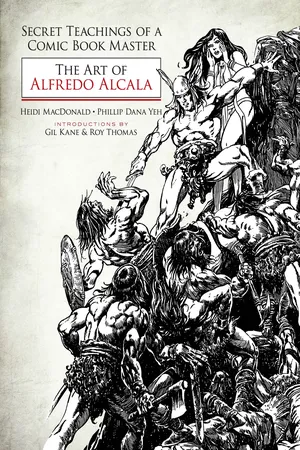
Secret Teachings of a Comic Book Master
The Art of Alfredo Alcala
- 80 pages
- English
- ePUB (mobile friendly)
- Available on iOS & Android
eBook - ePub
About this book
Information
The Art of Observation
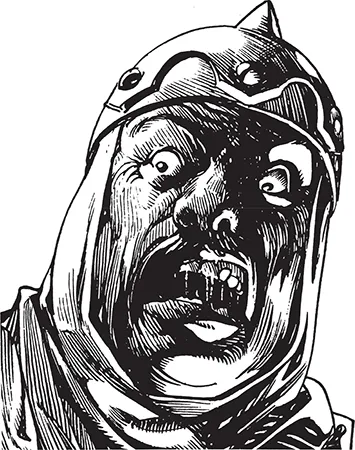
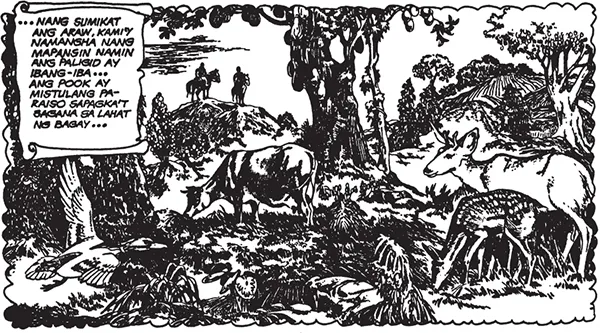
For Alfredo Alcala, the first step in becoming a good artist is a simple one: look around you. “The best advice I would give to an artist is to observe reality. Look at everything around you, people, trees, cars, animals” Learning to draw is really nothing more than the ability to translate what you have seen to paper, according to Alcala.
The key to being able to draw anything anytime is observation. Alcala uses the trick of drawing in the air with his finger, tracing the outline of what he sees. Then he goes home and tries to draw it with a pencil. Alcala has a phenomenal photographic memory, but everyone can benefit from this trick. By copying the shape, you commit it to memory. It’s this observation/memorization process that leads to knowing the secrets of proportion (which we’ll get back to in a later chapter).
“Try this. Look at a table and notice the shape of it. Now make a drawing of it. The drawing might not be accurate. Why? Your memory can’t retain the shape. Now, outline a drawing in the air with the hand. That way it registers in your head. Try drawing it again. The drawing should be more accurate. When you follow it with your finger you are already drawing the shape. You’ve memorized it.
“It’s like a cartoon, in that you see everything with a shape. Don’t just look at it. Trace it with your finger. Then draw it out.” (In fact, Alcala makes such a habit of mid-air doodling that sometimes he covers his hand with a napkin so people won’t notice!)
The ability to draw from memory begins with drawing from life. Sketching what you see is perhaps the single most important part of learning to draw. By all means, take a regular life drawing class, but don’t stop there.
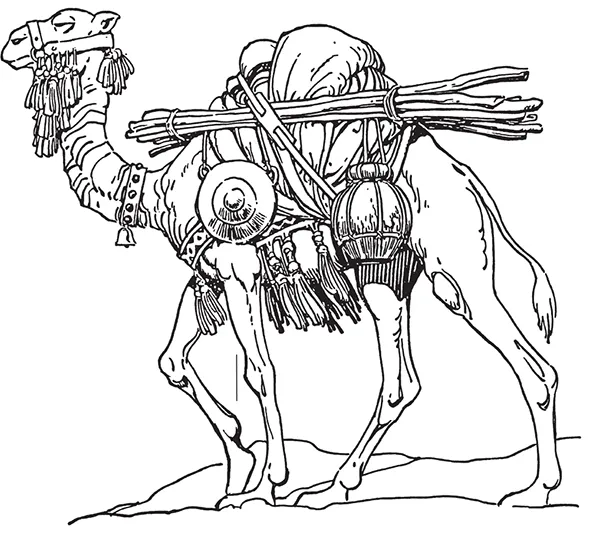
Living in the city, Alcala points out, you don’t often see a camel. However, there’s nothing wrong with going to the zoo—it’s all for art, after all. “If you want to draw a camel, observe one, try to memorize the proportions. That way you can draw it anytime.”
In order to sharpen your eye, Alcala advises, “Always look at live people, the live, real ones. Don’t think about drawing an ear, look at someone’s ear. After you’ve doodled in the air, doodle on paper to see what you’ve learned by doing it with your finger. You notice that your drawing resembles what you looked at. That’s when you know you’ve got it.
“That’s only an exercise, though. The main thing is to apply everything directly. If you’re a painter, what you paint is yourself - you only change the face or the figure - you insert yourself into the feeling you’re trying to portray.”
Of course, the other secret to good drawing is practice. “You must draw constantly. Even if you make mistakes, in time you’ll know what you’re doing wrong, and be able to correct yourself. Later on you’ll see that your vision is improving, and so are your ideas. Don’t stop! Draw whenever you get the chance.”
Alcala is well aware that there are many distractions for an artist. “If you can spend four hours a day drawing, that would be wonderful. But don’t waste time watching television or goofing off. You’ll go home and you’ll have only half an hour to draw. Spend more time drawing than watching television. I prefer to just listen to the radio when I’m working, because I’m not using my vision, I listen to the music. When you watch TV, you look at the picture, and you forget your drawing.”
Once you have begun to truly see the world around you, you can begin to translate that into a style of art that is really your own.
Discovering Your Style
“As you go on you will discover what you like to draw,” Alcala continues. “Maybe it’s animals, or landscapes, or the human figure. You might like superheroes. When you’re just starting out, you’re just playing around, discovering the surface. Then you may discover what you love to draw. Perhaps you love landscapes. Because you love it, you might not pay as much attention to other kinds of drawing, such as architecture.”
At first, young artists have a tendency to want to do everything, Alcala says. “I say, kid, you like everything. You see one artist and you want to be like him but then you see some one else and want to be like that. You see a comic book by someone you admire and say ‘I ought to be like him.’ You’ll see a magazine, and say ‘Why, I ought to be in a magazine or newspaper!’ In the beginning, young artists always want to do everything, but as you go along, you will discover what you love, what you really love. Still, a good artist may have a specialty, but he’s still a total artist.
“You also learn what medium you prefer: oil, charcoal, pastel, or pen and ink. Don’t imitate your friend the artist, and say I want to be like him. You may not have a natural aptitude for a certain medium, while the person you admire does. So don’t just try to imitate the other artist.
“That’s the final step in becoming an artist. You can have all the technique in the world, but when at last you put it into your own vision, which no one else could see, that’s the ultimate.”
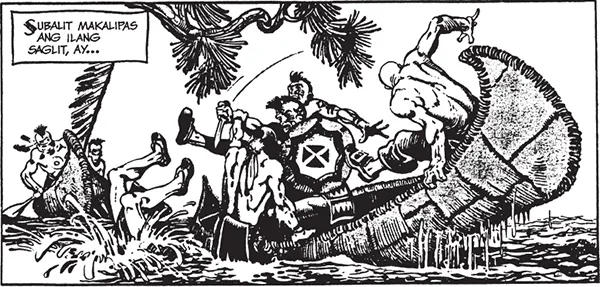
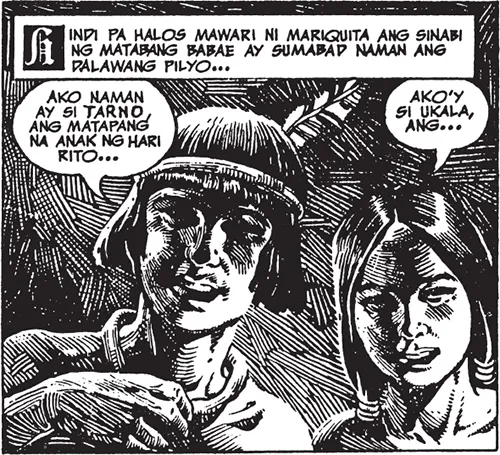
In Alcala’s own case, he learned that the more photographic, or realistic a drawing was, the less he was interested in it. “But the more decorative it is, the more I like it. I like stylized art.”
“I like to draw people. I also like to draw unusual genres. I’ve always tried to get away from the commonplace, from whatever was flooding the market. When I started doing sword and sorcery, only a few people were doing it; later on, many people were doing it.”
Of course, even though young artists must strive always to develop an individual style, there is still a great deal to be learned from artists of the past. In particular, Alcala studied the great illustrators, such as J.C. Leyendecker and Dean Cornwell.
“Their thinking was so wide. Leyendecker was very decorative and good on the eye, but I feel more for Cornwell. His atmosphere, layout and action all have tremendous movement. Many artists may make the figures in the foreground lively, but the people in the background just stand around. Cornwell doesn’t do that. Everything moves!” Cornwell also excelled at playing with light and shade.
“I like Leyendecker for his decorative, unusual art. He was very stylized. I like the variety in his work. Cornwell is more of a colorist. He played with color a lot in his composition. He didn’t do what you expected him to do. A simple landscape, a tree, a meadow, everything became interesting when he painted it.”
Once again, this is what makes a true artist: someone whose vision surprises the viewer. Even with all his artistic vision, Alcala “cannot imagine what Cornwell imagined. I can’t think the way he did. He twisted everything. An uninteresting thing became interesting. But I don’t know how he did it, how he saw it. He knew how to play with color, how to take a dead do-nothing object and make it a colorful, living shape.”
Among comics artists, Alcala mentions Gil Kane, Joe Kubert and Alex Toth as some whose storytelling and layout stand out. “Kane maintains proportion, and is an excellent storyteller. His figure drawing is consistent. He maintains quality, that’s the most important thing. He’s also an intelligent guy. When an artist is smart, you can tell it in his drawing.”
He also mentions the late Lou Fine, who drew comics back in the 40s, and was a major influence on many of the superhero artists of the 60s. “He was very good and very observant. His anatomy was outstanding. I heard that Fine was always in the gym watching people working out with barbells, and so on. He didn’t render for the sake of rendering, but you could see the contours. Lou Fine is one of my idols. Oddly enough, it turned out that my list of idols is almost the same as Lou Fine’s. I told Nestor Redondo that my idols were Brangwyn, Cornwell and Leyendecker. Later on, I saw a list of Fine’s idols, and it was identical.”
The young artist must never forget that learning to draw is an ongoing process which never really ends. Alcala refers to a story about another one of his artistic influences Frank Brangwyn. “The great Brangwyn was always observing. Even when he was out with a girl, he wasn’t just out with a girl in the moonlight. He studied the color, the blending of the moon and her skin. So he had a dual purpose: Dating the girl plus studying the color of the skin in moonlight! When I heard this story I said to myself, ‘Wow, I’m not thinking of that, but from now on I’ll look!’
“Always observe. Never stop. I’m at an age when you would think I know everything I need to know, but I never stop buying books. I always want to learn more. I’m not a good artist—yet. I said ‘Yet.’ I still wish to improve, to learn even more. Never stop. Once you think ‘I’m a good artist,’ that’s the end of you. I never call myself a good artist. I’ve still got to learn. A lot of young artists don’t bother to observe the world around them; instead they just look at other artists. Nobody tells them what to do. They became comic book artists, but because they haven’t studied, they don’t even know that their drawings are out of proportion.
“...
Table of contents
- Cover
- Title Page
- Copyright Page
- Contents
- Introduction
- Chapter 1: The Art of Observation
- Chapter 2: Voltar
- Chapter 3: Painting
Trusted by 375,005 students
Access to over 1.5 million titles for a fair monthly price.
Study more efficiently using our study tools.
Frequently asked questions
Yes, you can cancel anytime from the Subscription tab in your account settings on the Perlego website. Your subscription will stay active until the end of your current billing period. Learn how to cancel your subscription
No, books cannot be downloaded as external files, such as PDFs, for use outside of Perlego. However, you can download books within the Perlego app for offline reading on mobile or tablet. Learn how to download books offline
Perlego offers two plans: Essential and Complete
- Essential is ideal for learners and professionals who enjoy exploring a wide range of subjects. Access the Essential Library with 800,000+ trusted titles and best-sellers across business, personal growth, and the humanities. Includes unlimited reading time and Standard Read Aloud voice.
- Complete: Perfect for advanced learners and researchers needing full, unrestricted access. Unlock 1.5M+ books across hundreds of subjects, including academic and specialized titles. The Complete Plan also includes advanced features like Premium Read Aloud and Research Assistant.
We are an online textbook subscription service, where you can get access to an entire online library for less than the price of a single book per month. With over 1.5 million books across 990+ topics, we’ve got you covered! Learn about our mission
Look out for the read-aloud symbol on your next book to see if you can listen to it. The read-aloud tool reads text aloud for you, highlighting the text as it is being read. You can pause it, speed it up and slow it down. Learn more about Read Aloud
Yes! You can use the Perlego app on both iOS and Android devices to read anytime, anywhere — even offline. Perfect for commutes or when you’re on the go.
Please note we cannot support devices running on iOS 13 and Android 7 or earlier. Learn more about using the app
Please note we cannot support devices running on iOS 13 and Android 7 or earlier. Learn more about using the app
Yes, you can access Secret Teachings of a Comic Book Master by Heidi MacDonald,Phillip Dana Yeh in PDF and/or ePUB format, as well as other popular books in Art & Art Techniques. We have over 1.5 million books available in our catalogue for you to explore.