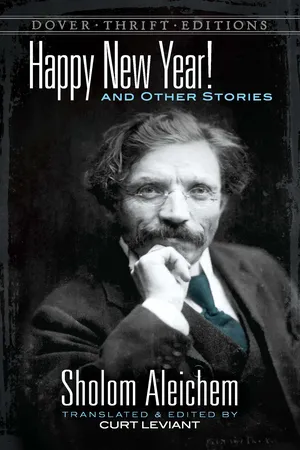
One of the most beloved and prolific writers of Yiddish literature, Sholom Aleichem (1859–1916) produced a wealth of wonderful stories that combine traditional Jewish oral humor with Western literary tradition. For years a living legend, he wrote enduring gems of fiction, eleven of which are included in this entertaining collection.
The master storyteller brilliantly recaptures the joy and tribulations of Jewish life in such tales as "Geese," "At the Doctor's," "Three Widows," "The Passover Eve Vagabonds," "On America," "Someone to Envy," "Three Calendars," "The Ruined Passover," the title story, and two others. Introduced and ably translated by Curt Leviant, these tales sparkle with wit, wisdom, and a warm humanity that will appeal to a wide audience of readers, especially those with an interest in Jewish cultural life.
- 128 pages
- English
- ePUB (mobile friendly)
- Available on iOS & Android
eBook - ePub
Happy New Year! and Other Stories
About this book
Trusted by 375,005 students
Access to over 1.5 million titles for a fair monthly price.
Study more efficiently using our study tools.
Information
75,000
TROUBLES, YOU SAY? You call everything troubles. But I think that since the beginning of time and the creation of the Jewish people, a trouble like mine hasn’t been heard, felt, or seen even in the wildest dream. If you have the time, move up a bit, pay close attention, and Γ11 tell you the story of 75,000 from a to z, down to the very last detail.
The whole affair makes my chest tighten; it gags me; it sends a stream of fire through me. I feel that I must get it out of my system. You get the picture? Just do me one favor. If I interrupt my story or get side-tracked and start jabbering about Boyberik, just lead me back to it. Ever since this business of the 75,000, you see, my ears have been ringing— and I usually forget where I’m at. I don’t wish the likes of it on you! You get the picture? By the way, can you spare 75,000—damn it—I mean, a cigarette?
Well then, where was I? Oh, yes, the 75,000. … You’re looking at a man whose lottery ticket won the 75,000 rubles this past May 1. At first you might think: well what’s there to listen to? Don’t plenty of people win money? Don’t folks say that a man from Nikolay won two hundred thousand and a young bookkeeper from Odessa forty thousand rubles? But not a peep is heard from them. Everything is fine and dandy. True, right, everyone expects the big prizes. One hundred thirty-six million people envy us. You get the picture? But the point is, there’s no comparing one prize and another. The story of this prize is an amazing one which weaves into, around, and out of itself. You really have to prop yourself up and hear me out to the end to understand what’s going on.
First of all, let me introduce myself. I’m not going to give you a song and dance that I’m a great scholar, philosopher, or man of wealth. You’re looking at a plain, down-to-earth Jew who has his own house and a respected name in town, as well. You get the picture? True, I once had money, lots of it. Then again, how can I say lots? Certainly Brodsky had much more. But, in any case, I did have a few thousand rubles. Then, God took pity on me, as they say, and I was bitten by the bug-to-get-rich-quick. I started selling wheat in the famine-stricken districts and was left flat broke. But at least I could still meet my debts. No doubt you think that as soon as I lost the money I became depressed. Well then, you don’t know me. Money means no more to me than—I don’t know—a cigarette butt! It means absolutely nothing to me. How do I mean nothing? Sure, money is important, but to go fight over it, or kill yourself for it—not on your life! When you don’t have what you need, if you can’t live properly, if you can’t give the donation you’d like to give—then things are bad. Take my word for it—when they ask one villager for a three-ruble contribution for the communal funds and skip me, it annoys the daylights out of me. You get the picture? I’d rather get hell from my wife as to why there’s no money for Sabbath provisions than say no to a poor man while I still have forty kopeks jangling in my pocket. You get the picture? That’s the sort of madman I am. By the way, do you have forty … damn it… I mean a match?
Well flien, where was I? Oh, yes, the rubles. I lost the few rubles and was left without a kopek to my name. Having lost my few rubles and being left without a kopek to my name, I told my wife one fine morning:
“Tsipora, listen to what I’ve got to say. We’re clean broke.”
“What do you mean by clean broke?” she said.
“We don’t even have a kopek to our name.”
Well, being a female, she immediately started bawling. “Oh, my God. We’re sunk. We’re lost. We’re six feet under. What are you talking about Yakov-Yosil—where’s all your money?”
“Shush up! Pipe down! What are you raising such a racket for? Who says it was my money? God gave and God took. Or like they say: Ivan never had and never will have money. Who says that Yakov-Yosil is supposed to have two maids, a four-room apartment and wear a silken Sabbath cloak? There’s plenty of Jews who are starving. But do they die? If you keep asking why this, why that, the world wouldn’t exist for long.”
I cited other examples and proverbs and my wife finally admitted that I was right. You get the picture? You ought to know that I’m married to a woman I’m proud of. She has a good head on her shoulders. You don’t have to plead too long to make your point. She stopped her sniffling and fussing immediately and even took to consoling me, saying that the whole thing was probably fated, that God is a merciful Father and would watch over us. . . .
Without dilly-dallying, I sub-leased my apartment, moved into one tiny room and kitchen, and, begging your pardon, dismissed the maids. My wife, may she live and be well, rolled up her sleeves and became the cook. And I let it be known that I, Reb Yakov-Yosil, was to be called Pauper. What do I mean by Pauper? As you can well imagine, there are plenty poorer than me. After all, I still had an apartment, a piece of property from which I could make my livelihood. The only trouble was that there were four weeks in the month. Had there been only two weeks in a month, maybe our expenses and income would have balanced. Each month always had two extra weeks and, naturally, that’s no good. But, never mind. Like they say—you get used to troubles. Let me tell you, being a poor man is the most peaceful thing in the world. Your mind is free of headaches, payments, loans, rat-races, and a topsy-turvy world. But wait—there’s a God up above who says: What good is it, Yakov-Yosil, having peace of mind and living without troubles? Do you have a ticket to the lottery? Well, here’s 75,000 for you, go break your neck with it! You get the picture? By the way, do you happen to have a ticket—damn it—I mean, a cigarette?
Well then, where was I? Oh, yes, the lottery ticket. Ticket? You think it’s so simple for a Jew to have a ticket and collect the 75,000? Wait just a minute. First of all, why does a Jew have a ticket? So that he can pawn it and get some money for it. Well then, why don’t you go into a bank, Yakov-Yosil, you ass, and get some cash for it? But the excuses are that in the first place there are no banks in our village and, secondly, what do I need the bank for? Can’t a bank go bankrupt if it has a mind to? Then again, things do operate in an orderly manner in this orderly world and no one was grabbing the ticket out of my hand. Who wanted my ticket anyway? You get the picture? Well, that’s what I thought at the time. On second thought, perhaps I didn’t really think at all. But I decided: my tenant, a fine young man, a gentleman and a scholar, was a money-lender. Why not pawn the ticket with him? If he’d give me 200 for it, I’d take it. Why shouldn’t I? So I went over to him— Birnbaum, he was called—and said:
“Mr. Birnbaum, would you give me 200 rubles for my ticket?”
“I’ll give you 200 rubles for your ticket,” he said.
“How much interest would I have to pay?” I said.
“How much interest do you want me to charge you?” he said.
“How do I know?” I said. “Charge me bank rates.”
“I’ll charge you bank rates,” he said.
In a nutshell, we settled on the interest, I pawned my ticket for five months, and took the 200 rubles. You get the picture? Then why don’t you take a receipt from him, Yakov-Yosil, you ass, stating that you left such-and-such a ticket of series and number so-and-so. But, no! Just the opposite. Birnbaum took a receipt from me that I borrowed 200 rubles for five months and left him such-and-such a ticket of series and number so-and-so. And if I didn’t pay the 200 rubles in time, said ticket would be his and I would have nothing on him. You get the picture? You know what I thought then? I thought: what’s there to be afraid of? In any case, if I’d redeem the ticket at the proper time and pay my debt, everything would be fine and dandy. If not, I’d pay him the interest due and he’d just have to wait. Why wouldn’t he wait? Why should he care, so long as he got the interest? You get the picture? Well, here’s what happened. When the time came, naturally, I didn’t redeem the ticket. Five months passed, then another five. Slowly it stretched on into two years and five months. I kept paying the interest, of course. That is, sometimes I paid, sometimes not. What was I afraid of? Would he sell the ticket? He wouldn’t sell my ticket. Why should he sell my ticket? Anyway, that’s what I thought at the time. On second thought, perhaps I really didn’t think at all. Meanwhile, times were bad, business was rotten; the extra weeks in the months kept piling up and I worked my fingers to the bone. What was one to do? Just live and be well—there were always plenty of troubles! And this situation lasted until Passover.
But this year, before Passover, God sent a little business my way. I bought a few carloads of millet. The price of millet skyrocketed. I sold the millet and, thank heaven, made a neat profit on the millet. I had myself a Passover that Brodsky himself would have envied. Not owing a kopek to a soul and having a few hundred rubles to your name to boot was nothing to sneeze at. I was riding high—you get the picture? So why don’t you take two hundred rubles, Yakov-Yosil, you ass, and pay Birnbaum and buy back your lottery ticket? But, no. I decided—what’s the rush? He won’t run away with the ticket. After Passover will be time enough. If not, I’ll pay the interest and take a receipt for the ticket. Anyway, that’s what I thought then. On second thought, perhaps I didn’t really think at all. You get the picture? I upped and turned the money into sacks which I stored in a warehouse. Well, thank goodness for a miracle—the lock was jimmied that night. It happened right after Passover, on April 30, the night before the May 1 lottery drawing. All my sacks were stolen! I was flat broke again.
“Tsipora,” I said to my wife. “You know what? We’re flat broke again.”
“What do you mean flat broke?”
“We don’t even have a sack to our name,” I said.
“What do you mean? Where did the sacks disappear to?”
“They’ve been carried off! Right out of the warehouse!”
Being a woman, naturally, she started bawling and wailing.
“Shush up, Tsipora,” I said. “Don’t yell. You’re not alone here. Make believe the house burned down and we got out of it naked as the day we were born. Does that make you feel any better?”
“What a comparison?” she said. “Is that why they have to steal your sacks?”
‘What’s one thing got to do with the other?” I said. “Mark my words, the sacks will be found.”
“How are they going to get to you?” she said. “Are the crooks going to present you with the sacks just because you’re called Yakov-Yosil? They don’t have anything better to do, eh?”
“Go on!” I said. “You’re a ninny. Man can’t even imagine the wonders of God!”
Well, here’s what happened! The sacks, of course, were goners. What sacks? Where sacks? But I ran around like a madman, contacted the police, searched high and low, poked into every rat-hole. But it was a lost cause. Like trying to find yesterday. You get the picture? My head was in another world, my heart was in my throat, my mouth was dry— I was completely depressed. But around noon, while standing near the local stock exchange, that is, near the pharmacy on the marketplace, a thought flew through my mind: after all, today’s some sort of judgment day. The lottery drawing—the first of May. God can do anything! We have an Almighty God. If only He wills it, He can make me and my whole family happy.
Then, remembering the stolen sacks, I forgot all about the first of May lottery drawing and started looking for the sacks again. I had a little clue and kept searching the whole day into the rest of that night and on until the dawn of May 2. I was in a complete daze, I hadn’t eaten for twenty-four hours and here it was 1 P.M. and I was passing out. You get the picture?
When I came home, my wife pounced on me: “How about washing up and having a bite? Haven’t you had enough of that sack affair. Your sacks are sticking like a bone in my throat. The devil take those sacks. Do you have to kill yourself on account of those sacks? We’ll be no better off with or without the sacks. What a business with sacks! Here sacks, there sacks. All I hear is sacks, sacks, sacks.”
“You know, wife, dear?” I said. “Let’s forget about the sacks, huh? I’ve been sacked enough as is. Now you come along and rub salt into my wounds. Sacks, sacks, sacks.” You get the picture? Can I trouble you for a sack—damn it—I mean, another cigarette?
Well then, where was I? Oh yes, the sacks. Well, it was a lost cause. What to do? I wasn’t going to kill myself for them. I washed and sat down to eat, but—nothing doing! My appetite was gone.
“What’s wrong with you, Yakov-Yosil?” asked my wife, God bless her. “Who crossed you today?”
“I myself don’t know what the matter is,” I said, left the table in the middle of the meal, and lay down on the sofa. No sooner did I stretch out than the paper was delivered. Why then don’t you take it, Yakov-Yosil, you ass, and see if per...
Table of contents
- Cover
- Title page
- Dedication
- Introduction
- Contents
- Geese
- Three Calendars
- Happy New Year!
- Someone to Envy
- At the Doctor’s
- Three Widows
- The Passover Eve Vagabonds
- On America
- 75,000
- The Ruined Passover
- From the Riviera
- About the Translator
Frequently asked questions
Yes, you can cancel anytime from the Subscription tab in your account settings on the Perlego website. Your subscription will stay active until the end of your current billing period. Learn how to cancel your subscription
No, books cannot be downloaded as external files, such as PDFs, for use outside of Perlego. However, you can download books within the Perlego app for offline reading on mobile or tablet. Learn how to download books offline
Perlego offers two plans: Essential and Complete
- Essential is ideal for learners and professionals who enjoy exploring a wide range of subjects. Access the Essential Library with 800,000+ trusted titles and best-sellers across business, personal growth, and the humanities. Includes unlimited reading time and Standard Read Aloud voice.
- Complete: Perfect for advanced learners and researchers needing full, unrestricted access. Unlock 1.5M+ books across hundreds of subjects, including academic and specialized titles. The Complete Plan also includes advanced features like Premium Read Aloud and Research Assistant.
We are an online textbook subscription service, where you can get access to an entire online library for less than the price of a single book per month. With over 1.5 million books across 990+ topics, we’ve got you covered! Learn about our mission
Look out for the read-aloud symbol on your next book to see if you can listen to it. The read-aloud tool reads text aloud for you, highlighting the text as it is being read. You can pause it, speed it up and slow it down. Learn more about Read Aloud
Yes! You can use the Perlego app on both iOS and Android devices to read anytime, anywhere — even offline. Perfect for commutes or when you’re on the go.
Please note we cannot support devices running on iOS 13 and Android 7 or earlier. Learn more about using the app
Please note we cannot support devices running on iOS 13 and Android 7 or earlier. Learn more about using the app
Yes, you can access Happy New Year! and Other Stories by Sholom Aleichem, Curt Leviant in PDF and/or ePUB format, as well as other popular books in Literature & Classics. We have over 1.5 million books available in our catalogue for you to explore.