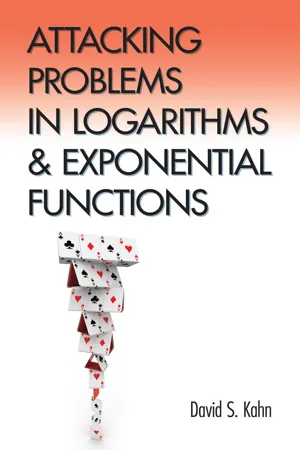
This original volume offers a concise, highly focused review of what high school and beginning college students need to know in order to solve problems in logarithms and exponential functions. Numerous rigorously tested examples and coherent to-the-point explanations, presented in an easy-to-follow format, provide valuable tools for conquering this challenging subject. The treatment is organized in a way that permits readers to advance sequentially or skip around between chapters. An essential companion volume to the author's Attacking Trigonometry Problems, this book will equip students with the skills they will need to successfully approach the problems in logarithms and exponential functions that they will encounter on exams.
Now that we have learned how to solve equations and problems that use exponentials, we are going to learn how to solve problems that use logarithms. As with the previous unit, we will look at a variety of types of problems and see what we need to do to get to the solution. We will also look at a couple of different types of word problems that are solved with logarithms.
First, let’s look at an equation that uses logarithms. We are used to equations that involve a variable, or more than one variable. There are also equations where the variable is a function of x, such as with trigonometric functions, exponentials, or, in this case, logarithms. We will use the laws of logarithms to solve them. Let’s do an example.
Example 1: Solve for x: log(x + 3) − log(x − 2) = log6.
Remember the Log Laws. The Quotient Law says that
. We can use this to rewrite the left side of the equation as
. Now, because the two logs are equal, we can ignore the log parts and solve the equation
. Cross-multiply: x + 3 = 6(x − 2).
Then solve: x + 3 = 6x − 12, so x = 3.
It is always a good idea to check our answer with log equations because logarithms are only defined for positive values. If we plug x = 3 into the left side of the equation, we get: log(3 + 3) − log(3 − 2), which reduces to: log6 − log1. Because log 1 = 0, this becomes log 6. So, our solution works.
That wasn’t so bad! Let’s try a similar one.
Example 2: Solve for x: log(x + 3) + log(x − 2) = log6.
Again, remember the Log Laws. The Product Law says that logAB = logA + logB. We can use this to rewrite the left side of the equation as log[(x + 3)(x − 2)] = log6. Now, because the two logs are equal, we can ignore the log parts and solve the equation (x + 3)(x − 2) = 6. This is a simple quadratic equation. Expand the left side: x2 + x − 6 = 6. Subtract 6 from both sides: x2 + x − 12 = 0. Now we can factor this and solve: (x + 4)(x − 3) = 0, so x = −4 or x = 3.
Let’s check our answers. First, let’s plug x = −4 into the left side of the equation. Note that we would then be taking the log of a negative number, which is not allowed. Thus, x = −4 is not a valid solution. Next, let’s plug x = 3 into the left side of the equation: log(3 + 3) + log(3 − 2). Which reduces to: log6 + log1. Just like last time, because log1 = 0, this becomes log6. So, our second solution works. Therefore, even though we found two values of x, the only solution is x = 3.
Let’s do another one.
Example 3: Solve for x: ln(x − 2)+ ln(x + 4) = ln 7.
The Product Law says that log(AB) = log A + logB, so we can rewrite the left side of the equation as ln[(x − 2)(x + 4)] = ln 7. Now, because the two logs are equal, we can ignore the log parts and solve the equation (x − 2) (x + 4) = 7. This is a simple quadratic equation. Expand the left side: x2 + 2x − 8 = 7. Subtract 7 from both sides: x2 + 2x − 15 = 0. Now we can factor this and solve: (x + 5)(x − 3) = 0, so x = −5 or x = 3.
Let’s check our answers. First, let’s plug x = −5 into the left side of the equation. Note that we would then be taking the log of a negative number, whi...
Table of contents
Cover
Title page
Copyright
Acknowledgments
Table of Contents
Unit One Seven Simple Rules for Working with Exponents
Unit Two Exponential Expressions
Unit Three Scientific Notation
Unit Four Graphs of Exponential Functions
Unit Five Logarithms
Unit Six Log Laws
Unit Seven Exponential Growth and Natural Logarithms
Unit Eight Graphs of Logarithmic Functions
Unit Nine Problems That Use Exponentials
Unit Ten Problems That Use Logarithms
Trusted by 375,005 students
Access to over 1.5 million titles for a fair monthly price.
Study more efficiently using our study tools.
Frequently asked questions
Yes, you can cancel anytime from the Subscription tab in your account settings on the Perlego website. Your subscription will stay active until the end of your current billing period. Learn how to cancel your subscription
No, books cannot be downloaded as external files, such as PDFs, for use outside of Perlego. However, you can download books within the Perlego app for offline reading on mobile or tablet. Learn how to download books offline
Perlego offers two plans: Essential and Complete
Essential is ideal for learners and professionals who enjoy exploring a wide range of subjects. Access the Essential Library with 800,000+ trusted titles and best-sellers across business, personal growth, and the humanities. Includes unlimited reading time and Standard Read Aloud voice.
Complete: Perfect for advanced learners and researchers needing full, unrestricted access. Unlock 1.5M+ books across hundreds of subjects, including academic and specialized titles. The Complete Plan also includes advanced features like Premium Read Aloud and Research Assistant.
Both plans are available with monthly, semester, or annual billing cycles.
We are an online textbook subscription service, where you can get access to an entire online library for less than the price of a single book per month. With over 1.5 million books across 990+ topics, we’ve got you covered! Learn about our mission
Look out for the read-aloud symbol on your next book to see if you can listen to it. The read-aloud tool reads text aloud for you, highlighting the text as it is being read. You can pause it, speed it up and slow it down. Learn more about Read Aloud
Yes! You can use the Perlego app on both iOS and Android devices to read anytime, anywhere — even offline. Perfect for commutes or when you’re on the go. Please note we cannot support devices running on iOS 13 and Android 7 or earlier. Learn more about using the app
Yes, you can access Attacking Problems in Logarithms and Exponential Functions by David S. Kahn in PDF and/or ePUB format, as well as other popular books in Mathematics & Functional Analysis. We have over 1.5 million books available in our catalogue for you to explore.