"A well-illustrated survey of style. Chock full of detailed, quality illustrations accompanied by brief descriptions. A worthy offering. Nostalgic types who enjoy perusing vintage catalogs and clip art books will find much to savor here. This practical resource is sure to provide inspiration for artists and fashion designers. Five stars." — biblio-filer
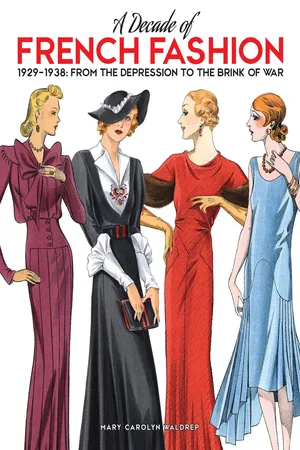
In addition to a world-wide depression and the rise of Fascism throughout Europe, the years between 1929 and 1938 witnessed dramatic changes in women's fashion. With the turning of the decade, the free and easy fashions of the Roaring Twenties shifted to a softer, more conservative look, with an emphasis on curves rather than angles. Hemlines plummeted almost overnight and did not begin to rise until mid-decade.
These selections from full-color French catalogs produced for the international market from 1929 through 1938 document the changes in fashion from the time of the stock market crash to the dawn of World War II. More than 100 images of day and evening wear illustrate the movement from flapper fashions to a more austere look. Fashion designers, costume historians, costumers, and anyone who loves fashion will treasure this richly illustrated survey.
"A must for anyone interested in fashion and costume, this book offers exactly what the title suggests — a decade of French fashion, portrayed in beautiful illustrations from contemporary catalogues. A joy to read and savor." — newbooks magazine
"This is a book to read and time and time again, each new viewing helping further details —from button placements to hemline shapes — to present themselves to you, the reader, as you soak up and savor the supreme elegance that was 1930s fashion for those with the means to buy from the best that France had to offer." — Chronically Vintage
eBook - ePub
A Decade of French Fashion, 1929-1938
From the Depression to the Brink of War
- 112 pages
- English
- ePUB (mobile friendly)
- Available on iOS & Android
eBook - ePub
About this book
Information
Beginning in the 1890s and continuing into the middle of the 20th century, publishers such as Journal Périodique and Chic Parisien produced books of fashion plates for the international market. Complete with back views, notes on fashion trends, and captions detailing fabrics and styling details in French, English, and German, these books showcased the latest in French fashion. These books were published monthly or bimonthly with twice-yearly supplements. The books were sold in the United States by a variety of distributors. The eight volumes featured here were distributed by three different New York companies — S. Reinach Company in 1929, Haire Fashion Publications in 1932 and 1933, and Imported Fashion Books, Inc. in 1938. The eighth publication had no cover, although it appears to be from 1935/1936.
These beautiful full color plates offer firsthand evidence of the dramatic change in fashion in the period between the world wars.
In the aftermath of the “Great War,” both men and women embraced new freedom in lifestyle and fashion as traditional roles and mores began to change. For women, the trend to a more relaxed silhouette, which had started before the war, became even more pronounced. By the middle of the 1920s, fashionable skirts were at the knee and a slim, boyish silhouette was all the rage. This silhouette, although quite narrow at the top, exploded with movement from the hips down — pleats, ruffles, and godets gave ease to skirts, allowing women to stride forth with confidence. Skirts began to drop slightly by the end of the decade, often by means of uneven hems, but in general, the silhouette remained in fashion through the end of the decade. Although the style was by no means adapted by everyone, the prevailing image of the 1920s woman is the flapper with short skirts and bobbed hair.
The free and easy Jazz Age came to a halt in late October 1929 when stock prices began to fall precipitously, culminating on October 29, enshrined in American folklore as Black Tuesday. Stocks continued to decline over the next few weeks, recovered briefly, but then the country slid inexorably into the Great Depression. By 1933 more than 20% of America’s population was unemployed, and many of those who still had jobs had taken a pay cut.
Fashion, too, took an abrupt turn as women turned to a more conservative, ladylike look. Hemlines plummeted, the waistline moved to a more natural position, and shoulders widened. For many, “make do” was the fashion watchword of the decade. Clothes were patched and remade and, when absolutely necessary, replaced with the inexpensive ready-to-wear from outlets such as Sears, Roebuck, and Co. and Montgomery Ward. Nevertheless, fashion is hard to suppress, and America’s women craved glamour as represented by the stars they saw on the silver screen. Indeed, the burgeoning film industry soon became even more influential on style than the Paris fashion houses.
The prevailing look of the thirties was long and lean, with hemlines reaching the bottom of the calf by 1932, and then beginning a slow rise to just below the knee by the end of the decade. The silhouette was very fluid, with draping and bias cutting emphasizing the body. Skirts were very narrow, with slim godets, pleats, or gathers providing walking ease. Bodices were draped, asymmetrical, crossed, wrapped, peplumed, and trimmed with openwork, ruffles, pleats, and bow collars, while sleeves came in infinite variety — leg of mutton, puffed, raglan, kimono, and more. Novelty seaming, both curved and angular, was seen on both skirts and bodices. The full-skirted tunic top over a slim skirt for both day and evening became popular, and after a decade of being ignored, the waistline was emphasized with belts, sashes, and insets. Jackets, ranging in length from bolero to hip-length, became a fashion staple, w...
Table of contents
- Cover
- Title Page
- Copyright Page
- A Decade Of French Fashion
Trusted by 375,005 students
Access to over 1.5 million titles for a fair monthly price.
Study more efficiently using our study tools.
Frequently asked questions
Yes, you can cancel anytime from the Subscription tab in your account settings on the Perlego website. Your subscription will stay active until the end of your current billing period. Learn how to cancel your subscription
No, books cannot be downloaded as external files, such as PDFs, for use outside of Perlego. However, you can download books within the Perlego app for offline reading on mobile or tablet. Learn how to download books offline
Perlego offers two plans: Essential and Complete
- Essential is ideal for learners and professionals who enjoy exploring a wide range of subjects. Access the Essential Library with 800,000+ trusted titles and best-sellers across business, personal growth, and the humanities. Includes unlimited reading time and Standard Read Aloud voice.
- Complete: Perfect for advanced learners and researchers needing full, unrestricted access. Unlock 1.5M+ books across hundreds of subjects, including academic and specialized titles. The Complete Plan also includes advanced features like Premium Read Aloud and Research Assistant.
We are an online textbook subscription service, where you can get access to an entire online library for less than the price of a single book per month. With over 1.5 million books across 990+ topics, we’ve got you covered! Learn about our mission
Look out for the read-aloud symbol on your next book to see if you can listen to it. The read-aloud tool reads text aloud for you, highlighting the text as it is being read. You can pause it, speed it up and slow it down. Learn more about Read Aloud
Yes! You can use the Perlego app on both iOS and Android devices to read anytime, anywhere — even offline. Perfect for commutes or when you’re on the go.
Please note we cannot support devices running on iOS 13 and Android 7 or earlier. Learn more about using the app
Please note we cannot support devices running on iOS 13 and Android 7 or earlier. Learn more about using the app
Yes, you can access A Decade of French Fashion, 1929-1938 by Mary Carolyn Waldrep in PDF and/or ePUB format, as well as other popular books in Design & Fashion Design. We have over 1.5 million books available in our catalogue for you to explore.