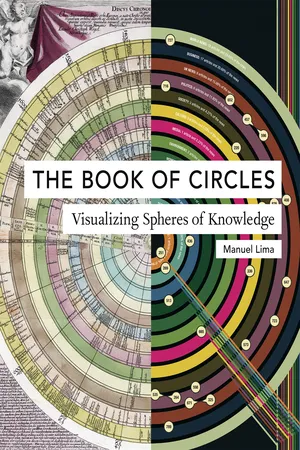
In this follow-up to his hugely popular The Book of Trees and Visual Complexity, Manuel Lima takes us on a lively tour through millennia of circular information design. Three hundred detailed and colorful illustrations from around the world cover an encyclopedic array of subjects—architecture, urban planning, fine art, design, fashion, technology, religion, cartography, biology, astronomy, and physics, all based on the circle, the universal symbol of unity, wholeness, infinity, enlightenment, and perfection. Clay tokens used by ancient Sumerians as a system of recording trade are juxtaposed with logos of modern retailers like Target; Venn diagrams are discussed alongside the trefoil biohazard symbol, symbols of the Christian trinity, and the Olympic rings; and a diagram revealing the characteristics of ten thousand porn stars displays structural similarities to early celestial charts placing the earth at the center of the universe.
Lima's introduction provides an authoritative history of the circle, and a preface describes his unique taxonomy of the many varieties of circle diagrams, rounding out this visual feast for infographics enthusiasts.
- 272 pages
- English
- ePUB (mobile friendly)
- Available on iOS & Android
eBook - ePub
About this book
Information
Topic
DesignSubtopic
Art GeneralFamily 1
RINGS & SPIRALS

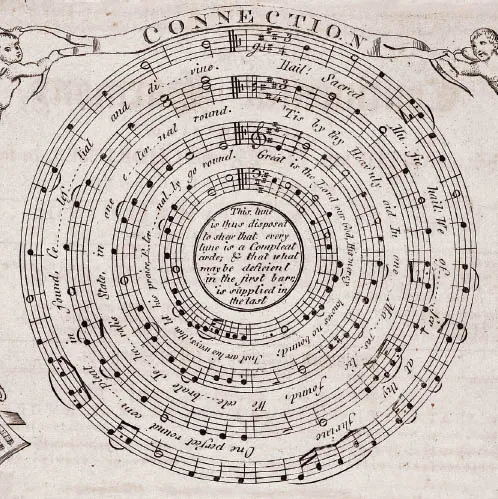
William Billings
Musical score for the song “Connection”
1794
Musical score for the song “Connection”
1794
Frontispiece to The Continental Harmony (1794), a book by William Billings containing dozens of psalm anthems and hymns. Billings was a prominent early American choral composer. This illustration represents the score for the tune “Connection” as a four-stave, circular piece of music, which starts at the top of the outermost ring and works its way to the center.
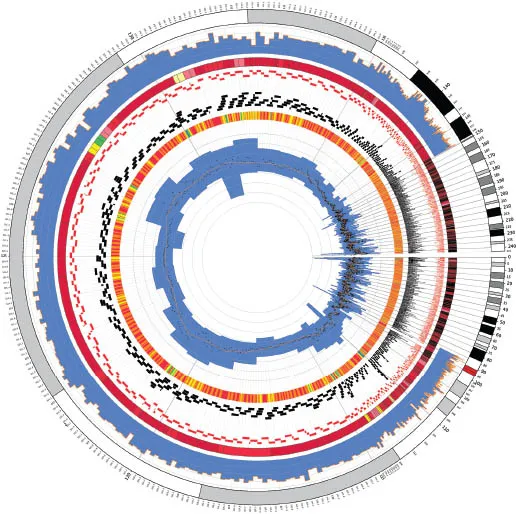
Martin Krzywinski
Circos
2009
Circos
2009
Chart depicting human chromosome 1 in a set of concentric colored rings. These rings demonstrate one of countless possible configurations for Circos, a software package for visualizing data and information using a circular layout. It has been an influential tool within the scientific community, particularly in mapping genomic data, and drawings constructed with Circos have appeared in numerous publications such as the New York Times, Science, Nature, American Scientist, and Bioinformatics.

Klari Reis
Petri dish painting details (Petri Projects)
2009–present
Petri dish painting details (Petri Projects)
2009–present
Painting by San Francisco–based artist Klari Reis, who is inspired by microscopic organic cellular imagery and natural reactions to create images that explore our complex relationship with today’s biotechnology industry. Shown here is one of a large set of petri dishes painted by hand with epoxy polymer, an industrial plastic typically used for flooring. The dish is part of an installation project in which pieces hang on a wall on steel rods at varying distances from one other.
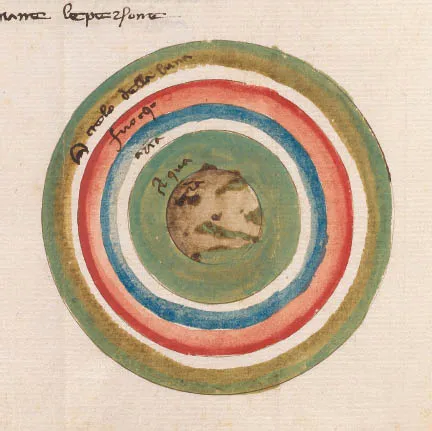
Leonardo Dati
Earth and the four elements
fifteenth century
Earth and the four elements
fifteenth century
Watercolor drawing featured in La Sfera (The sphere), a book by Italian friar and humanist Leonardo Dati containing texts on astronomy, geography, poetry, mathematics, and fortune-telling. This drawing is a representation of the long-lasting geocentric model of the universe, showing the classical elements, with the heaviest one, earth, at the very core, surrounded by water, air, fire, and the final ring of celestial ether.
Oronce Finé
Geocentric model
1549
Geocentric model
1549
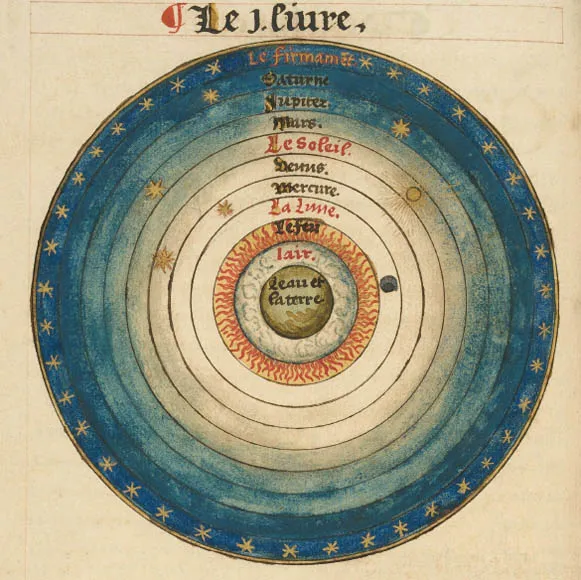
Drawing taken from the popular astronomy textbook Le Sphere du Monde (The sphere of the world), written by prominent French mathematician Oronce Finé—a text so authoritative that an illustrated copy of the manuscript was given to King Henry II of France. It shows a geocentric model of the universe, where two of the four elements (water and land) are placed at the center, while the remaining elements, the moon, the planets, and the sun radiate out. The final outer ring is the firmament, the sphere that contains the fixed stars and separates the Earthly world from heaven.

Dave Bowker
One Week of the Guardian: Wednesday
2008
One Week of the Guardian: Wednesday
2008
Part of a series of experiments exploring how to visualize the content of the Guardian newspaper in an artistic and engaging way, a diagram showing the popularity of fifty-four news articles. The concentric circles group articles into color-coded categories (e.g., life and style articles are shown by orange, technology by cyan, and science by blue), with the least popular category positioned in the center. Word counts for each article are noted within speech bubbles.
Carlos Simpson
How Old Is the Internet?
2013
How Old Is the Internet?
2013
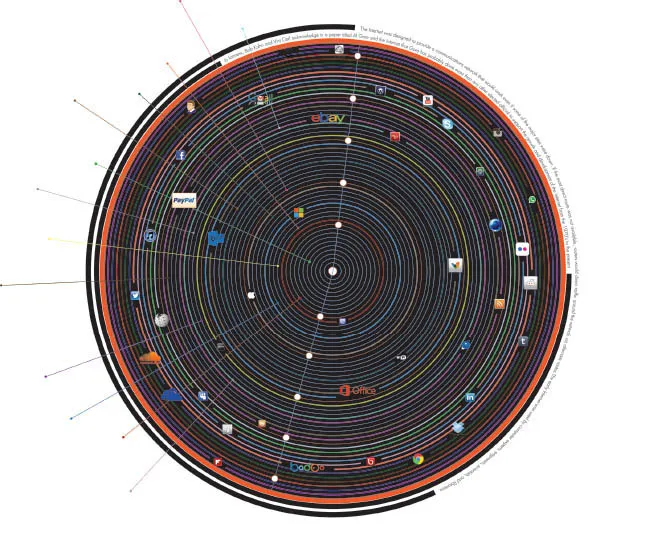
Mimicking the rings of a tree, a diagram showing the development of the Internet over the past thirty years. The start of the Internet is shown at the center; each ring radiating out represents a single year. The logos of various technology companies are placed to show when they launched, giving a sense of the explosion of activity in the past ten years. The colored lines that protrude from the circle indicate various legislative efforts to regulate the Internet and other key commercial milestones; for example, the orange line represents the adoption of email by ARPANET, while the gray one conveys the development of Mosaic in 1993.
Valentina D’Efilippo
The Shining—A visual deconstruction
2009
The Shining—A visual deconstruction
2009
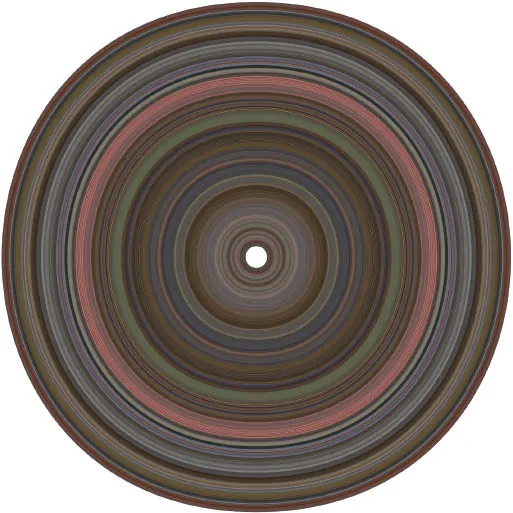
D’Efilippo’s visual deconstruction of Stanley Kubrick’s movie The Shining in terms of its timing, action, and color. D’...
Table of contents
- Cover
- Title
- Dedication
- Contents
- Preface
- Acknowledgments
- Introduction
- A Taxonomy of Circles
- Family 1 Rings & Spirals
- Family 2 Wheels & Pies
- Family 3 Grids & Graticules
- Family 4 Ebbs & Flows
- Family 5 Shapes & Boundaries
- Family 6 Maps & Blueprints
- Family 7 Nodes & Links
- Bibliography
- Image Credits
- Index
- About the Author
- Copyright
Trusted by 375,005 students
Access to over 1.5 million titles for a fair monthly price.
Study more efficiently using our study tools.
Frequently asked questions
Yes, you can cancel anytime from the Subscription tab in your account settings on the Perlego website. Your subscription will stay active until the end of your current billing period. Learn how to cancel your subscription
No, books cannot be downloaded as external files, such as PDFs, for use outside of Perlego. However, you can download books within the Perlego app for offline reading on mobile or tablet. Learn how to download books offline
We are an online textbook subscription service, where you can get access to an entire online library for less than the price of a single book per month. With over 1.5 million books across 990+ topics, we’ve got you covered! Learn about our mission
Look out for the read-aloud symbol on your next book to see if you can listen to it. The read-aloud tool reads text aloud for you, highlighting the text as it is being read. You can pause it, speed it up and slow it down. Learn more about Read Aloud
Yes! You can use the Perlego app on both iOS and Android devices to read anytime, anywhere — even offline. Perfect for commutes or when you’re on the go.
Please note we cannot support devices running on iOS 13 and Android 7 or earlier. Learn more about using the app
Please note we cannot support devices running on iOS 13 and Android 7 or earlier. Learn more about using the app
Yes, you can access The Book of Circles by Manuel Lima in PDF and/or ePUB format, as well as other popular books in Design & Art General. We have over 1.5 million books available in our catalogue for you to explore.