"Ideal for students and non-specialist general readers with an interest in the literary works of an iconic American author. Very highly recommended." ― The Midwest Book Review
Although better known today for his novels, in the 1920s F. Scott Fitzgerald ranked among the top writers of magazine fiction. Fitzgerald represented the dreams and aspirations of the post-World War I generation in his life as well as his works. With his glamorous wife, Zelda, and cosmopolitan social circle, the gifted young wordsmith projected the perfect image for narrating tales of restless youth in a hectic world.
These short stories offer insights into many themes, characters, and techniques that emerged in Fitzgerald's later works. "Winter Dreams," written three years before The Great Gatsby, shares the concept of commitment to an idealized dream. "Babes in the Woods," developed while the author was still a student at Princeton, evidences the roots of This Side of Paradise. A dozen other selections ― including "The Curious Case of Benjamin Button," "The Camel's Back," "The Four Fists," and "The Cut-Glass Bowl" ― offer further insights into the author's growing skills as well as individual examples of his sparkling prose, understated wit, and deft characterizations.
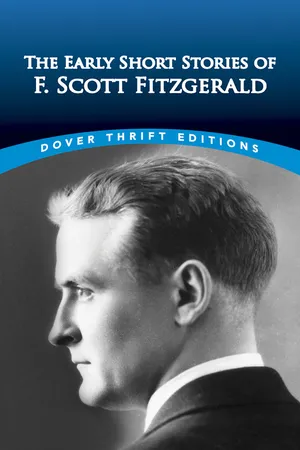
eBook - ePub
The Early Short Stories of F. Scott Fitzgerald
- 256 pages
- English
- ePUB (mobile friendly)
- Available on iOS & Android
eBook - ePub
The Early Short Stories of F. Scott Fitzgerald
About this book
Information
Subtopic
ClassicsIndex
LiteratureTHE CAMEL’S BACK
THE GLAZED EYE of the tired reader resting for a second on the above title will presume it to be merely metaphorical. Stories about the cup and the lip and the bad penny and the new broom rarely have anything to do with cups or lips or pennies or brooms. This story is the exception. It has to do with a material, visible and large-as-life camel’s back.
Starting from the neck we shall work toward the tail. I want you to meet Mr. Perry Parkhurst, twenty-eight, lawyer, native of Toledo. Perry has nice teeth, a Harvard diploma, parts his hair in the middle. You have met him before—in Cleveland, Portland, St. Paul, Indianapolis, Kansas City, and so forth. Baker Brothers, New York, pause on their semi-annual trip through the West to clothe him; Montmorency & Co. dispatch a young man post-haste every three months to see that he has the correct number of little punctures on his shoes. He has a domestic roadster now, will have a French roadster if he lives long enough, and doubtless a Chinese tank if it comes into fashion. He looks like the advertisement of the young man rubbing his sunset-colored chest with liniment and goes East every other year to his class reunion.
I want you to meet his Love. Her name is Betty Medill, and she would take well in the movies. Her father gives her three hundred a month to dress on, and she has tawny eyes and hair and feather fans of five colors. I shall also introduce her father, Cyrus Medill. Though he is to all appearances flesh and blood, he is, strange to say, commonly known in Toledo as the Aluminum Man. But when he sits in his club window with two or three Iron Men, and the White Pine Man, and the Brass Man, they look very much as you and I do, only more so, if you know what I mean.
Now during the Christmas holidays of 1919 there took place in Toledo, counting only the people with the italicized the, forty-one dinner parties, sixteen dances, six luncheons, male and female, twelve teas, four stag dinners, two weddings, and thirteen bridge parties. It was the cumulative effect of all this that moved Perry Parkhurst on the twenty-ninth day of December to a decision.
This Medill girl would marry him and she wouldn’t marry him. She was having such a good time that she hated to take such a definite step. Meanwhile, their secret engagement had got so long that it seemed as if any day it might break off of its own weight. A little man named Warburton, who knew it all, persuaded Perry to superman her, to get a marriage license and go up to the Medill house and tell her she’d have to marry him at once or call it off forever. So he presented himself, his heart, his license, and his ultimatum, and within five minutes they were in the midst of a violent quarrel, a burst of sporadic open fighting such as occurs near the end of all long wars and engagements. It brought about one of those ghastly lapses in which two people who are in love pull up sharp, look at each other coolly and think it’s all been a mistake. Afterward they usually kiss wholesomely and assure the other person it was all their fault. Say it all was my fault! Say it was! I want to hear you say it!
But while reconciliation was trembling in the air, while each was, in a measure, stalling it off, so that they might the more voluptuously and sentimentally enjoy it when it came, they were permanently interrupted by a twenty-minute phone call for Betty from a garrulous aunt. At the end of eighteen minutes Perry Parkhurst, urged on by pride and suspicion and injured dignity, put on his long fur coat, picked up his light brown soft hat, and stalked out the door.
“It’s all over,” he muttered brokenly as he tried to jam his car into first. “It’s all over—if I have to choke you for an hour, damn you!” This last to the car, which had been standing some time and was quite cold.
He drove downtown—that is, he got into a snow rut that led him downtown. He sat slouched down very low in his seat, much too dispirited to care where he went.
In front of the Clarendon Hotel he was hailed from the sidewalk by a bad man named Baily, who had big teeth and lived at the hotel and had never been in love.
“Perry,” said the bad man softly when the roadster drew up beside him at the curb, “I’ve got six quarts of the doggonedest still champagne you ever tasted. A third of it’s yours, Perry, if you’ll come up-stairs and help Martin Macy and me drink it.”
“Baily,” said Perry tensely, “I’ll drink your champagne. I’ll drink every drop of it. I don’t care if it kills me.”
“Shut up, you nut!” said the bad man gently. “They don’t put wood alcohol in champagne. This is the stuff that proves the world is more than six thousand years old. It’s so ancient that the cork is petrified. You have to pull it with a stone drill.”
“Take me up-stairs,” said Perry moodily. “If that cork sees my heart it’ll fall out from pure mortification.”
The room up-stairs was full of those innocent hotel pictures of little girls eating apples and sitting in swings and talking to dogs. The other decorations were neckties and a pink man reading a pink paper devoted to ladies in pink tights.
“When you have to go into the highways and byways——” said the pink man, looking reproachfully at Baily and Perry.
“Hello, Martin Macy,” said Perry shortly, “where’s this stone-age champagne?”
“What’s the rush? This isn’t an operation, understand. This is a party.”
Perry sat down dully and looked disapprovingly at all the neckties.
Baily leisurely opened the door of a wardrobe and brought out six handsome bottles.
“Take off that darn fur coat!” said Martin Macy to Perry. “Or maybe you’d like to have us open all the windows.”
“Give me champagne,” said Perry.
“Going to the Townsends’ circus ball to-night?”
“Am not!”
“ ’Vited?”
“Uh-huh.”
“Why not go?”
“Oh, I’m sick of parties,” exclaimed Perry. “I’m sick of ’em. I’ve been to so many that I’m sick of ’em.”
“Maybe you’re going to the Howard Tates’ party?”
“No, I tell you; I’m sick of ’em.”
“Well,” said Macy consolingly, “the Tates’ is just for college kids anyways.”
“I tell you——”
“I thought you’d be going to one of ’em anyways. I see by the papers you haven’t missed a one this Christmas.”
“Hm,” grunted Perry morosely.
He would never go to any more parties. Classical phrases played in his mind—that side of his life was closed, closed. Now when a man says “closed, closed” like that, you can be pretty sure that some woman has double-closed him, so to speak. Perry was also thinking that other classical thought, about how cowardly suicide is. A noble thought that one—warm and inspiring. Think of all the fine men we should lose if suicide were not so cowardly!
An hour later was six o’clock, and Perry had lost all resemblance to the young man in the liniment advertisement. He looked like a rough draft for a riotous cartoon. They were singing—an impromptu song of Baily’s improvisation:
“One Lump Perry, the parlor snake,
Famous through the city for the way he drinks his tea;
Plays with it, toys with it,
Makes no noise with it,
Balanced on a napkin on his well-trained knee——”
“Trouble is,” said Perry, who had just banged his hair with Baily’s comb and was tying an orange tie round it to get the effect of Julius Cæsar, “that you fellas can’t sing worth a damn. Soon’s I leave th’ air and start singin’ tenor you start singin’ tenor too.”
“ ’M a natural tenor,” said Macy gravely. “Voice lacks cultivation, tha’s all. Gotta natural voice, m’aunt used say. Naturally good singer.”
“Singers, singers, all good singers,” remarked Baily, who was at the telephone. “No, not the cabaret; I want night egg. I mean some dog-gone clerk ’at’s got food—food! I want——”
“Julius Cæsar,” announced Perry, turning round from the mirror. “Man of iron will and stern ’termination.”
“Shut up!” yelled Baily. “Say, iss Mr. Baily. Sen’ up enormous supper. Use y’own judgment. Right away.”
He connected the receiver and the hook with some difficulty, and then with his lips closed and an expression of solemn intensity in his eyes went to the lower drawer of his dresser and pulled it open.
“Lookit!” he commanded. In his hands he held a truncated garment of pink gingham.
“Pants,” he exclaimed gravely. “Lookit!”
This was a pink blouse, a red tie, and a Buster Brown collar. “Lookit!” he repeated. “Costume for the Townsends’ circus ball. I’m li’l’ boy carries water for the elephants.”
Perry was impressed in spite of himself.
“I’m going to be Julius Cæsar,” he announced after a moment of concentration.
“Thought you weren’t going!” said Macy.
“Me? Sure, I’m goin’. Never miss a party. Good for the nerves— like celery.”
“Cæsar!” scoffed Baily. “Can’t be Cæsar! He is not about a circus. Cæsar’s Shakespeare. Go as a clown.”
Perry shook his head.
“Nope; Cæsar.”
“Cæsar?”
“Sure. Chariot.”
Light dawned on Baily.
“That’s right. Good idea.”
Perry looked round the room searchingly.
“You lend me a bathrobe and this tie,” he said finally.
Baily considered.
“No good.”
“Sure, tha’s all I need. Cæsar was a savage. They can’t kick if I come as Cæsar, if he was a savage.”
“No,” said Baily, shaking his head slowly. “Get a costume over at a costumer’s. Over at Nolak’s.”
“Closed up.”
“Find out.”
After a puzzling five minutes at the phone a small, weary voice managed to convince Perry that it was Mr. Nolak speaking, and that they would remain open until eight because of the Townsends’ ball. Thus assured, Perry ate a great amount of filet mignon and drank his third of the last bottle of champagne. At eight-fifteen the man in the tall hat who stands in front of the Clarendon found him trying to start his roadster.
“Froze up,” said Perry wisely. “The cold froze it. The cold air.” “Froze, eh?”
“Yes. Cold air froze it.”
“Can’t start it?”
“Nope. Let it stand here till summer. One those hot ole August days’ll thaw it out awright.”
“Goin’ let it stand?”
“Sure. Let ’er stand. Take a hot thief to steal it. Gemme taxi.”
The man in the tall hat summoned a taxi.
“Where to, mister?”
“Go to Nolak’s—costume fella.”
II
Mrs. Nolak was short and ineffectual looking, and on the cessation of the world war had belonged for a while to one of the new nationalities. Owing to unsettled European conditions she had never since been quite sure what she was. The shop in which she and her husband performed their daily stint was dim and ghostly, and peopled with suits of armor and Chinese mandarins, and enormous papier-mâché birds suspended from the ceiling. In a vague background many rows of masks glared eyelessly at the visitor, and there were glass cases full of crowns and scepters, and jewels and enor...
Table of contents
- Cover
- Title Page
- Copyright Page
- Note
- Contents
- Babes in the Woods (1917)
- The Pierian Springs and the Last Straw (1917)
- Sentiment—And the Use of Rouge (1917)
- The Spire and the Gargoyle (1917)
- Benediction (1920)
- The Camel’s Back (1920)
- The Cut-Glass Bowl (1920)
- Dalyrimple Goes Wrong (1920)
- The Four Fists (1920)
- Head and Shoulders (1920)
- The Lees of Happiness (1920)
- The Smilers (1920)
- Jemina, the Mountain Girl (1921)
- Tarquin of Cheapside (1921)
- The Curious Case of Benjamin Button (1922)
- Winter Dreams (1922)
Trusted by 375,005 students
Access to over 1.5 million titles for a fair monthly price.
Study more efficiently using our study tools.
Frequently asked questions
Yes, you can cancel anytime from the Subscription tab in your account settings on the Perlego website. Your subscription will stay active until the end of your current billing period. Learn how to cancel your subscription
No, books cannot be downloaded as external files, such as PDFs, for use outside of Perlego. However, you can download books within the Perlego app for offline reading on mobile or tablet. Learn how to download books offline
We are an online textbook subscription service, where you can get access to an entire online library for less than the price of a single book per month. With over 1.5 million books across 990+ topics, we’ve got you covered! Learn about our mission
Look out for the read-aloud symbol on your next book to see if you can listen to it. The read-aloud tool reads text aloud for you, highlighting the text as it is being read. You can pause it, speed it up and slow it down. Learn more about Read Aloud
Yes! You can use the Perlego app on both iOS and Android devices to read anytime, anywhere — even offline. Perfect for commutes or when you’re on the go.
Please note we cannot support devices running on iOS 13 and Android 7 or earlier. Learn more about using the app
Please note we cannot support devices running on iOS 13 and Android 7 or earlier. Learn more about using the app
Yes, you can access The Early Short Stories of F. Scott Fitzgerald by F. Scott Fitzgerald,Dover Thrift Editions, James Daley, Dover Thrift Editions in PDF and/or ePUB format, as well as other popular books in Literature & Classics. We have over 1.5 million books available in our catalogue for you to explore.