By focusing on ordinary differential equations that contain a small parameter, this concise graduate-level introduction to the theory of nonlinear oscillations provides a unified approach to obtaining periodic solutions to nonautonomous and autonomous differential equations. It also indicates key relationships with other related procedures and probes the consequences of the methods of averaging and integral manifolds. Part I of the text features introductory material, including discussions of matrices, linear systems of differential equations, and stability of solutions of nonlinear systems. Part II offers extensive treatment of periodic solutions, including the general theory for periodic solutions based on the work of Cesari-Halel-Gambill, with specific examples and applications of the theory. Part III covers various aspects of almost periodic solutions, including methods of averaging and the existence of integral manifolds. An indispensable resource for engineers and mathematicians with knowledge of elementary differential equations and matrices, this text is illuminated by numerous clear examples.
Most physical systems are nonlinear. We shall assume the evolution of the physical system is governed by a real ordinary differential equation; that is, the state x(t) = (x1(t), x2(t), . . . , xn(t)) of the physical system at time t is a point along the solution of the differential system
which passes through the point
, at time t = t0.
In general, the functions fi are nonlinear functions of the state variables x1, x2, . . . , xn. For the sake of simplicity in analyzing (1-1), the functions fi are frequently replaced by linear functions. In many cases this is sufficient, but there are phenomena which cannot be explained by analysis of the linear approximation.
The purpose of the present book is to concentrate on some aspects of differential equations which depend very strongly upon the fact that (1-1) is nonlinear.
The basic quality of a linear system (1-1) is (1) the sum of any two solutions of (1-1) is also a solution (the principle of superposition) and (2) any constant multiple of a solution of (1-1) is also a solution. Consequently, knowing the behavior of the solutions of (1-1) in a small neighborhood of the origin, x1 = x2 = · · · = xn = 0, implies one knows the behavior of the solutions everywhere in the state space; that is, globally. Furthermore, if one has a periodic solution of a linear system (1-1), then it cannot be isolated since any constant multiple of a solution is also a solution.
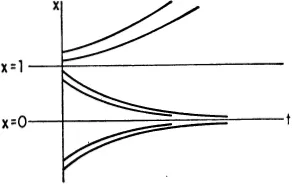
In nonlinear systems none of the above properties need be true. In fact, there is no principle of superposition, the behavior of solutions is generally only a local property, and there may be isolated periodic solutions (except for a phase shift). A simple example illustrating the local property of the behavior of solutions is
whose solutions are shown in Fig. 1-1.
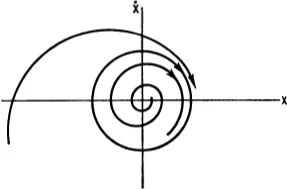
The most classical example of a system which has an isolated periodic solution (except for a shift in phase) is the van der Pol equation
whose trajectories in the
plane are shown in Fig. 1-2. The closed curve C has the property that all other trajectories approach it as t → ∞ except, of course, the trajectory which passes through the equilibrium point
. This is a phenomenon which is due to the nonlinear structure of the system and could never be explained by a linear analysis. Such an oscillation is called self-excited.
Fig. 1-1
Fig. 1-2
Another interesting phenomenon that may occur in nonlinear systems is the following: Suppose system (1-1) is linear and apply a periodic forcing function of period T to (1-1). If the unforced system has no periodic solution, then there can never be an isolated periodic solution of any period except T. In nonlinear systems, this is not the case and isolated periodic solutions of period mT, where m i...
Table of contents
Cover
Title Page
Copyright Page
Dedication
Contents
Preface
Part I. Introduction and Background Material
Part II. Periodic Solutions
Part III. Almost Periodic Solutions and Integral Manifolds
Appendix: Principle of Contraction Mappings
Bibliography
Index
Trusted by 375,005 students
Access to over 1.5 million titles for a fair monthly price.
Study more efficiently using our study tools.
Frequently asked questions
Yes, you can cancel anytime from the Subscription tab in your account settings on the Perlego website. Your subscription will stay active until the end of your current billing period. Learn how to cancel your subscription
No, books cannot be downloaded as external files, such as PDFs, for use outside of Perlego. However, you can download books within the Perlego app for offline reading on mobile or tablet. Learn how to download books offline
Perlego offers two plans: Essential and Complete
Essential is ideal for learners and professionals who enjoy exploring a wide range of subjects. Access the Essential Library with 800,000+ trusted titles and best-sellers across business, personal growth, and the humanities. Includes unlimited reading time and Standard Read Aloud voice.
Complete: Perfect for advanced learners and researchers needing full, unrestricted access. Unlock 1.5M+ books across hundreds of subjects, including academic and specialized titles. The Complete Plan also includes advanced features like Premium Read Aloud and Research Assistant.
Both plans are available with monthly, semester, or annual billing cycles.
We are an online textbook subscription service, where you can get access to an entire online library for less than the price of a single book per month. With over 1.5 million books across 990+ topics, we’ve got you covered! Learn about our mission
Look out for the read-aloud symbol on your next book to see if you can listen to it. The read-aloud tool reads text aloud for you, highlighting the text as it is being read. You can pause it, speed it up and slow it down. Learn more about Read Aloud
Yes! You can use the Perlego app on both iOS and Android devices to read anytime, anywhere — even offline. Perfect for commutes or when you’re on the go. Please note we cannot support devices running on iOS 13 and Android 7 or earlier. Learn more about using the app
Yes, you can access Oscillations in Nonlinear Systems by Jack K. Hale in PDF and/or ePUB format, as well as other popular books in Mathematics & Differential Equations. We have over 1.5 million books available in our catalogue for you to explore.