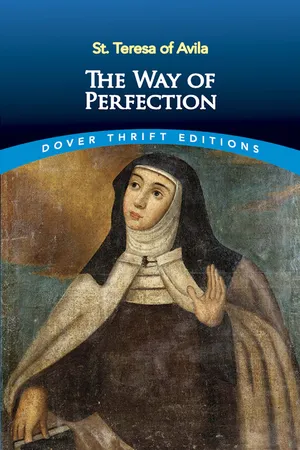
The Way of Perfection
eBook - ePub

The Way of Perfection

  1. 288 pages
  2. English
  3. ePUB (mobile friendly)
  4. Available on iOS & Android
eBook - ePub

About this book

This classic of the interior life and Christian mysticism remains as fresh and inspiring today as it was 400 years ago. Written by a prominent sixteenth-century Spanish mystic and Carmelite nun, it forms a practical guide to prayer that embraces readers with its warmth and accessibility.
St. Teresa of Avila's detailed directions on the achievement of spiritual perfection designate three essentials — fraternal love, detachment from material things, and true humility. She discusses a variety of maxims related to the practice of prayer and concludes with a thought-provoking commentary on the Lord's Prayer. A work of sublime mystical beauty, The Way of Perfection is above all a treatise of utter simplicity that offers lucid instruction to all seekers of a more meaningful way of life.

Frequently asked questions

Yes, you can cancel anytime from the Subscription tab in your account settings on the Perlego website. Your subscription will stay active until the end of your current billing period. Learn how to cancel your subscription.
No, books cannot be downloaded as external files, such as PDFs, for use outside of Perlego. However, you can download books within the Perlego app for offline reading on mobile or tablet. Learn more here.
Perlego offers two plans: Essential and Complete
  • Essential is ideal for learners and professionals who enjoy exploring a wide range of subjects. Access the Essential Library with 800,000+ trusted titles and best-sellers across business, personal growth, and the humanities. Includes unlimited reading time and Standard Read Aloud voice.
  • Complete: Perfect for advanced learners and researchers needing full, unrestricted access. Unlock 1.4M+ books across hundreds of subjects, including academic and specialized titles. The Complete Plan also includes advanced features like Premium Read Aloud and Research Assistant.
Both plans are available with monthly, semester, or annual billing cycles.
We are an online textbook subscription service, where you can get access to an entire online library for less than the price of a single book per month. With over 1 million books across 1000+ topics, we’ve got you covered! Learn more here.
Look out for the read-aloud symbol on your next book to see if you can listen to it. The read-aloud tool reads text aloud for you, highlighting the text as it is being read. You can pause it, speed it up and slow it down. Learn more here.
Yes! You can use the Perlego app on both iOS or Android devices to read anytime, anywhere — even offline. Perfect for commutes or when you’re on the go.
Please note we cannot support devices running on iOS 13 and Android 7 or earlier. Learn more about using the app.
Yes, you can access The Way of Perfection by St. Teresa of Avila, E. Allison Peers in PDF and/or ePUB format, as well as other popular books in Theology & Religion & Women Authors Literary Collections. We have over one million books available in our catalogue for you to explore.

Table of contents

  1. Cover
  2. Title page
  3. Copyright Page
  4. Contents
  5. Introduction
  6. Translator’s Note
  7. General Argument
  8. Protestation
  9. Prologue
  10. Chapter 1—Of the reason which moved me to found this convent in such strict observance
  11. Chapter 2-Treats of how the necessities of the body should be disregarded and of the good that comes from poverty
  12. Chapter 3—Continues the subject begun in the first chapter and persuades the sisters to busy themselves constantly in beseeching God to help those who work for the Church. Ends with an exclamatory prayer
  13. Chapter 4—Exhorts the nuns to keep their Rule and names three things which are important for the spiritual life. Describes the first of these three things, which is love of one’s neighbour, and speaks of the harm which can be done by in dividual friendships
  14. Appendix to Chapter 4
  15. Chapter 5—Continues speaking of confessors. Explains why it is important that they should be learned men
  16. Chapter 6—Returns to the subject of perfect love, already begun
  17. Chapter 7—Treats of the same subject of spiritual love and gives certain counsels for gaining it
  18. Chapter 8—Treats of the great benefit of self-detachment, both interior and exterior, from all things created
  19. Chapter 9—Treats of the great blessing that shunning their relatives brings to those who have left the world and shows how by doing so they will find truer friends
  20. Chapter 10—Teaches that detachment from the things aforementioned is insufficient if we are not detached from our own selves and that this virtue and humility go together
  21. Chapter 11—Continues to treat of mortification and describes how it may be attained in times of sickness
  22. Chapter 12—Teaches that the true lover of God must care little for life and honour
  23. Chapter 13—Continues to treat of mortification and explains how one must renounce the world’s standards of wisdom in order to attain to true wisdom
  24. Chapter 14—Treats of the great importance of not professing anyone whose spirit is contrary to the things aforementioned
  25. Chapter 15—Treats of the great advantage which comes from our not excusing ourselves, even though we find we are unjustly condemned
  26. Chapter 16—Describes the difference between perfection in the lives of contemplatives and in the lives of those who are content with mental prayer. Explains how it is sometimes possible for God to raise a distracted soul to perfect contemplation and the reason for this. This chapter and that which comes next are to be noted carefully
  27. Chapter 17—How not all souls are fitted for contemplation and how some take long to attain it. True humility will walk happily along the road by which the Lord leads it
  28. Chapter 18—Continues the same subject and shows how much greater are the trials of contemplatives than those of actives. This chapter offers great consolation to actives
  29. Chapter 19—Begins to treat of prayer. Addresses souls who cannot reason with the understanding
  30. Chapter 20—Describes how, in one way or another, we never lack consolation on the road of prayer. Counsels the sisters to include this subject continually in their conversation
  31. Chapter 21—Describes the great importance of setting out upon the practice of prayer with firm resolution and of heeding no difficulties put in the way by the devil
  32. Chapter 22—Explains the meaning of mental prayer
  33. Chapter 23—Describes the importance of not turning back when one has set out upon the way of prayer. Repeats how necessary it is to be resolute
  34. Chapter 24—Describes how vocal prayer may be practised with perfection and how closely allied it is to mental prayer
  35. Chapter 25—Describes the great gain which comes to a soul when it practises vocal prayer perfectly. Shows how God may raise it thence to things supernatural
  36. Chapter 26—Continues the description of a method for recollecting the thoughts. Describes means of doing this. This chapter is very profitable for those who are beginning prayer
  37. Chapter 27—Describes the great love shown us by the Lord in the first words of the Paternoster and the great importance of our making no account of good birth if we truly desire to be the daughters of Cod
  38. Chapter 28—Describes the nature of the Prayer of Recollection and sets down some of the means by which we can make it a habit
  39. Chapter 29—Continues to describe methods for achieving this Prayer of Recollection. Says what little account we should make of being favoured by our superiors
  40. Chapter 30—Describes the importance of understanding what we ask for in prayer. Treats of these words in the Paternoster: “Sanctificetur nomen tuum, adveniat regnum tuum”. Applies them to the Prayer of Quiet, and begins the explanation of them
  41. Chapter 31—Continues the same subject. Explains what is meant by the Prayer of Quiet. Gives several counsels to those who experience it. This chapter is very noteworthy
  42. Chapter 32—Expounds these words of the Paternoster: “Fiat voluntas tua sicut in coelo et in terra.” Describes how much is accomplished by those who repeat these words with full resolution and how well the Lord rewards them for it
  43. Chapter 33—Treats of our great need that the Lord should give us what we ask in these words of the Paternoster: “Panem nostrum quotidianum da nobis hodie.”
  44. Chapter 34—Continues the same subject. This is very suitable for reading after the reception of the Most Holy Sacrament
  45. Chapter 35—Describes the recollection which should be practised after Communion. Concludes this subject with an exclamatory prayer to the Eternal Father
  46. Chapter 36—Treats of these words in the Paternoster: “Dimitte nobis debita nostra”
  47. Chapter 37—Describes the excellence of this prayer called the Paternoster, and the many ways in which we shall find consolation in it
  48. Chapter 38—Treats of the great need which we have to beseech the Eternal Father to grant us what we ask in these words: “Et ne nos inducas in tentationem, sed libera nos a malo.” Explains certain temptations. This chapter is noteworthy
  49. Chapter 39—Continues the same subject and gives counsels concerning different kinds of temptation. Suggests two remedies by which we may be freed from temptations
  50. Chapter 40—Describes how, by striving always to walk in the love and fear of God, we shall travel safely amid all these temptations
  51. Chapter 41—Speaks of the fear of God and of how we must keep ourselves from venial sins
  52. Chapter 42—Treats of these last words of the Paternoster: “Sed libera nos a malo. Amen.” “But deliver us from evil. Amen.”