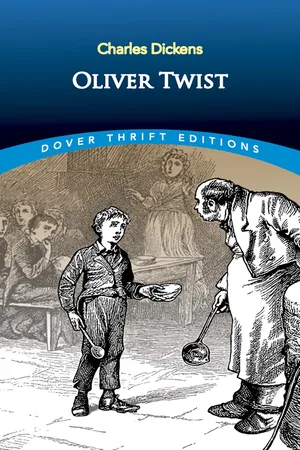
Starved and mistreated, empty bowl in hand, the young hero musters the courage to approach his master, saying, "Please, sir, I want some more." Oliver Twist's famous cry of the heart has resounded with readers since the novel's initial appearance in 1837, and the book remains a popular favorite with fans of all ages.
Dickens was no stranger to the pain of hunger and the degradation of poverty. He poured his own youthful experience of Victorian London's unspeakable squalor into this realistic depiction of the link between destitution and crime. Oliver escapes his miserable servitude by running away to London, where he unwillingly but inevitably joins a scabrous gang of thieves. Masterminded by the loathsome Fagin, the underworld crew features some of Dickens' most memorable characters, including the juvenile pickpocket known as the Artful Dodger, the vicious Bill Sikes, and gentle Nancy, an angel of self-sacrifice.
A profound social critic, Dickens introduced genteel readers to the problems of the poor in a way that had rarely been attempted before. This tale of the struggle between hope and cruelty continues to speak to modern audiences.
- 368 pages
- English
- ePUB (mobile friendly)
- Available on iOS & Android
eBook - ePub
Oliver Twist
About this book
Information
CHAPTER I
TREATS OF THE PLACE WHERE OLIVER TWIST WAS BORN; AND OF THE CIRCUMSTANCES ATTENDING HIS BIRTH.
Among other public buildings in a certain town, which for many reasons it will be prudent to refrain from mentioning, and to which I will assign no fictitious name, there is one anciently common to most towns, great or small: to wit, a workhouse; and in this workhouse was born; on a day and date which I need not trouble myself to repeat, inasmuch as it can be of no possible consequence to the reader, in this stage of the business at all events: the item of mortality whose name is prefixed to the head of this chapter.
For a long time after it was ushered into this world of sorrow and trouble, by the parish surgeon, it remained a matter of considerable doubt whether the child would survive to bear any name at all; in which case it is somewhat more than probable that these memoirs would never have appeared; or, if they had, that being comprised within a couple of pages, they would have possessed the inestimable merit of being the most concise and faithful specimen of biography, extant in the literature of any age or country.
Although I am not disposed to maintain that the being born in a workhouse, is in itself the most fortunate and enviable circumstance that can possibly befal a human being, I do mean to say that in this particular instance, it was the best thing for Oliver Twist that could by possibility have occurred. The fact is, that there was considerable difficulty in inducing Oliver to take upon himself the office of respiration,—a troublesome practice, but one which custom has rendered necessary to our easy existence; and for some time he lay gasping on a little flock mattress, rather unequally poised between this world and the next: the balance being decidedly in favour of the latter. Now, if, during this brief period, Oliver had been surrounded by careful grandmothers, anxious aunts, experienced nurses, and doctors of profound wisdom, he would most inevitably and indubitably have been killed in no time. There being nobody by, however, but a pauper old woman, who was rendered rather misty by an unwonted allowance of beer; and a parish surgeon who did such matters by contract; Oliver and Nature fought out the point between them. The result was, that, after a few struggles, Oliver breathed, sneezed, and proceeded to advertise to the inmates of the workhouse the fact of a new burden having been imposed upon the parish, by setting up as loud a cry as could reasonably have been expected from a male infant who had not been possessed of that very useful appendage, a voice, for a much longer space of time than three minutes and a quarter.
As Oliver gave this first proof of the free and proper action of his lungs, the patchwork coverlet which was carelessly flung over the iron bedstead, rustled; the pale face of a young woman was raised feebly from the pillow; and a faint voice imperfectly articulated the words, ‘Let me see the child, and die.’
The surgeon had been sitting with his face turned towards the fire: giving the palms of his hands, a warm and a rub alternately. As the young woman spoke, he rose, and advancing to the bed’s head, said, with more kindness than might have been expected of him:
‘Oh you must not talk about dying yet.’
‘Lor bless her dear heart, no!’ interposed the nurse, hastily depositing in her pocket a green glass bottle, the contents of which she had been tasting in a corner with evident satisfaction. ‘Lor bless her dear heart, when she has lived as long as I have, sir, and had thirteen children of her own, and all on ’em dead except two, and them in the wurkus with me, she’ll know better than to take on in that way, bless her dear heart! Think what it is to be a mother, there’s a dear young lamb, do.’
Apparently this consolatory perspective of a mother’s prospects, failed in producing its due effect. The patient shook her head, and stretched out her hand towards the child.
The surgeon deposited it in her arms. She imprinted her cold white lips passionately on its forehead; passed her hands over her face; gazed wildly round; shuddered; fell back—and died. They chafed her breast, hands, and temples; but the blood had stopped for ever. They talked of hope and comfort. They had been strangers too long.
‘It’s all over, Mrs. Thingummy!’ said the surgeon at last.
‘Ah, poor dear, so it is!’ said the nurse, picking up the cork of the green bottle, which had fallen out on the pillow as she stooped to take up the child. ‘Poor dear!’
‘You needn’t mind sending up to me, if the child cries, nurse,’ said the surgeon, putting on his gloves with great deliberation. ‘It’s very likely it will be troublesome. Give it a little gruel if it is.’ He put on his hat, and, pausing by the bed-side on his way to the door, added ‘She was a good-looking girl, too; where did she come from?’
‘She was brought here last night,’ replied the old woman, ‘by the overseer’s order. She was found lying in the street. She had walked some distance, for her shoes were worn to pieces; but where she came from, or where she was going to, nobody knows.’
The surgeon leaned over the body, and raised the left hand. ‘The old story,’ he said, shaking his head: ‘no wedding-ring, I see. Ah! Good-night! ’
The medical gentleman walked away to dinner; and the nurse, having once more applied herself to the green bottle, sat down on a low chair before the fire, and proceeded to dress the infant.
What an excellent example of the power of dress, young Oliver Twist was! Wrapped in the blanket which had hitherto formed his only covering, he might have been the child of a nobleman or a beggar; it would have been hard for the haughtiest stranger to have assigned him his proper station in society. But now that he was enveloped in the old calico robes which had grown yellow in the same service, he was badged and ticketed, and fell into his place at once—a parish child—the orphan of a workhouse—the humble half-starved drudge—to be cuffed and buffeted through the world—despised by all, and pitied by none.
Oliver cried lustily. If he could have known that he was an orphan, left to the tender mercies of churchwardens and overseers, perhaps he would have cried the louder.
CHAPTER II
TREATS OF OLIVER TWIST’S GROWTH, EDUCATION, AND BOARD.
For the next eight or ten months, Oliver was the victim of a systematic course of treachery and deception. He was brought up by hand. The hungry and destitute situation of the infant orphan was duly reported by the workhouse authorities to the parish authorities. The parish authorities inquired with dignity of the workhouse authorities, whether there was no female then domiciled in ‘the house’ who was in a situation to impart to Oliver Twist, the consolation and nourishment of which he stood in need. The workhouse authorities replied with humility, that there was not. Upon this, the parish authorities magnanimously and humanely resolved, that Oliver should be ‘farmed,’ or, in other words, that he should be despatched to a branch-workhouse some three miles off, where twenty or thirty other juvenile offenders against the poor-laws, rolled about the floor all day, without the inconvenience of too much food or too much clothing, under the parental superintendence of an elderly female, who received the culprits at and for the consideration of sevenpence-halfpenny per small head per week. Sevenpence-halfpenny’s worth per week is a good round diet for a child; a great deal may be got for sevenpence-halfpenny: quite enough to overload its stomach, and make it uncomfortable. The elderly female was a woman of wisdom and experience; she knew what was good for children; and she had a very accurate perception of what was good for herself. So, she appropriated the greater part of the weekly stipend to her own use, and consigned the rising parochial generation to even a shorter allowance than was originally provided for them. Thereby finding in the lowest depth a deeper still; and proving herself a very great experimental philosopher.
Everybody knows the story of another experimental philosopher, who had a great theory about a horse being able to live without eating, and who demonstrated it so well, that he got his own horse down to a straw a day, and would unquestionably have rendered him a very spirited and rampacious animal on nothing at all, if he had not died, just four-and-twenty hours before he was to have had his first comfortable bait of air. Unfortunately for the experimenal philosophy of the female to whose protecting care Oliver Twist was delivered over, a similar result usually attended the operation of her system; for at the very moment when the child had contrived to exist upon the smallest possible portion of the weakest possible food, it did perversely happen in eight and a half cases out of ten, either that it sickened from want and cold, or fell into the fire from neglect, or got half-smothered by accident; in any one of which cases, the miserable little being was usually summoned into another world, and there gathered to the fathers it had never known in this.
Occasionally, when there was some more than usually interesting inquest upon a parish child who had been overlooked in turning up a bedstead, or inadvertently scalded to death when there happened to be a washing; though the latter accident was very scarce,—anything approaching to a washing being of rare occurrence in the farm—the jury would take it into their heads to ask troublesome questions, or the parishioners would rebelliously affix their signatures to a remonstrance. But these impertinences were speedily checked by the evidence of the surgeon, and the testimony of the beadle; the former of whom had always opened the body and found nothing inside (which was very probable indeed), and the latter of whom invariably swore whatever the parish wanted; which was very self-devotional. Besides, the board made periodical pilgrimages to the farm, and always sent the beadle the day before, to say they were going. The children were neat and clean to behold, when they went; and what more would the people have!
It cannot be expected that this system of farming would produce any very extraordinary or luxuriant crop. Oliver Twist’s ninth birth-day found him a pale thin child, somewhat diminutive in stature, and de-cidely small in circumference. But nature or inheritance had implanted a good sturdy spirit in Oliver’s breast. It had had plenty of room to expand, thanks to the spare diet of the establishment; and perhaps to this circumstance may be attributed his having any ninth birth-day at all. Be this as it may, however, it was his ninth birth-day; and he was keeping it in the coal-cellar with a select party of two other young gentleman, who, after participating with him in a sound threshing, had been locked up for atrociously presuming to be hungry, when Mrs. Mann, the good lady of the house, was unexpectedly startled by the apparition of Mr. Bumble, the beadle, striving to undo the wicket of the garden-gate.
‘Goodness gracious! is that you, Mr. Bumble, sir?’ said Mrs. Mann, thrusting her head out of the window in well-affected ecstasies of joy. ‘(Susan, take Oliver and them two brats up stairs, and wash ’em directly.)—My heart alive! Mr. Bumble, how glad I am to see you, sure-ly!’
Now, Mr. Bumble was a fat man, and a choleric; so, instead of responding to this open-hearted salutation in a kindred spirit, he gave the little wicket a tremendous shake, and then bestowed upon it a kick which could have emanated from no leg but a beadle’s.
‘Lor, only think,’ said Mrs. Mann, running out,—for the three boys had been removed by this time,—‘only think of that! That I should have forgotten that the gate was bolted on the inside, on account of them dear children! Walk in sir; walk in, pray, Mr. Bumble, do sir.’
Although this invitation was accompanied with a curtsey that might have softened the heart of a churchwarden, it by no means mollified the beadle.
‘Do you think this respectful or proper conduct, Mrs. Mann,’ inquired Mr. Bumble, grasping his cane, ‘to keep the parish officers a waiting at your garden-gate, when they come here upon porochial business with the porochial orphans? Are you aweer, Mrs. Mann, that you are, as I may say, a porochial delegate, and a stipendiary?’
‘I’m sure, Mr. Bumble, that I was only a telling one or two of the dear children as is so fond of you, that it was you a coming,’ replied Mrs. Mann with great humility.
Mr. Bumble had a great idea of his oratorical powers and his importance. He had displayed the one, and vindicated the other. He relaxed.
‘Well, well, Mrs. Mann,’ he replied in a calmer tone; ‘it may be as you say; it may be. Lead the way in, Mrs. Mann, for I come on business, and have something to say.’
Mrs. Mann ushered the beadle into a small parlour with a brick floor; placed a seat for him; and officiously deposited his cocked hat and cane on the table before him. Mr. Bumble wiped from his forehead the perspiration which his walk had engendered; glanced complacently at the cocked hat; and smiled. Yes, he smiled. Beadles are but men: and Mr. Bumble smiled.
‘Now don’t you be offended at what I’m a going to say,’ observed Mrs. Mann, with captivating sweetness. ‘You’ve had a long walk, you know, or I wouldn’t mention it. Now, will you take a little drop of somethink, Mr. Bumble?’
‘Not a drop. Not a drop,’ said Mr. Bumble, waving his right hand in a dignified, but placid manner.
‘I think you will,’ said Mrs. Mann, who had noticed the tone of the refusal, and the gesture that had accompanied it. ‘Just a leetle drop, with a little cold water, and a lump of sugar.’
Mr. Bumble coughed.
‘Now, just a leetle drop,’ said Mrs. Mann persuasively.
‘What is it?’ inquired the beadle.
‘Why, it’s what I’m obliged to keep a little of in the house, to put into the blessed infants’ Daffy, when they ain’t well, Mr. Bumble,’ replied Mrs. Mann as she opened a corner cupboard, and took down a bottle and glass. ‘It’s gin. I’ll not deceive you, Mr. B. It’s gin.’
‘Do you give the children Daffy, Mrs. Mann?’ inquired Bumble, following with his eyes the interesting process of mixing.
‘Ah, bless ’em, that I do, dear as it is,’ replied the nurse. ‘I couldn’t see ’em suffer before my very eyes, you know, sir.’
‘No’; said Mr. Bumble approvingly; ‘no, you could not. You are a humane woman, Mrs. Mann.’ (Here she set down the glass.) ‘I shall take a early opportunity of mentioning it to the board, Mrs. Mann.’ (He drew it towards him.) ‘You feel as a mother, Mrs. Mann.’ (He stirred the gin-and-water.) ‘I—I drink your health with cheerfulness, Mrs. Mann;’ and he swallowed half of it.
‘And now about business,’ said the beadle, taking out a leathern pocket-book. ‘The child that was half-baptized Oliver Twist, is nine year old to-day.’
‘Bless him!’ interposed Mrs. Mann, inflaming her left eye with the corner of her apron.
‘And notwithstanding a offered reward of ten pound, which was afterwards increased to twenty pound. Notwithstanding the most superlative, and, I may say, supernat’ral exertions on the part of this parish,’ said Bumble, ‘we have never been able to discover who is his father, or what was his mother’s settlement, name, or con—di-tion. ’
Mrs. Mann raised her hands in astonishment; but added, after a moment’s reflection, ‘How comes he to have any name at all, then?’
The beadle drew himself up with great pride, and said, ‘I inwented it.’
‘You, Mr. Bumble!’
‘I, Mrs. Mann. We name our fondlins in alphabetical order. The last was a S,—Swubble, I named him. This was a T,—Twist, I named him. The next one as comes will be Unwin, and the next Vilkins. I have got names ready made to the end of the alphabet, and all the way through it again, when we come to Z.’
‘Why, you’re quite a literary character, sir!’ said Mrs. Mann.
‘Well, well,’ said the beadle, evidently gratified with the compliment; ‘perhaps I may be. Perhaps I may be, Mrs. Mann.’ He finished the gin-and-water, and added, ‘Oliver being now too old to remain here, the board have determined to have him back into the house. I have come out myself to take him there. So let me see him at once.’
‘I’ll fetch him directly,’ said Mrs. Mann, leaving the room for that purpose. Oliver, having had by this time as much of the outer coat of dirt, which encrusted his face and hands, removed, as could be scrubbed off in one washing, was led into the room by his benevolent protectress.
‘Make a bow to the gentleman, Oliver,’ said Mrs. Mann.
Oliver made a bow, which was divided between the beadle on the chair, and the cocked-hat on the table.
‘Will you go along with me, Oliver?’ said Mr. Bumble, in a majestic voice.
Oliver was about to say that he would go along with anybody with great readiness, when, glancing upward, he caught sight of Mrs. Mann, who had got behind the beadle’s chair, and was shaking her fist at him with a furious countenance. He took the hint at once, for the fist had been too often impressed upon his body not to be deeply impressed upon his recollection.
‘Will she go with me?’ inquired poor Oliver.
‘No, she can’t,’ replied Mr. Bumble. ‘But she’ll come and see you sometimes.’
This was no very great consolation to the child. Young as he was, however, he had sense enough to make a feint of feeling great regret at going away. It was no very difficult matter for the boy to call tears into his eyes. Hunger and recent ill-usage are great assistants if you want to cry; and Oliver cried very naturally indeed. Mrs. Mann gave him a thousand embraces, and, what Oliver wanted a great deal more, a piece of bread and butter, lest he should seem too hungry when he got to the workhouse. With the slice of bread in his hand, and the little brown-cloth ...
Table of contents
- Title Page
- Copyright Page
- Note
- The Author’s Preface to the Third Edition (1841)
- Table of Contents
- CHAPTER I - TREATS OF THE PLACE WHERE OLIVER TWIST WAS BORN; AND OF THE CIRCUMSTANCES ATTENDING HIS BIRTH.
- CHAPTER II - TREATS OF OLIVER TWIST’S GROWTH, EDUCATION, AND BOARD.
- CHAPTER III - RELATES HOW OLIVER TWIST WAS VERY NEAR GETTING A PLACE, WHICH WOULD NOT HAVE BEEN A SINECURE.
- CHAPTER IV - OLIVER, BEING OFFERED ANOTHER PLACE, MAKES HIS FIRST ENTRY INTO PUBLIC LIFE.
- CHAPTER V - OLIVER MINGLES WITH NEW ASSOCIATES. GOING TO A FUNERAL FOR THE FIRST TIME, HE FORMS AN UNFAVOURABLE NOTION OF HIS MASTER’S BUSINESS.
- CHAPTER VI - OLIVER, BEING GOADED BY THE TAUNTS OF NOAH, ROUSES INTO ACTION, AND RATHER ASTONISHES HIM.
- CHAPTER VII - OLIVER CONTINUES REFRACTORY.
- CHAPTER VIII - OLIVER WALKS TO LONDON. HE ENCOUNTERS ON THE ROAD, A STRANGE SORT OF YOUNG GENTLEMAN.
- CHAPTER IX - CONTAINING FURTHER PARTICULARS CONCERNING THE PLEASANT OLD GENTLEMAN, AND HIS HOPEFUL PUPILS.
- CHAPTER X - OLIVER BECOMES BETTER ACQUAINTED WITH THE CHARACTERS OF HIS NEW ASSOCIATES; AND PURCHASES EXPERIENCE AT A HIGH PRICE. BEING A SHORT, BUT VERY IMPORTANT CHAPTER, IN THIS HISTORY.
- CHAPTER XI - TREATS OF MR. FANG THE POLICE MAGISTRATE; AND FURNISHES A SLIGHT SPECIMEN OF HIS MODE OF ADMINISTERING JUSTICE.
- CHAPTER XII - IN WHICH OLIVER IS TAKEN BETTER CARE OF, THAN HE EVER WAS BEFORE. AND IN WHICH THE NARRATIVE REVERTS TO THE MERRY OLD GENTLEMAN AND HIS YOUTHFUL FRIENDS.
- CHAPTER XIII - SOME NEW ACQUAINTANCES ARE INTRODUCED TO THE INTELLIGENT READER; CONNECTED WITH WHOM, VARIOUS PLEASANT MATTERS ARE RELATED, APPERTAINING TO THIS HISTORY.
- CHAPTER XIV - COMPRISING FURTHER PARTICULARS OF OLIVER’S STAY AT MR. BROWNLOW’S. WITH THE REMARKABLE PREDICTION WHICH ONE MR. GRIMWIG UTTERED CONCERNING HIM, WHEN HE WENT OUT ON AN ERRAND.
- CHAPTER XV - SHOWING HOW VERY FOND OF OLIVER TWIST, THE MERRY OLD JEW AND MISS NANCY WERE.
- CHAPTER XVI - RELATES WHAT BECAME OF OLIVER TWIST, AFTER HE HAD BEEN CLAIMED BY NANCY.
- CHAPTER XVII - OLIVER’S DESTINY, CONTINUING UNPROPITIOUS, BRINGS A GREAT MAN TO LONDON TO INJURE HIS REPUTATION.
- CHAPTER XVIII - HOW OLIVER PASSED HIS TIME, IN THE IMPROVING SOCIETY OF HIS REPUTABLE FRIENDS.
- CHAPTER XIX - IN WHICH A NOTABLE PLAN IS DISCUSSED AND DETERMINED ON.
- CHAPTER XX - WHEREIN OLIVER IS DELIVERED OVER TO MR. WILLIAM SIKES.
- CHAPTER XXI - THE EXPEDITION.
- CHAPTER XXII - THE BURGLARY.
- CHAPTER XXIII - WHICH CONTAINS THE SUBSTANCE OF A PLEASANT CONVERSATION BETWEEN MR. BUMBLE AND A LADY; AND SHEWS THAT EVEN A BEADLE MAY BE SUSCEPTIBLE ON SOME POINTS.
- CHAPTER XXIV - TREATS OF A VERY POOR SUBJECT. BUT IS A SHORT ONE; AND MAY BE FOUND OF IMPORTANCE IN THIS HISTORY.
- CHAPTER XXV - WHEREIN THIS HISTORY REVERTS TO MR. FAGIN AND COMPANY.
- CHAPTER XXVI - IN WHICH, A MYSTERIOUS CHARACTER APPEARS UPON THE SCENE; AND MANY THINGS, INSEPARABLE FROM THIS HISTORY, ARE DONE AND PERFORMED.
- CHAPTER XXVII - ATONES FOR THE UNPOLITENESS OF A FORMER CHAPTER; WHICH DESERTED A LADY, MOST UNCEREMONIOUSLY.
- CHAPTER XXVIII - LOOKS AFTER OLIVER, AND PROCEEDS WITH HIS ADVENTURES.
- CHAPTER XXIX - HAS AN INTRODUCTORY ACCOUNT OF THE INMATES OF THE HOUSE, TO WHICH OLIVER RESORTED.
- CHAPTER XXX - RELATES WHAT OLIVER’S NEW VISITORS THOUGHT OF HIM.
- CHAPTER XXXI - INVOLVES A CRITICAL POSITION.
- CHAPTER XXXII - OF THE HAPPY LIFE OLIVER BEGAN TO LEAD WITH HIS KIND FRIENDS.
- CHAPTER XXXIII - WHEREIN THE HAPPINESS OF OLIVER AND HIS FRIENDS, EXPERIENCES A SUDDEN CHECK.
- CHAPTER XXXIV - CONTAINS SOME INTRODUCTORY PARTICULARS RELATIVE TO A YOUNG GENTLEMAN WHO NOW ARRIVES UPON THE SCENE; AND A NEW ADVENTURE WHICH HAPPENED TO OLIVER.
- CHAPTER XXXV - CONTAINING THE UNSATISFACTORY RESULT OF OLIVER’S ADVENTURE; AND A CONVERSATION OF SOME IMPORTANCE BETWEEN HARRY MAYLIE AND ROSE.
- CHAPTER XXXVI - IS A VERY SHORT ONE, AND MAY APPEAR OF NO GREAT IMPORTANCE IN ITS PLACE. BUT IT SHOULD BE READ NOTWITHSTANDING, AS A SEQUEL TO THE LAST, AND A KEY TO ONE THAT WILL FOLLOW WHEN ITS TIME ARRIVES.
- CHAPTER XXXVII - IN WHICH THE READER MAY PERCEIVE A CONTRAST, NOT UNCOMMON IN MATRIMONIAL CASES.
- CHAPTER XXXVIII - CONTAINING AN ACCOUNT OF WHAT PASSED BETWEEN MR. AND MRS. BUMBLE, AND MONKS, AT THEIR NOCTURNAL INTERVIEW.
- CHAPTER XXXIX - INTRODUCES SOME RESPECTABLE CHARACTERS WITH WHOM THE READER IS ALREADY ACQUAINTED, AND SHOWS HOW MONKS AND THE JEW LAID THEIR WORTHY HEADS TOGETHER.
- CHAPTER XL - A STRANGE INTERVIEW, WHICH IS A SEQUEL TO THE LAST CHAPTER.
- CHAPTER XLI - CONTAINING FRESH DISCOVERIES, AND SHOWING THAT SURPRISES, LIKE MISFORTUNES, SELDOM COME ALONE.
- CHAPTER XLII - AN OLD ACQUAINTANCE OF OLIVER’S, EXHIBITING DECIDED MARKS OF GENIUS, BECOMES A PUBLIC CHARACTER IN THE METROPOLIS.
- CHAPTER XLIII - WHEREIN IS SHOWN HOW THE ARTFUL DODGER GOT INTO TROUBLE.
- CHAPTER XLIV - THE TIME ARRIVES, FOR NANCY TO REDEEM HER PLEDGE TO ROSE MAYLIE. SHE FAILS.
- CHAPTER XLV - NOAH CLAYPOLE IS EMPLOYED BY FAGIN ON A SECRET MISSION.
- CHAPTER XLVI - THE APPOINTMENT KEPT.
- CHAPTER XLVII - FATAL CONSEQUENCES.
- CHAPTER XLVIII - THE FLIGHT OF SIKES.
- CHAPTER XLIX - MONKS AND MR. BROWNLOW AT LENGTH MEET. THEIR CONVERSATION, AND THE INTELLIGENCE THAT INTERRUPTS IT.
- CHAPTER L - THE PURSUIT AND ESCAPE.
- CHAPTER LI - AFFORDING AN EXPLANATION OF MORE MYSTERIES THAN ONE, AND COMPREHENDING A PROPOSAL OF MARRIAGE WITH NO WORD OF SETTLEMENT OR PIN-MONEY.
- CHAPTER LII - THE JEW’S LAST NIGHT ALIVE.
- CHAPTER LIII - AND LAST.
- DOVER -THRIFT -EDITIONS
Trusted by 375,005 students
Access to over 1.5 million titles for a fair monthly price.
Study more efficiently using our study tools.
Frequently asked questions
Yes, you can cancel anytime from the Subscription tab in your account settings on the Perlego website. Your subscription will stay active until the end of your current billing period. Learn how to cancel your subscription
No, books cannot be downloaded as external files, such as PDFs, for use outside of Perlego. However, you can download books within the Perlego app for offline reading on mobile or tablet. Learn how to download books offline
We are an online textbook subscription service, where you can get access to an entire online library for less than the price of a single book per month. With over 1.5 million books across 990+ topics, we’ve got you covered! Learn about our mission
Look out for the read-aloud symbol on your next book to see if you can listen to it. The read-aloud tool reads text aloud for you, highlighting the text as it is being read. You can pause it, speed it up and slow it down. Learn more about Read Aloud
Yes! You can use the Perlego app on both iOS and Android devices to read anytime, anywhere — even offline. Perfect for commutes or when you’re on the go.
Please note we cannot support devices running on iOS 13 and Android 7 or earlier. Learn more about using the app
Please note we cannot support devices running on iOS 13 and Android 7 or earlier. Learn more about using the app
Yes, you can access Oliver Twist by Charles Dickens in PDF and/or ePUB format, as well as other popular books in Literature & Classics. We have over 1.5 million books available in our catalogue for you to explore.