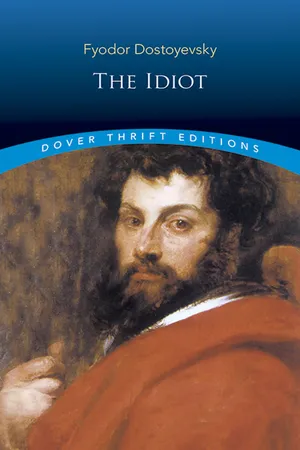
One of the towering figures of Russian literature, Fyodor Dostoyevsky depicted with remarkable insight the depth and complexity of the human soul. In this literary classic, he focuses on Prince Myshkin — a nobleman whose gentle, child-like nature, and refusal to be offended by anything has earned him the nickname of "the idiot."
Returning to Russia from Switzerland, where he underwent medical treatment for a number of years, Myshkin learns of his benefactor's death, finds himself heir to a large fortune, and without instigation, becomes entangled in the intrigues of a corrupt ruling class.
A superb, panoramic view of 19th-century Russian manners, morals, and philosophy, The Idiot remains a provocative example of psychological realism.
- 544 pages
- English
- ePUB (mobile friendly)
- Available on iOS & Android
eBook - ePub
The Idiot
About this book
Information
Topic
LiteraturSubtopic
AltertumswissenschaftenPART ONE
1
At nine o’clock in the morning, towards the end of November, the Warsaw train was approaching Petersburg at full speed. It was thawing, and so damp and foggy that it was difficult to distinguish anything ten paces from the line to right or left of the carriage windows. Some of the passengers were returning from abroad, but the third-class compartments were most crowded, chiefly with people of humble rank, who had come a shorter distance on business. All of course were tired and shivering, their eyes were heavy after the night’s journey, and all their faces were pale and yellow to match the fog.
In one of the third-class carriages, two passengers had, from early dawn, been sitting facing one another by the window. Both were young men, not very well dressed, and travelling with little luggage; both were of rather striking appearance, and both showed a desire to enter into conversation. If they had both known what was remarkable in one another at that moment, they would have been surprised at the chance which had so strangely brought them opposite one another in a third-class carriage of the Warsaw train. One of them was a short man about twenty-seven, with almost black curly hair and small, grey, fiery eyes. He had a broad and flat nose and high cheek bones. His thin lips were continually curved in an insolent, mocking and even malicious smile. But the high and well-shaped forehead redeemed the ignoble lines of the lower part of the face. What was particularly striking about the young man’s face was its death-like pallor, which gave him a look of exhaustion in spite of his sturdy figure, and at the same time an almost painfully passionate expression, out of keeping with his coarse and insolent smile and the hard and conceited look in his eyes. He was warmly dressed in a full, black, sheepskin-lined overcoat, and had not felt the cold at night, while his shivering neighbour had been exposed to the chill and damp of a Russian November night, for which he was evidently unprepared. He had a fairly thick and full cloak with a big hood, such as is often used in winter by travellers abroad in Switzerland, or the North of Italy, who are not of course proposing such a journey as that from Eydtkuhnen to Petersburg. But what was quite suitable and satisfactory in Italy turned out not quite sufficient for Russia. The owner of the cloak was a young man, also twenty-six or twenty-seven years old, above the average in height, with very fair thick hair, with sunken cheeks and a thin, pointed, almost white beard. His eyes were large, blue and dreamy; there was something gentle, though heavy-looking in their expression, something of that strange look from which some people can recognise at the first glance a victim of epilepsy. Yet the young man’s face was pleasing, thin and clean-cut, though colourless, and at this moment blue with cold. He carried a little bundle tied up in an old faded silk handkerchief, apparently containing all his belongings. He wore thick-soled shoes and gaiters, all in the foreign style. His dark-haired neighbour in the sheepskin observed all this, partly from having nothing to do, and at last, with an indelicate smile, in which satisfaction at the misfortunes of others is sometimes so unceremoniously and casually expressed, he asked:
“Chilly?”
And he twitched his shoulders.
“Very,” answered his neighbour, with extraordinary readiness, “and to think it’s thawing too. What if it were freezing? I didn’t expect it to be so cold at home. I’ve got out of the way of it.”
“From abroad, eh?”
“Yes, from Switzerland.”
“Phew! You don’t say so!” The dark-haired man whistled and laughed.
They fell into talk. The readiness of the fair young man in the Swiss cloak to answer all his companion’s inquiries was remarkable. He betrayed no suspicion of the extreme impertinence of some of his misplaced and idle questions. He told him he had been a long while, over four years, away from Russia, that he had been sent abroad for his health on account of a strange nervous disease, something of the nature of epilepsy or St. Vitus’s dance, attacks of twitching and trembling. The dark man smiled several times as he listened, and laughed, especially when, in answer to his inquiry, “Well, have they cured you?” his companion answered, “No, they haven’t.”
“Ha! You must have wasted a lot of money over it, and we believe in them over here,” the dark man observed, sarcastically.
“Perfectly true!” interposed a badly dressed, heavily built man of about forty, with a red nose and pimpled face, sitting beside them.
He seemed to be some sort of petty official, with the typical failings of his class. “Perfectly true, they only absorb all the resources of Russia for nothing!”
“Oh, you are quite mistaken in my case!” the patient from Switzerland replied in a gentle and conciliatory voice. “I can’t dispute your opinion, of course, because I don’t know all about it, but my doctor shared his last penny with me for the journey here; and he’s been keeping me for nearly two years at his expense.”
“Why, had you no one to pay for you?” asked the dark man.
“No; Mr. Pavlishtchev, who used to pay for me there, died two years ago. I’ve written since to Petersburg, to Madame Epanchin, a distant relation of mine, but I’ve had no answer. So I’ve come. . . .”
“Where are you going then?”
“You mean, where am I going to stay? . . . I really don’t know yet. . . . Somewhere. . . .”
“You’ve not made up your mind yet?” And both his listeners laughed again.
“And I shouldn’t wonder if that bundle is all you’ve got in the world?” queried the dark man.
“I wouldn’t mind betting it is,” chimed in the red-nosed official with a gleeful air, “and that he’s nothing else in the luggage van, though poverty is no vice, one must admit.”
It appeared that this was the case; the fair-haired young man acknowledged it at once with peculiar readiness.
“Your bundle has some value, anyway,” the petty official went on, when they had laughed to their heart’s content (strange to say, the owner of the bundle began to laugh too, looking at them, and that increased their mirth), “and though one may safely bet there is no gold in it, neither French, German, nor Dutch—one may be sure of that, if only from the gaiters you have got on over your foreign shoes—yet if you can add to your bundle a relation such as Madame Epanchin, the general’s lady, the bundle acquires a very different value, that is if Madame Epanchin really is related to you, and you are not labouring under a delusion, a mistake that often happens . . . through excess of imagination.”
“Ah, you’ve guessed right again,” the fair young man assented. “It really is almost a mistake, that’s to say, she is almost no relation; so much so that I really was not at all surprised at getting no answer. It was what I expected.”
“You simply wasted the money for the stamps. H’m! . . . anyway you are straightforward and simple-hearted, and that’s to your credit. H’m! . . . I know General Epanchin, for he is a man every one knows; and I used to know Mr. Pavlishtchev, too, who paid your expenses in Switzerland, that is if it was Nikolay Andreyevitch Pavlishtchev, for there were two of them, cousins. The other lives in the Crimea. The late Nikolay Andreyevitch was a worthy man and well connected, and he’d four thousand serfs in his day. . . .” “That’s right, Nikolay Andreyevitch was his name.”
And as he answered, the young man looked intently and searchingly at the omniscient gentleman.
Such omniscient gentlemen are to be found pretty often in a certain stratum of society. They know everything. All the restless curiosity and faculties of their mind are irresistibly bent in one direction, no doubt from lack of more important ideas and interests in life, as the critic of to-day would explain. But the words, “they know everything,” must be taken in a rather limited sense: in what department so-and-so serves, who are his friends, what his income is, where he was governor, who his wife is and what dowry she brought him, who are his first cousins and who are his second cousins, and everything of that sort. For the most part these omniscient gentlemen are out at elbow, and receive a salary of seventeen roubles a month. The people of whose lives they know every detail would be at a loss to imagine their motives. Yet many of them get positive consolation out of this knowledge, which amounts to a complete science, and derive from it self-respect and their highest spiritual gratification. And indeed it is a fascinating science. I have seen learned men, literary men, poets, politicians, who sought and found in that science their loftiest comfort and their ultimate goal, and have indeed made their career only by means of it.
During this part of the conversation the dark young man had been yawning and looking aimlessly out of the window, impatiently expecting the end of the journey. He was preoccupied, extremely so, in fact, almost agitated. His behaviour indeed was somewhat strange; sometimes he seemed to be listening without hearing, and looking without seeing. He would laugh sometimes not knowing, or forgetting, what he was laughing at.
“Excuse me, whom have I the honour” . . . the pimply gentleman said suddenly, addressing the fair young man with the bundle.
“Prince Lyov Nikolayevitch Myshkin is my name,” the latter replied with prompt and unhesitating readiness.
“Prince Myshkin? Lyov Nikolayevitch? I don’t know it. I don’t believe I’ve ever heard it,” the official responded, thoughtfully. “I don’t mean the surname, it’s an historical name, it’s to be found in Karamzin’s History, and with good reason; I mean you personally, and indeed there are no Prince Myshkins to be met anywhere, one never hears of them.”
“I should think not,” Myshkin answered at once, “there are no Prince Myshkins now except me; I believe I am the last of them. And as for our fathers and grandfathers, some of them were no more than peasant proprietors. My father was a sub-lieutenant in the army, yet General Epanchin’s wife was somehow Princess Myshkin; she was the last of her lot, too. . . .”
“He-he-he! The last of her lot! He-he! how funnily you put it,” chuckled the official.
The dark man grinned too. Myshkin was rather surprised that he had perpetrated a joke, and indeed it was a feeble one.
“Believe me, I said it without thinking,” he explained at last, wondering.
“To be sure, to be sure you did,” the official assented good-humouredly.
“And have you been studying, too, with the professor out there, prince?” asked the dark man suddenly.
“Yes . . . I have.”
“But I’ve never studied anything.”
“Well, I only did a little, you know,” added Myshkin almost apologetically. “I couldn’t be taught systematically, because of my illness.”
“Do you know the Rogozhins?” the dark man asked quickly.
“No, I don’t know them at all. I know very few people in Russia. Are you a Rogozhin?”
“Yes, my name is Rogozhin, Parfyon.”
“Parfyon? One of those Rogozhins . . .” the official began, with increased gravity.
“Yes, one of those, one of the same,” the dark man interrupted quickly, with uncivil impatience. He had not once addressed the pimply gentleman indeed, but from the beginning had spoken only to Myshkin.
“But . . . how is that?” The official was petrified with amazement, and his eyes seemed almost starting out of his head. His whole face immediately assumed an expression of reverence and servility, almost of awe. “Related to the Semyon Parfenovitch Rogozhin, who died a month ago and left a fortune of two and a half million roubles?”
“And how do you know he left two and a half millions?” the dark man interrupted, not deigning even now to glance towards the official.
“Look at him!” he winked to Myshkin, indicating him. “What do they gain by cringing upon one at once? But it’s true that my father has been dead a month, and here I am, coming home from Pskov almost without boots to my feet. My brother, the rascal, and my mother haven’t sent me a penny nor a word—nothing! As if I were a dog! I’ve been lying ill with fever at Pskov for the last month.”
“And now you are coming in for a tidy million, at the lowest reckoning, oh! Lord!” the official flung up his hands.
“What is it to him, tell me that?” said Rogozhin, nodding irritably and angrily towards him again. “Why, I am not going to give you a farthing of it, you may stand on your head before me, if you like.”
“I will, I will.”
“You see! But I won’t give you anything, I won’t, if you dance for a whole week.”
“Well, don’t! Why should you? Don’t! But I shall dance, I shall leave my wife and little children and dance before you. I must do homage! I must!”
“Hang you!” the dark man spat. “Five weeks ago, like you with nothing but a bundle,” he said, addressing the prince, “I ran away from my father to my aunt’s at Pskov. And there I fell ill and he died while I was away. He kicked the bucket. Eternal memory to the deceased, but he almost killed me! Would you believe it, prince, yes, by God! If I hadn’t run away then, he would have killed me on the spot.”
“Did you make him very angry?” asked the prince, looking with special interest at the millionaire in the sheepskin. But though there may have been something remarkable in the million and in coming into an inheritance, Myshkin was surprised and interested at something else as well. And Rogozhin himself for some reason talked readily to the prince, though indeed his need of conversation seemed rather physical than mental, arising more from preoccupation than frankness, from agitation and excitement, for the sake of looking at some one and exercising his tongue. He seemed to be still ill or at least feverish. As for the petty official, he was simply hanging on Rogozhin, hardly daring to breathe, and catching at each word, as though he hoped to find a diamond.
“Angry he certainly was, and perhaps with reason,” answered Rogozhin, “but it was my brother’s doing more than anything. My mother I can’t blame, she is an old woman, spends her time reading the Lives of the Saints, sitting with old women; and what brother Semyon says is law. And why didn’t he let me know in time? I understand it! It’s true, I was unconscious at the time. They say a telegram was sent, too, but it was sent to my aunt. And she has been a widow for thirty years and she spends her time with crazy pilgrims from morning till night. She is not a nun exactly, but something worse. She was frightened by the telegram, and took it to the police station without opening it, and there it lies to this day. Only Vassily Vassilitch Konyov was the saving of me, he wrote me all about it. At night my brother cut off the solid gold tassels from the brocaded pall on my father’s coffin. ‘Think what a lot of money they are worth,’ said he. For that alone he can be sent to Siberia if I like, for it’s sacrilege. Hey there, you scarecrow,” he turned to the official, “is that the law—is it sacrilege?”
“It is sacrilege, it is,” the latter assented at once.
“Is it a matter of Siberia?”
“Siberia, to be sure! Siberia at once.”
“They think I am still ill,” Rogozhin went on to Myshkin, “but without a word to anyone, I got into the carriage, ill as I was, and I am on my way home. You’ll have to open the door to me, brother Semyon Semyonovitch! He turned my father against me, I know. But it’s true I did anger my father over Nastasya Filippovna. That was my own doing. I was in fault there.”
“Over Nastasya Filippovna?” the official pronounced with servility, seeming to deliberate.
“Why, you don’t know her!” Rogozhin shouted impatiently.
“Yes, I do!” answered the man, triumphantly.
“Upon my word! But there are lots of Nastasya Filippovnas. And what an insolent brute you are, let me tell you! I knew some brute like this would hang on to me at once,” he continued to Myshkin.
“But perhaps I do know!” said the official, fidgeting. “Lebedyev knows! You are pleased to reproach me, your excellency, but what if I prove it? Yes, I mean that very Nastasya Filippovna, on account of whom your parent tried to give you a lesson with his stick. Nastasya Filippovna’s name is Barashkov, and she’s a lady, so to speak, of high position, and even a princess in her own way, and she is connected with a man called Totsky—Afanasy Ivanovitch—with him and no one else, a man of property and great fortune, a member of companies and societies, and he’s great friends with General Epanchin on that account. . . .”
“Aha! so that’s it, is it?” Rogozhin was genuinely surprised at last. “Ugh, hang it, he actually does know!”
“He knows everything! Lebedyev knows everything! I went about with young Alexandre Lihatchov for two months, your excellency, and it was after his father’s death too, and I know my way about, so to say, so that he couldn’t stir a step without Lebedyev. Now he is in the debtor’s prison; but then I had every opportunity to know Armance and Coralie, and Princess Patsky and Nastasya Filippovna, and much else besides.”
“Nastasya Filippovna? Why, did Lihatchov . . .” Rogozhin looked angrily at him. His lips positively twitched and turned white.
“Not at all! Not at all! Not in the least!” the official assured him with nervous haste. “Lihatchov couldn’t get at her for any money! No, she is not an Armance. She has nobody but Totsky. And of an evening she sits in her own box at the Grand or the French Theatre. The officers may talk a lot about her, but even they can say nothing against her. ‘That’s the famous Nastasya Filippovna,’ they say, and that’s all. But nothing further, for there is nothing.”
“That’s all true,” Rogozhin confirmed, frowning gloomily. “Zalyozhev said so at the time. I was running across the Nevsky, prince, in my father’s three-year-old coat and she came out of a shop and got into her carriage. I was all aflame in an instant. I met Zalyozhev. He is quite another sort—got up like a hair-dresser’s assistant, with an eyeglass in his eye, while at my father’s house we wear tarred boots and, are kept on L...
Table of contents
- Title Page
- Copyright Page
- Note
- Table of Contents
- PART ONE
- PART TWO
- PART THREE
- PART FOUR
Trusted by 375,005 students
Access to over 1.5 million titles for a fair monthly price.
Study more efficiently using our study tools.
Frequently asked questions
Yes, you can cancel anytime from the Subscription tab in your account settings on the Perlego website. Your subscription will stay active until the end of your current billing period. Learn how to cancel your subscription
No, books cannot be downloaded as external files, such as PDFs, for use outside of Perlego. However, you can download books within the Perlego app for offline reading on mobile or tablet. Learn how to download books offline
Perlego offers two plans: Essential and Complete
- Essential is ideal for learners and professionals who enjoy exploring a wide range of subjects. Access the Essential Library with 800,000+ trusted titles and best-sellers across business, personal growth, and the humanities. Includes unlimited reading time and Standard Read Aloud voice.
- Complete: Perfect for advanced learners and researchers needing full, unrestricted access. Unlock 1.5M+ books across hundreds of subjects, including academic and specialized titles. The Complete Plan also includes advanced features like Premium Read Aloud and Research Assistant.
We are an online textbook subscription service, where you can get access to an entire online library for less than the price of a single book per month. With over 1.5 million books across 990+ topics, we’ve got you covered! Learn about our mission
Look out for the read-aloud symbol on your next book to see if you can listen to it. The read-aloud tool reads text aloud for you, highlighting the text as it is being read. You can pause it, speed it up and slow it down. Learn more about Read Aloud
Yes! You can use the Perlego app on both iOS and Android devices to read anytime, anywhere — even offline. Perfect for commutes or when you’re on the go.
Please note we cannot support devices running on iOS 13 and Android 7 or earlier. Learn more about using the app
Please note we cannot support devices running on iOS 13 and Android 7 or earlier. Learn more about using the app
Yes, you can access The Idiot by Fyodor Dostoyevsky in PDF and/or ePUB format, as well as other popular books in Literatur & Altertumswissenschaften. We have over 1.5 million books available in our catalogue for you to explore.