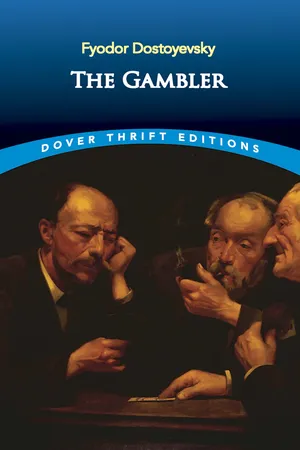
A compulsive gambler himself at a certain period of his life, Dostoyevsky wrote this novel with real authority. Set in the appropriately named Roulettenburg, a German spa with a casino and an international clientele, it concerns the gambling episodes, tangled love affairs, and complicated lives of Alexey Ivanovitch, a young gambler; Polina Alexandrovna, the woman he loves; a pair of French adventurers, and other characters.
Although not as dark as some of Dostoyevsky's other works, The Gambler nevertheless offers a grim and psychologically probing picture of the fatal attractions of gambling. Among its strengths are its well-drawn characters — Aunt Antonida, although lightly sketched in, is especially delightful — and its faithful depiction of life among the gambling set in fashionable German watering holes. This edition reprints Constance Garnett's authoritative translation.
- 112 pages
- English
- ePUB (mobile friendly)
- Available on iOS & Android
eBook - ePub
The Gambler
About this book
Information
Subtopic
ClassicsIndex
LiteratureCHAPTER I
AT LAST I have come back from my fortnight’s absence. Our friends have already been two days in Roulettenburg. I imagined that they were expecting me with the greatest eagerness; I was mistaken, however. The General had an extremely independent air, he talked to me condescendingly and sent me away to his sister. I even fancied that the General was a little ashamed to look at me. Marya Filippovna was tremendously busy and scarcely spoke to me; she took the money, however, counted it, and listened to my whole report. They were expecting Mezentsov, the little Frenchman, and some Englishman; as usual, as soon as there was money there was a dinner-party; in the Moscow style. Polina Alexandrovna, seeing me, asked why I had been away so long, and without waiting for an answer went off somewhere. Of course, she did that on purpose. We must have an explanation, though. Things have accumulated.
They had assigned me a little room on the fourth storey of the hotel. They know here that I belong to the General’s suite. It all looks as though they had managed to impress the people. The General is looked upon by every one here as a very rich Russian grandee. Even before dinner he commissioned me, among other things, to change two notes for a thousand francs each. I changed them at the office of the hotel. Now we shall be looked upon as millionaires for a whole week, at least. I wanted to take Misha and Nadya out for a walk, but on the stairs I was summoned back to the General; he had graciously bethought him to inquire where I was taking them. The man is absolutely unable to look me straight in the face; he would like to very much, but every time I meet his eyes with an intent, that is, disrespectful air, he seems overcome with embarrassment. In very bombastic language, piling one sentence on another, and at last losing his thread altogether, he gave me to understand that I was to take the children for a walk in the park, as far as possible from the Casino. At last he lost his temper completely, and added sharply: “Or else maybe you’ll be taking them into the gambling saloon. You must excuse me,” he added, “but I know you are still rather thoughtless and capable, perhaps, of gambling. In any case, though, I am not your mentor and have no desire to be, yet I have the right, at any rate, to desire that you will not compromise me, so to speak . . .”
“But I have no money,” I said calmly; “one must have it before one can lose it.”
“You shall have it at once,” answered the General, flushing a little; he rummaged in his bureau, looked up in an account book, and it turned out that he had a hundred and twenty roubles owing me.
“How are we to settle up?” he said. “We must change it into thalers. Come, take a hundred thalers — the rest, of course, won’t be lost.”
I took the money without a word.
“Please don’t be offended by my words, you are so ready to take offence.... If I did make an observation, it was only, so to speak, by way of warning, and, of course, I have some right to do so. . . .”
On my way home before dinner, with the children, I met a perfect cavalcade. Our party had driven out to look at some ruin. Two magnificent carriages, superb horses! In one carriage was Mlle. Blanche with Marya Filippovna and Polina; the Frenchman, the Englishman and our General were on horseback. The passers-by stopped and stared; a sensation was created; but the General will have a bad time, all the same. I calculated that with the four thousand francs I had brought, added to what they had evidently managed to get hold of, they had now seven or eight thousand francs; but that is not enough for Mlle. Blanche.
Mlle. Blanche, too, is staying at the hotel with her mother; our Frenchman is somewhere in the house, too. The footman calls him “Monsieur le Comte.” Mlle. Blanche’s mother is called “Madame la Comtesse”; well, who knows, they may be Comte and Comtesse.
I felt sure that M. le Comte would not recognize me when we assembled at dinner. The General, of course, would not have thought of introducing us or even saying a word to him on my behalf; and M. le Comte has been in Russia himself, and knows what is called an outchitel is very small fry. He knows me very well, however. But I must confess I made my appearance at dinner unbidden; I fancy the General forgot to give orders, or else he would certainly have sent me to dine at the table d’hôte. I came of my own accord, so that the General looked at me with astonishment. Kind-hearted Marva Filippovna immediately made a place for me; but my meeting with Mr. Astley saved the situation, and I could not help seeming to belong to the party.
I met this strange Englishman for the first time in the train in Prussia, where we sat opposite to one another, when I was travelling to join the family; then I came across him as I was going into France, and then again in Switzerland: in the course of that fortnight twice — and now I suddenly met him in Roulettenburg. I never met a man so shy in my life. He is stupidly shy and, of course, is aware of it himself, for he is by no means stupid. He is very sweet and gentle, however. I drew him into talk at our first meeting in Prussia. He told me that he had been that summer at North Cape, and that he was very anxious to visit the fair at Nizhni Novogorod. I don’t know how he made acquaintance with the General; I believe that he is hopelessly in love with Polina. When she came in he glowed like a sunset. He was very glad that I was sitting beside him at the table and seemed already to look upon me as his bosom friend.
At dinner the Frenchman gave himself airs in an extraordinary way; he was nonchalant and majestic with every one. In Moscow, I remember, he used to blow soap bubbles. He talked a great deal about finance and Russian politics. The General sometimes ventured to contradict, but discreetly, and only so far as he could without too great loss of dignity.
I was in a strange mood; of course, before we were half through dinner I had asked myself my usual invariable question: “Why I went on dancing attendance on this General, and had not left them long ago?” From time to time I glanced at Polina Alexandrovna. She took no notice of me whatever. It ended by my flying into a rage and making up my mind to be rude.
I began by suddenly, apropos of nothing, breaking in on the conversation in a loud voice. What I longed to do above all things was to be abusive to the Frenchman. I turned round to the General and very loudly and distinctly, I believe, interrupted him. I observed that this summer it was utterly impossible for a Russian to dine at table d’hôte. The General turned upon me an astonished stare.
“If you are a self-respecting man,” I went on, “you will certainly be inviting abuse and must put up with affronts to your dignity. In Paris, on the Rhine, even in Switzerland, there are so many little Poles, and French people who sympathize with them, that there’s no chance for a Russian to utter a word.”
I spoke in French. The General looked at me in amazement. I don’t know whether he was angry or simply astonished at my so forgetting myself.
“It seems some one gave you a lesson,” said the Frenchman, carelessly and contemptuously.
“I had a row for the first time with a Pole in Paris,” I answered; “then with a French officer who took the Pole’s part. And then some of the French came over to my side, when I told them how I tried to spit in Monseigneur’s coffee.”
“Spit?” asked the General, with dignified perplexity, and he even looked about him aghast.
The Frenchman scanned me mistrustfully.
“Just so,” I answered. “After feeling convinced for two whole days that I might have to pay a brief visit to Rome about our business, I went to the office of the Papal Embassy to get my passport viséed. There I was met by a little abbé, a dried up little man of about fifty, with a frost-bitten expression. After listening to me politely, but extremely drily, he asked me to wait a little. Though I was in a hurry, of course I sat down to wait, and took up L‘Opinion Nationale and began reading a horrible abusive attack on Russia. Meanwhile, I heard some one in the next room ask to see Monseigneur; I saw my abbé bow to him. I addressed the same request to him again; he asked me to wait — more drily than ever. A little later some one else entered, a stranger, but on business, some Austrian; he was listened to and at once conducted upstairs. Then I felt very much vexed; I got up, went to the abbé and said resolutely, that as Monseigneur was receiving, he might settle my business, too. At once the abbé drew back in great surprise. It was beyond his comprehension that an insignificant Russian should dare to put himself on a level with Monseigneur’s guests. As though delighted to have an opportunity of insulting me, he looked me up and down, and shouted in the most insolent tone: ‘Can you really suppose that Monseigneur is going to leave his coffee on your account?’ Then I shouted, too, but more loudly than he: ‘Let me tell you I’m ready to spit in your Monseigneur’s coffee! If you don’t finish with my passport this minute, I’ll go to him in person.’
“ ‘What! When the Cardinal is sitting with him!’ cried the abbé, recoiling from me with horror, and, flinging wide his arms, he stood like a cross, with an air of being ready to die rather than let me pass.
“Then I answered him that ‘I was a heretic and a barbarian, que je suis hérétique et barbare,’ and that I cared nothing for all these Archbishops, Cardinals, Monseigneurs and all of them. In short, I showed I was not going to give way. The abbé looked at me with uneasy ill-humour, then snatched my passport and carried it upstairs. A minute later it had been viséed. Here, wouldn’t you like to see it?” I took out the passport and showed the Roman visé.
“Well, I must say . . .” the General began.
“What saved you was saying that you were a heretic and barbarian,” the Frenchman observed, with a smile. “Cela n’était pas si bête.”
“Why, am I to model myself upon our Russians here? they sit, not daring to open their lips, and almost ready to deny they are Russians. In Paris, anyway in my hotel, they began to treat me much more attentively when I told every one about my passage-at-arms with the abbé. The fat Polish pan, the person most antagonistic to me at table d’hôte, sank into the background. The Frenchmen did not even resent it when I told them that I had, two years previously, seen a man at whom, in 1812, a French chasseur had shot simply in order to discharge his gun. The man was at that time a child of ten, and his family had not succeeded in leaving Moscow.”
“That’s impossible,” the Frenchman boiled up; “a French soldier would not fire at a child!”
“Yet it happened,” I answered. “I was told it by a most respectable captain on the retired list, and I saw the scar on his cheek from the bullet myself.”
The Frenchman began talking rapidly and at great length. The General began to support him, but I recommended him to read, for instance, passages in the “Notes” of General Perovsky, who was a prisoner in the hands of the French in 1812. At last Marya Filippovna began talking of something else to change the conversation. The General was very much displeased with me, for the Frenchman and I had almost begun shouting at one another. But I fancy my dispute with the Frenchman pleased Mr. Astley very much. Getting up from the table, he asked me to have a glass of wine with him.
In the evening I duly succeeded in getting a quarter of an hour’s talk with Polina Alexandrovna. Our conversation took place when we were all out for a walk. We all went into the park by the Casino. Polina sat down on a seat facing the fountain, and let Nadenka play with some children not far from her. I, too, let Misha run off to the fountain, and we were at last left alone.
We began, of course, at first with business. Polina simply flew into a rage when I gave her only seven hundred guldens. She had reckoned positively on my pawning her diamonds in Paris for two thousand guldens, if not more.
“I must have money, come what may,” she said. “I must get it or I am lost.”
I began asking her what had happened during my absence.
“Nothing, but the arrival of two pieces of news from Petersburg: first that Granny was very ill, and then, two days later, that she seemed to be dying. The news came from Timofey Petrovitch,” added Polina, “and he’s a trustworthy man. We are expecting every day to hear news of the end.”
“So you are all in suspense here?” I asked.
“Of course, all of us, and all the time; we’ve been hoping for nothing else for the last six months.”
“And are you hoping for it?” I asked.
“Why, I’m no relation. I am only the General’s step-daughter. But I am sure she will remember me in her will.”
“I fancy you’ll get a great deal,” I said emphatically.
“Yes, she was fond of me; but what makes you think so?”
“Tell me,” I answered with a question, “our marquis is initiated into all our secrets, it seems?”
“But why are you interested in that?” asked Polina, looking at me drily and austerely.
“I should think so; if I’m not mistaken, the General has already succeeded in borrowing from him.”
“You guess very correctly.”
“Well, would he have lent the money if he had not known about your ‘granny’? Did you notice at dinner, three times speaking of her, he called her ‘granny.’ What intimate and friendly relations!”
“Yes, you are right. As soon as he knows that I have come into something by the will, he will pay his addresses to me at once. That is what you wanted to know, was it?”
“He will only begin to pay you his addresses? I thought he had been doing that a long time.”
“You know perfectly well that he hasn’t!” Polina said, with anger. “Where did you meet that Englishman?” she added, after a minute’s silence.
“I knew you would ask about him directly.”
I told her of my previous meetings with Mr. Astley on my journey.
“He is shy and given to falling in love, and, of course, he’s fallen in love with you already.”
“Yes, he’s in love with me,” answered Polina.
“And, of course, he’s ten times as rich as the Frenchman. Why, is it certain that the Frenchman has anything? Isn’t that open to doubt?”
“No, it is not. He has a chateau of some sort. The General has spoken of that positively. Well, are you satisfied?”
“If I were in your place I should certainly marry the Englishman.”
“Why?” asked Polina.
“The Frenchman is better looking, but he is nastier; and the Englishman, besides being honest, is ten times as rich,” I snapped out.
“Yes, but on the other hand, the Frenchman is a marquis and clever,” she answered, in the most composed manner.
“But is it true?” I went on, in the same way.
“It certainly is.”
Polina greatly disliked my questions, and I saw that she was trying to make me angry by her tone and the strangeness of her answers. I said as much to her at once.
“Well, it really amuses me to see you in such a rage. You must pay for the very fact of my allowing you to ask such questions and make such suppositions.”
“I certainly consider myself entitled to ask you any sort of question,” I answered calmly, “just because I am prepared to pay any price you like for it, and I set no value at all on my life now.”
Polina laughed.
“You told me last time at the Schlangenberg, that you were prepared, at a word from me, to throw yourself head foremost from the rock, and it is a thousand feet high, I believe. I shall one day utter that word, solely in order to see how you will pay the price, and trust me I won’t give way. You are hateful to me, just because I’ve allowed you to take such liberties, and even more hateful because you are so necessary to me. But so long as you are necessary to me, I must take care of you.”
She began getting up. She spoke with irritation. Of late she had always ended every conversation with me in anger and irritation, real anger.
“Allow me to ask you, what about Mlle. Blanche?” I asked, not liking to let her go without explanation.
“You know all about Mlle. Blanche. Nothing more has happened since. Mile. Blanche will, no doubt, be Madame la Générale, that is, if the rumour of Granny’s death is confirmed, of course, for Mlle. Blanche and her mother and her cousin twice removed, the Marquis — all know very well that we are ruined.”
“And is the General hopelessly in love?”
“That’s not the point now. Listen and remember: take these seven hundred florins and go and play. Win me as much as you can at roulette; I must have money now, come what may.”
Saying this, she c...
Table of contents
- Title Page
- Copyright Page
- Table of Contents
- Note
- THE GAMBLER
- CHAPTER I
- CHAPTER II
- CHAPTER III
- CHAPTER IV
- CHAPTER V
- CHAPTER VI
- CHAPTER VII
- CHAPTER VIII
- CHAPTER IX
- CHAPTER X
- CHAPTER XI
- CHAPTER XII
- CHAPTER XIII
- CHAPTER XIV
- CHAPTER XV
- CHAPTER XVI
- CHAPTER XVII
- DOVER · THRIFT · EDITIONS
Trusted by 375,005 students
Access to over 1.5 million titles for a fair monthly price.
Study more efficiently using our study tools.
Frequently asked questions
Yes, you can cancel anytime from the Subscription tab in your account settings on the Perlego website. Your subscription will stay active until the end of your current billing period. Learn how to cancel your subscription
No, books cannot be downloaded as external files, such as PDFs, for use outside of Perlego. However, you can download books within the Perlego app for offline reading on mobile or tablet. Learn how to download books offline
Perlego offers two plans: Essential and Complete
- Essential is ideal for learners and professionals who enjoy exploring a wide range of subjects. Access the Essential Library with 800,000+ trusted titles and best-sellers across business, personal growth, and the humanities. Includes unlimited reading time and Standard Read Aloud voice.
- Complete: Perfect for advanced learners and researchers needing full, unrestricted access. Unlock 1.5M+ books across hundreds of subjects, including academic and specialized titles. The Complete Plan also includes advanced features like Premium Read Aloud and Research Assistant.
We are an online textbook subscription service, where you can get access to an entire online library for less than the price of a single book per month. With over 1.5 million books across 990+ topics, we’ve got you covered! Learn about our mission
Look out for the read-aloud symbol on your next book to see if you can listen to it. The read-aloud tool reads text aloud for you, highlighting the text as it is being read. You can pause it, speed it up and slow it down. Learn more about Read Aloud
Yes! You can use the Perlego app on both iOS and Android devices to read anytime, anywhere — even offline. Perfect for commutes or when you’re on the go.
Please note we cannot support devices running on iOS 13 and Android 7 or earlier. Learn more about using the app
Please note we cannot support devices running on iOS 13 and Android 7 or earlier. Learn more about using the app
Yes, you can access The Gambler by Fyodor Dostoyevsky in PDF and/or ePUB format, as well as other popular books in Literature & Classics. We have over 1.5 million books available in our catalogue for you to explore.