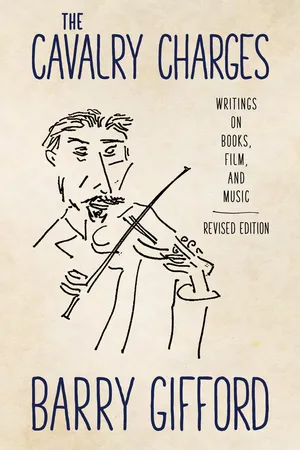
The Cavalry Charges: Writings on Books, Film, and Music, Revised Edition is a collection of anecdotal reflections that relate many of the experiences that shaped Barry Gifford as a writer. Representative of Gifford's body of work, this volume is divided into three sections: books, film and television, and music. Within these sections, Gifford's best work is showcased, including a nine-part dossier on Marlon Brando's One-Eyed Jacks in which Gifford examines the public and private lives of those involved in the film. New to the collection are four previously published essays: a brief look at the novels of Álvaro Mutis; a reflection on Gifford's schooling under Nebraska poet John Neihardt; an essay on Elliot Chaze and his novel Black Wings Has My Angel; and a short piece on Sailor and Lula.
- 262 pages
- English
- ePUB (mobile friendly)
- Available on iOS & Android
eBook - ePub
About this book
Trusted by 375,005 students
Access to over 1.5 million titles for a fair monthly price.
Study more efficiently using our study tools.
Information
MUSIC

The Last Time I Saw Artie
Artie Shaw, the clarinetist and bandleader, died in 2005 at the age of ninety-four. Born Arthur Arshawsky in New York City and raised there and in New Haven, Connecticut, he lived the last third of his life in Newbury Park, California, near Thousand Oaks, which is where I met him in 1982. The reason for our meeting was to talk about the writer William Saroyan, who had died the year before, and about whom my associate Larry Lee and I were writing a biography. Artie had introduced Saroyan to Carol Marcus, whom the Academy Award– and Pulitzer Prize–winning author had married twice. (After her second divorce from Saroyan, Carol went on to marry Walter Matthau, to whom she remained married for the rest of her life.)
Shaw, a tall, balding man with a bushy mustache, greeted Larry and me in the driveway of his modest house. “Hey, you remind me of the young Jimmy Caan,” he said to me. Artie was seventy then; with him at his house was his twenty-nine-year-old girlfriend, a former music student of his. He seemed very strong. In his heyday, the 1930s and ’40s, Shaw, along with his rival Benny Goodman, was the most famous bandleader in America. He made headlines by hiring an African American vocalist—Billie Holiday—the first white bandleader to do so, as well as for his groundbreaking orchestral arrangements; but his greatest notoriety came as a result of his eight marriages.
Among Artie Shaw’s wives were the actresses Ava Gardner, Lana Turner, and Evelyn Keyes; and the best-selling author Kathleen Winsor, who looked like a movie star. Artie told me his eight marriages lasted a real-time total of four years. “Six months together,” he said, “and six months to get the divorce.” I asked him why the marriages failed. “After six months,” he explained, “the Artie Shaw mask came off; so did the Lana Turner and Ava Gardner masks. Then we were stuck with the real person, which was too frightening to contemplate, so the deal was off. We ran away from each other.”
Shaw was a big star; he even appeared in a few films, usually as himself.
“The reason I married these women had to do with access,” he told us. “I’d walk into the Stork Club in New York and Sherman Billingsley, the owner, would immediately usher me into the Cub Room in the back, where celebrities could have privacy and not be hassled by the hoi polloi. I’d sit down next to Judy Garland, or Lana, or Ava, or Rita Hayworth. We’d strike up a conversation and make a date. It was like the high school cafeteria, only all the girls were beautiful.”
I told Artie that of the women he’d married, the one I preferred was Ava Gardner. “Yeah, Ava was okay,” he said, “but you shoulda seen Lana at eighteen with that blond mane in a convertible. Boy, was she something. For a Jewish kid like me, she was the ultimate shiksa. None of us was perfectly behaved, but Lana in particular liked to be admired. I remember when she was making The Postman Always Rings Twice with John Garfield, who was a good buddy of mine. One night I said to him, ‘Julie’—his real name was Jules Garfinkel—‘tell me the truth, you’re bangin’ Lana, aren’t you?’ ‘No, Artie,’ he says, ‘I wouldn’t touch her, she’s your wife.’ After a couple more drinks, I said to him, ‘Come on, Julie, you can tell me. I know Lana, she needs the attention. And she’s gorgeous, impossible to resist. I couldn’t blame you.’ Finally, a drink or two more, and Julie confesses. ‘Okay, Artie,” he tells me, ‘between scenes we take a ride and do it in the car.’ So I divorced Lana, but Julie and I stayed friends until the day he died.”
Artie was in psychotherapy for more than thirty years before he declared that it was bunk. He wrote books about it. He quit playing the clarinet and had his horn made into a lamp, which he showed to me, still working, in his living room. His compositions and recordings provided a comfortable income, and he taught music at colleges when he felt like it. Women continued to fascinate and interest him, but he stopped marrying them. His dislike for Benny Goodman—“as a person, not as a musician”—had not abated; Artie seemed happy to have outlived his nemesis.
We went together to a copy shop in a shopping mall crowded with teenagers. “Nobody in here ever heard of me,” Artie said, “and neither have most of their parents. It doesn’t matter. I did some things. I had Lana next to me in the convertible. Now I have a novel to finish.” I asked him what the novel was about. “Everything,” he said, “only everything.”
Lost Interlude
I remember going to see Jerry Lee Lewis perform at a roadhouse called the Rebel Room or the Rebel Rouser Room, I forget which, in Boonville, Missouri, in 1964, when I was eighteen. I was then attending the University of Missouri, which was just up the road, thirty miles away, in Columbia. I believe I went with my friend Tom Cooke, a locally prominent folk singer. Tom was a good songwriter, a pal of Arlo Guthrie’s, and I thought he would be a big star, but by the late ’60s he disappeared down the drug-filled rabbit hole of America. Too bad—Tom had a sweet voice, an easygoing, ingratiating style, he was handsome and a great guitar picker. I heard from his sister, Candy, sometime during the 1980s, who told me he had changed his name and had undergone a religious or lifestyle conversion of some kind. Tom wanted to tell me about it himself, she said, that he was going to write to me from Chicago, where he was living, but he never did and I don’t know what became of him. But one winter night in 1964 we drove in Tom’s ’57 Chevy Bel-Air convertible to Boonville, Missouri, to witness the then professionally...
Table of contents
- Cover
- Title Page
- Copyright
- Dedication
- Contents
- Acknowledgments
- Author’s Note
- Books
- Film and Television
- Music
- About the Author
Frequently asked questions
Yes, you can cancel anytime from the Subscription tab in your account settings on the Perlego website. Your subscription will stay active until the end of your current billing period. Learn how to cancel your subscription
No, books cannot be downloaded as external files, such as PDFs, for use outside of Perlego. However, you can download books within the Perlego app for offline reading on mobile or tablet. Learn how to download books offline
Perlego offers two plans: Essential and Complete
- Essential is ideal for learners and professionals who enjoy exploring a wide range of subjects. Access the Essential Library with 800,000+ trusted titles and best-sellers across business, personal growth, and the humanities. Includes unlimited reading time and Standard Read Aloud voice.
- Complete: Perfect for advanced learners and researchers needing full, unrestricted access. Unlock 1.5M+ books across hundreds of subjects, including academic and specialized titles. The Complete Plan also includes advanced features like Premium Read Aloud and Research Assistant.
We are an online textbook subscription service, where you can get access to an entire online library for less than the price of a single book per month. With over 1.5 million books across 990+ topics, we’ve got you covered! Learn about our mission
Look out for the read-aloud symbol on your next book to see if you can listen to it. The read-aloud tool reads text aloud for you, highlighting the text as it is being read. You can pause it, speed it up and slow it down. Learn more about Read Aloud
Yes! You can use the Perlego app on both iOS and Android devices to read anytime, anywhere — even offline. Perfect for commutes or when you’re on the go.
Please note we cannot support devices running on iOS 13 and Android 7 or earlier. Learn more about using the app
Please note we cannot support devices running on iOS 13 and Android 7 or earlier. Learn more about using the app
Yes, you can access The Cavalry Charges by Barry Gifford in PDF and/or ePUB format, as well as other popular books in Literature & Film & Video. We have over 1.5 million books available in our catalogue for you to explore.