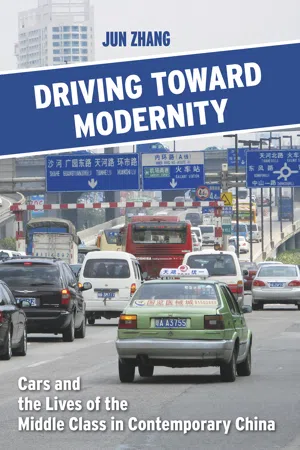
In Driving toward Modernity, Jun Zhang ethnographically explores the entanglement between the rise of the automotive regime and emergence of the middle class in South China. Focusing on the Pearl River Delta, one of the nation's wealthiest regions, Zhang shows how private cars have shaped everyday middle-class sociality, solidarity, and subjectivity, and how the automotive regime has helped make the new middle classes of the PRC. By carefully analyzing how physical and social mobility intertwines, Driving toward Modernity paints a nuanced picture of modern Chinese life, comprising the continuity and rupture as well as the structure and agency of China's great transformation.
eBook - ePub
Driving toward Modernity
Cars and the Lives of the Middle Class in Contemporary China
- 240 pages
- English
- ePUB (mobile friendly)
- Available on iOS & Android
eBook - ePub
About this book
Information
Publisher
Cornell University PressYear
2019Print ISBN
9781501738401
9781501738395
eBook ISBN
9781501738425
Topic
Sciences socialesSubtopic
Histoire de la ChineChapter 1
DRIVING ALONE TOGETHER
Sociality, Solidarity, and Status
For almost a decade I lived in the northeastern part of the United States. I bicycled to school, to the office, to the gym, and to run errands and buy groceries. Occasionally my friends and colleagues would give me a lift in their cars, but most of the time I would walk. I used public transportation to nearby cities to visit friends and for other excursions. I told this to my middle-class interlocutors in China. “Which part of the world did you actually live in?” a young engineer, Shao Jing, jokingly asked me when he drove me home after our lunch meeting. In the 2010s, the majority of my middle-class Chinese interlocutors have been car owners. Driving is becoming an everyday experience: they drive to work and to do sports, to meet clients in and outside the city, to try out restaurants in the periurban areas, to find entertainment in nearby cities, and for weekend and holiday travels.
In such societies as the United States where cars are an integral part of everyday mobility, there is a tendency to associate owning and driving a car as the materialization and enactment of freedom, autonomy, and mobility (Boehm et al. 2006; Flonneau 2010). This perceived relation is, to a great extent, ideological, not only because the rhetoric of automobility—liberating, individuating, revivifying, equalizing—is a product of the political ideology of being a free American and the apparatus of corporate capitalism in post–World War II America (Seiler 2008) but also because existing social inequalities have their imprint on the kinds and extent of freedom people obtain with cars, and the ways of mobility enabled by the car and driving have been shaped along the lines of racial, class, and other power relationships in U.S. society (Lutz 2014; Lutz and Fernandez 2010; Packer 2008).
Yet driving as a reification of autonomy and freedom is so deeply ingrained in people that having a car has been considered a means of fighting existing inequality. Women drivers are an outstanding example of this. Professional women and housewives drive their children to attend all kinds of extracurricular activities and for grocery shopping. A car enables them to juggle tasks between work and family without changing a woman’s role in a gendered division of labor (Heiman 2015; Lutz 2014). Although they are often locked in a specific form of everyday-life rhythm made possible by that very vehicle, the car remains a quintessential vehicle for them to experience being free from the constraints of time and space (Jain 2002). This paradoxical experience is well captured in Gilroy’s analysis of African Americans’ desire of owning a car.
Not unlike the African Americans in Gilroy’s description, ordinary Chinese citizens were denied car ownership during the Maoist and early Reform years. With China becoming a member of the WTO in the twenty-first century, car ownership has been rapidly normalized among middle-class families. Global carmakers and advertising companies seek to sell their cars by promoting a narrative about a new lifestyle that emphasizes technology, freedom, autonomy, and status. In this context it is understandable why middle-class people like Shao Jing would ask me, “Which part of the world did you actually live in?”
That said, they do not seem to have an inclination “towards a disproportionate investment”—to borrow Gilroy’s words—in car ownership. It is outright puzzling for them to know that in the United States even someone living in a shelter may still own a car (Rowe 1999), or “in the years of deepest depression, the automobile remained a priority for many, including the unemployed” (Gudis 2010, 372).
Therefore, to what degree does the narrative of cars, autonomy, and mobility capture the Chinese middle class’s imagination and practices involving cars, if at all? This chapter tries to present the nuances of those imaginations and practices by examining how the middle class use and speak about their cars in their quotidian lives and how they drive on special occasions—organized and semiorganized driving tours and wedding car parades. My findings suggest that middle-class professionals tend to describe the significance of their cars in everyday life in practical terms, such as, most notably, “convenience” (fangbian) rather than “freedom” (ziyou). And the significance of the car in their lives, as described by them, was intensely social.
My description here does not intend to suggest a stereotype that individuals from the Chinese middle-class are obsessed with status or are keen to become a part of a collective or that they lack individuality or autonomy. The way the urban middle class use and talk about cars contains a significant level of self-consciousness and employs first-person pronouns (e.g., my life, my work, my friends, myself). When I asked them whether having cars made them feel free and mobile, their answers were usually affirmative.
Nevertheless, the sketches presented in this chapter illustrate, first, how cars and driving have become integral in the new form of middle-class sociality; and second, the perceived “pragmatic” value and prestige attached to certain cars and driving practices are not merely perceived thus because they are expensive. I contextualize the middle-class narratives and practices of having and driving a car in decades of social transformation, showing the complex interactions between the past and the present and between the state and the individuals. I argue that the specific ways of understanding automobility among the middle class have not only been shaped by but have been shaping the changing temporal-spatial arrangements in handling work and close social circles. Furthermore, the far-reaching influence of political practices, which are fond of a parade culture and endow officials with material and symbolic privileges, may serve as a useful context for us to understand the aesthetics and spatiality of the middle-class sociality as embodied in specific car and driving preferences.
Everyday Life Convenience: For Credibility and Sociality
“Happiness is the smell of a new car … It’s freedom from fear. It’s a billboard on the side of the road that screams with reassurance that whatever you’re doing is okay,” said Don Draper, the talented and egotistical protagonist in the popular TV drama series Mad Men that depicts the advertising industry in 1960s America. Don Draper’s romantic depiction of the smell of a car and the road is also what carmakers try to sell to their twenty-first-century Chinese consumers. However, my middle-class interlocutors’ remarks on Don Draper’s words were often cynical: phrases such as “What you’re doing is okay” and “freedom from fear” are idealistic, and “the smell of a new car” is, as several of them joked, “just too much formaldehyde in the car’s upholstery.”1 When I asked them whether they thought a car would bring freedom, they all answered yes. But if I let them describe what a car meant for them, they would tell me that they had or wanted to have a car because of practicality (shiji). In their descriptions, the term that was most frequently used was “convenience.”2
For some China observers, this reference to convenience as a reason for having a car sounds ironic. Traffic congestion has been a serious problem in major Chinese cities (Zhang Ju. 2016). In Guangzhou and nearby places, for example, the rapid construction of public transportation systems makes the subway a more reliable means than a car to move from place to place in terms of punctuality and time-cost efficiency.
Many middle-class drivers know it is illusive to think that a car can get a person around in a timely manner. While lawyers and entrepreneurs tend to drive regularly to work and for social life, many professionals, such as doctors, engineers, and corporate managers, have told me that they regularly rode the subway, took the taxi, or took a bus to go to work or meet with their friends. In fact, some of my interlocutors confessed that they had once, as they were aspiring to become car owners, fantasized about the fun of driving, but once they became car owners, they felt that driving was actually an exhausting form of labor, especially when they were stuck in traffic after a long day of work. The car was usually used when the family went out together or when they hung out with friends. This pattern is also more visible among those who worked and lived in or near the city center than those who lived in periurban areas and worked near the city center or vice versa.
It would be, however, a mistake to disregard my interlocutors’ frequent referral to “convenience” when they talked about their cars and driving experience. As Elizabeth Shove—writing about everyday normality and technologies—points out, “convenience-related consumption is not simply about saving or shifting time as such, but is instead about re-designing and re-negotiating temporal demands associated with the proper accomplishment of specific social practices” (2012, 300). What I would add to Shove’s point is that “convenience” in the Chinese middle class’s driving practices is more than managing temporal demands. Here I present scenarios about four individuals that are illustrative of the ways in which the majority of my interlocutors think and talk about the car and convenience. I then contextualize their stories in their changing social lives—temporal-spatial management and work-leisure relationship—to illustrate the significance of “convenience.”
Dong Mei was a college lecturer in her late twenties in 2007. Both Dong Mei and her husband had been faculty members in a university in Guangzhou since they finished graduate school. They lived in a subsidized apartment near the university. During one of our conversations, Dong Mei expressed her desire to have a car:
The weather is so hot, so people sweat easily. Public transportation takes so much time. Sometimes when my friends call me to have dinner together or to play badminton, I simply do not want to go through all the trouble to be there. You know we live near the campus. It is a long walk to the bus stop or to find a taxi. With a car it would be different. Many of our friends have cars now. It is convenient for them to go out. They are willing to give us a ride, but I do not feel I should bother them all the time. It would be much more convenient if we have our own car.
Dong’s words echoed Lawyer Qin’s, who described to me in 2008 his experience as a car owner:
After [my wife and I] bought our car, whenever our friends gave us a call to play cards or go sing karaoke, we would immediately drive out and join them. We would often leave home at 9:00 or 10:00 p.m. and come back past midnight. Before we bought our car, we seldom went out that late. It was so difficult to get a taxi home so late at night. But ever since we had a car, it was much more convenient to meet friends at night.
Qin and his wife were both lawyers but in separate firms. I first met the couple when I had dinner with Lawyer Lu and his wife. Lu and Qin went to the same university, came together to southern China to advance their careers, and married around the same time in the mid-2000s. Their wives also had similar trajectories. The Lus and the Qins became good friends. They lived in separate cities but with only a thirty-minute drive between them. When I met Lawyer Qin—again with the Lus—in 2011, the Qin couple was in their late thirties and had a baby girl. After they had the child, Lawyer Qin and his wife no longer drove out at night to socialize with friends or colleagues. Instead, they spent more time with friends who had children, such as the Lus. These two families would drive to visit each other and hang out regularly during daytime on the weekends.
Lawyer Lu came from a small town in inland China. Among four children, he was the only one who received higher education. After graduating with a law degree from a small college away from his hometown, he came to Guangdong in the late 1990s. He worked in a district-level—the lowest level—court before he joined a local law firm that handled contracts and legal disputes for factory owners in the Pearl River delta. After years of hard work, he made partner in the late 2000s. Lu lived with his wife and his parents in a four-bedroom apartment in a gated complex. His apartment building was well situated, and the location guaranteed his child a spot in a well-reputed primary school nearby. His first car was a dark blue, midsized Ford sedan. In 2010, Lu and his wife were looking for a second car, and I visited car dealerships with them. I suggested a Volvo S60, as Volvo was ranked one of the safest cars and was considered a low-profile, middle-class car in Western countries. Lu rejected it, saying, “No one would know the brand.” As we wandered into an Audi dealership, he explained to me,
The more competent the lawyer is, the more money he makes. Competence is not necessarily how well he knows the law. It has a lot to do with his networking and social skills. The more cases he wins, the more he earns, and the better the car he drives. Some clients decide on their lawyers based on what they drive. It’s stupid, but how else can they tell if you are a good lawyer? … An apartment doesn’t make a good basis, because no one knows where you live or whether you have bought it or are renting it. But nouveau riche factory owners know about cars. Cars are the most convenient thing for them to judge whether you are a good lawyer or not.
Lawyer Lu’s words echoed those from Xiaowang, a younger lawyer who also came from a small inland city. After graduating from college, Xiaowang worked in a small law firm in Guangzhou, while his parents still lived in his hometown in northern China. When I interviewed him in his office in 2007, Xiaowang began by saying, “A car is a production tool [shengchan gongju] for a lawyer, because it makes it easier to meet with clients.” The term “production tool” struck me, for it reminded me of the Marxist terminologies in China’s high school textbooks. I tried to interpret it on my own terms: “Do you mean easier in terms of transportation?” “No,” he corrected me:
Arriving in a car to meet your clients makes the meeting easier: The clients would trust a lawyer more if they see the lawyer coming in a car … A business suit? Nowadays people think you are selling insurance if you wear a suit and a tie. That is what people thought what I was before [when I wore a suit]. They thought I was there to sell them insurance plans. If you have a car, no one would question you that way.
Xiaowang was a junior lawyer who had practiced law for less than two years when I interviewed him. Nowadays, lawyers, particularly junior lawyers working in small law firms, such as the one Xiaowang worked in, have different work experiences from those working in big law firms. Big law firms often adopt a corporate structure with internal labor division and hierarchy. The names of these big law firms, to a great extent, are an indicator of the capacity of their lawyers and a source of confidence for the clients. Small law firms, which make up the majority of the legal service market, operate under a loose management structure. These firms are composed of contractual lawyers who pay a certain percentage of their fees to the firm to share the costs of running the office, utilities, paying the secretaries, and for other general management. Lawyers who can have their own cases instead of working on other lawyers’ cases are considered “independent” in a law firm. They sometimes handle their cases by themselves or often hire junior lawyers to work for them. The income of a small law firm depends on the cases these “independent” lawyers can bring in. For these lawyers, personal reputation, social networking, and legal knowledge are all crucial for securing clients and settling cases, and it is important for them to prove their competence to their potential clients.
In 2007 Xiaowang did not have his own clients yet and worked on cases that his supervisor gave him. Lawyer Lu, a more experienced lawyer from another small law firm, had passed the stage that Xiaowang was in and gradually moved up the ladder. I had similar conversations when I spoke to young and middle-aged lawyers between 2006 and 2015. The emphasis was that clients and other lawyers judged the ability of a lawyer by the car he or she drove. A car was a symbol of a lawyer’s ability and reputation. It showed others how successful he or she was. Havin...
Table of contents
- List of Abbreviations and Note on Translation
- Introduction
- Prologue
- 1. Driving Alone Together
- 2. Family Cars, Filial Consumer-Citizens
- 3. The Emerging Middle Class and the Car Market
- 4. Car Crash, Class Encounter
- 5. Bidding for a License Plate
- 6. Parking
- Epilogue
- Glossary
- Notes
- References
- Index
Trusted by 375,005 students
Access to over 1.5 million titles for a fair monthly price.
Study more efficiently using our study tools.
Frequently asked questions
Yes, you can cancel anytime from the Subscription tab in your account settings on the Perlego website. Your subscription will stay active until the end of your current billing period. Learn how to cancel your subscription
No, books cannot be downloaded as external files, such as PDFs, for use outside of Perlego. However, you can download books within the Perlego app for offline reading on mobile or tablet. Learn how to download books offline
Perlego offers two plans: Essential and Complete
- Essential is ideal for learners and professionals who enjoy exploring a wide range of subjects. Access the Essential Library with 800,000+ trusted titles and best-sellers across business, personal growth, and the humanities. Includes unlimited reading time and Standard Read Aloud voice.
- Complete: Perfect for advanced learners and researchers needing full, unrestricted access. Unlock 1.5M+ books across hundreds of subjects, including academic and specialized titles. The Complete Plan also includes advanced features like Premium Read Aloud and Research Assistant.
We are an online textbook subscription service, where you can get access to an entire online library for less than the price of a single book per month. With over 1.5 million books across 990+ topics, we’ve got you covered! Learn about our mission
Look out for the read-aloud symbol on your next book to see if you can listen to it. The read-aloud tool reads text aloud for you, highlighting the text as it is being read. You can pause it, speed it up and slow it down. Learn more about Read Aloud
Yes! You can use the Perlego app on both iOS and Android devices to read anytime, anywhere — even offline. Perfect for commutes or when you’re on the go.
Please note we cannot support devices running on iOS 13 and Android 7 or earlier. Learn more about using the app
Please note we cannot support devices running on iOS 13 and Android 7 or earlier. Learn more about using the app
Yes, you can access Driving toward Modernity by Jun Zhang in PDF and/or ePUB format, as well as other popular books in Sciences sociales & Histoire de la Chine. We have over 1.5 million books available in our catalogue for you to explore.