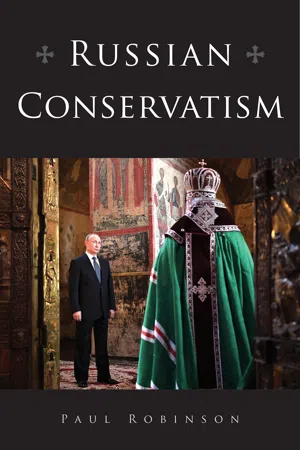
Russian Conservatism examines the history of Russian conservative thought from the beginning of the nineteenth century to the present. Robinson charts the contributions made by philosophers, politicians, and others during the Imperial, Soviet, and post-Soviet periods. Looking at cultural, political, and social-economic conservatism in Russia, Russian Conservatism demonstrates that such ideas are helpful in interpreting Russia's present as well as its past and will be influential in shaping Russia's future, for better or for worse, in the years to come.
- 296 pages
- English
- ePUB (mobile friendly)
- Available on iOS & Android
eBook - ePub
Russian Conservatism
About this book
Information
CHAPTER 1
DEFINING RUSSIAN CONSERVATISM
Anybody wishing to study conservatism confronts an immediate problem: scholars do not agree on what it is. Nor do they agree about its origins, while some argue that there is not a single type of conservatism, but several.1 The problem is further complicated by the fact that many of conservatism’s most commonly cited features appear at best to fit uneasily together and at worst to contradict each other entirely. Conservatism is universalistic, but also anti-universalistic; seems to oppose change, but also to promote it; can be vehemently anti-liberal, but also can be liberal; and so on. Different groups labeled “conservative” often hold views diametrically opposed to one another—modern day American “paleoconservatives,” for instance, are bitter enemies of American “neoconservatives.” Readers of this book will come across seemingly paradoxical phrases such as “liberal conservative,” “conservative modernization,” and even “revolutionary conservatism.” But different conservatives do all have something in common. Tying them together is the thread of a preference for organic change. Following this thread, this book will demonstrate that Russian conservatism is not a philosophy of the status quo. Rather, it is one that endorses change, but change of a certain, gradual sort that is in keeping, as much as possible, with national traditions.
DEFINING CONSERVATISM
Untangling the various complications of conservatism requires recognizing what one Russian scholar calls its “binary nature.”2 On the one hand, there are those who view conservatism as an ideology, containing immutable values that transcend time and space. On the other hand, there are those who view conservatism as a “natural attitude”3 in favor of existing institutions, which manifests itself in entirely different ways in different times and places, according to what the existing institutions happen to be.4 In reality, these two types of conservatism tend to exist side by side, creating tensions within conservatism that are not easily reconciled.
Regardless of whether conservatism is viewed as an ideology, an attitude, or some synthesis of the two, the question arises of what constitutes its core. Scholars often see this core as consisting of a preference for the status quo and a consequent inclination to resist change. Samuel Huntington, for instance, calls conservatism “the articulate, systematic, theoretical resistance to change.”5 Michael Oakeshott writes:
To be conservative is to be disposed to think and behave in certain manners … a propensity to use and to enjoy what is available rather than to wish for or to look for something else; to delight in what is present rather than what was or what may be.… To be conservative, then, is to prefer the familiar to the unknown, to prefer the tried to the untried, fact to mystery, the actual to the possible, the limited to the unbounded, the near to the distant.… The man of conservative temperament believes that a known good is not lightly to be surrendered for an unknown better.6
The “known good” will, however, vary considerably from time to time, from place to place, and from person to person. A conservative’s preferences will therefore vary too. As the Russian philosopher Konstantin Leontyev put it, “Everyone’s conservatism is his own—the Turk’s is Turkish, the Englishman’s is English, and the Russian’s is Russian.”7 If one accepts the idea that conservatism is a preference for the status quo, then a conservative in a communist society will be a communist, whereas a conservative in a free-market liberal democracy will be a free-market liberal democrat. A conservative, in effect, can be almost anything. Michael Freeden calls this “the chameleon theory of conservatism.”8 It posits that, “conservatism is relative to a society … conservatism is a positional ideology. The content of a political programme will vary dramatically from nation to nation, from state to state.”9
Indeed, people labeled as conservatives have proposed vastly different programs at different times and in different places. Russian conservatives of today do not hold precisely the same views as Russian conservatives of 150 years ago. Nevertheless, numerous scholars of conservatism have concluded that conservatism “is not an ideal of the status quo. It is predominantly about change.”10 Conservatism is about “managing change,” “an ideology concerned with change,” writes Kieron O’Hara.11 “Conservatism … is not an ideology of the status quo,” says Freeden. “Rather, it is an ideology predominantly concerned with the problem of change: not necessarily proposing to eliminate it.”12
This is very true of Russian conservatism. More often than not, far from taking “delight in what is present,” Russian conservatives have been deeply dissatisfied with the status quo and have longed to change it, sometimes proposing quite radical reforms. As will become obvious throughout this book, Russian conservatism is, and for the most part always has been, deeply interested in change.
What differentiates conservatism from other ideologies such as liberalism or socialism is not, therefore, opposition to change, but its preferences concerning the form that change should take. Conservatives are willing to countenance reform, but it has to be of a certain sort,13 that is to say of a sort that avoids revolutionary breaks and retains ties with the past. As Eduard Popov writes, “conservatism is directed to the future, but unlike progressivism, not by means of a rupture with the past.”14
This is the principle of organicism. To the conservative, a society is a “living organism.”15 Plants and animals grow and develop, gradually, and in accordance with their own nature. An attempt to change an organism’s nature, or to transplant an alien organism into it, will bring it no benefit, and may even kill it. The same applies to human societies. Writing in the late nineteenth century, Konstantin Pobedonostsev, a prominent conservative member of the Russian government under tsars Alexander III and Nicholas II, remarked:
A flower develops from a bud, and the makeup of the bud fully defines its development. If we want to give the latter a different character, which contradicts the constitution of the bud—then we will achieve nothing but death. The development of a people is also inextricably linked with the spiritual center crystalized by its history, which defines the uniqueness of the state, and makes the popular organism accept one direction of development and reject others.16
Russian conservatives have regularly compared Russia and Russian society to plants of one kind or another, and used words such as “organism” and “organic.” Perhaps one of the best definitions of conservatism is that produced by the émigré Russian philosopher Nikolai Berdiaev in 1923:
The conservative principle … is a free, organic principle. It consists of a healthy reaction to violation of organic nature.… The conservative principle is not by itself opposed to development, it merely demands that development be organic, that the future not destroy the past but continue to develop it.17
The organic principle provides the thread that ties conservatism together and solidifies it from merely an attitude or worldview into a fully developed ideology. According to many historians, European conservatism first coalesced into a formal ideology in the late eighteenth and early nineteenth centuries in reaction to the excesses of the French Revolution and Napoleonic Wars.18 In the eyes of some Europeans of the time, those excesses were a natural product of the rationalism, atheism, and universalism introduced in the eighteenth century by the intellectual movement known as the Enlightenment. The Enlightenment encouraged people to believe that they could determine the rules governing human society and apply universally applicable solutions to human problems. Conservatism was a reaction to this. It argued that it is necessary to recognize that human reason is limited; that there is truth in religion, custom, and tradition; that societies differ; and that there are no universally applicable policies for the betterment of all human beings everywhere.
In the place of rationalism, universalism, and, arguably, also liberalism, conservatives in general propose organicism and religious truth. As Michael Freeden says, conservatism consists of two “core concepts”—the “understanding of organic change” and “a belief in the extra-human origins of the social order.”19 These two concepts do not fit easily together. Organicism is by nature particularistic: it suggests that each society is different and should develop differently, and that there are no universally suitable social values or institutions. “A belief in the extra- human origins of the social order,” by contrast, suggests that there are universal, usually God-given values. Conservatism therefore contains an inherent contradiction between universalism and particularism. This can be seen very clearly in Russian conservatism. On the one hand, Russian conservatives of all types consistently claim that Russia is different from the West and that Western claims regarding universal human values are false. But the characteristic most often used to justify Russia’s claim to difference is its Orthodox religion, which is said to be a bearer of universal truth. Russian conservatism thus strives to be both universalistic and anti-universalistic at the same time. How conservatives have tried to resolve this paradox will be one of the major themes of this book.
Conservative ideology tends to be defined by what it is against. This differentiates it from ideologies such as liberalism and socialism, which more clearly articulate what they are for: liberty, equality, and so forth. Saying what conservatism is for is difficult. In efforts to do so, conservative intellectuals have often resorted to creating lists of what are believed to be the key conservative principles and values.20 The lists, however, vary from person to person. Freeden points out that one of the reasons for this is that “fixed conservative lists … are almost entirely composed of adjacent and peripheral concepts which are in principle eliminable.”21 Consequently, as Noel O’Sullivan remarks, “not every conservative thinker will be found to subscribe to all the ideas found on the list of ‘canons of conservative thought’; and there is the further difficulty that not all who do subscribe to them would invariably be described as conservative.”22
Nevertheless, certain features of organisms, and therefore of the organic worldview, tend to produce distinct preferences, each of which is more or less discernible in a conservative according to the person, time, and place. The first relevant feature is that organisms are not unchanging; they grow, flourish, and die. Organicism, therefore, is not inherently hostile to change. Rather, it considers change quite normal. But the organic principle will tend to produce a preference for slow and gradual, rather than revolutionary, change. Associated with this is a preference for order and stability, and a belief in the value of customs and tradition. From these will often flow a belief in the importance of “traditional” institutions, such as the nuclear family consisting of a married man and woman and their children.
Second, the fact that organisms eventually die can incline conservatives toward a cyclical view of progress. Like a living being, every civilization will eventually come to an end. No one can claim, therefore, to embody a set of values and institutions which constitute the perfection of human progress. This conclusion can lead conservatives to adopt a particularist or morally relativist position.
Third, just as different organisms have different natures, and so must be structured and develop in different ways, so too must societies. This leads to a rejection of ideas such as universal human rights and toward the adoption of nationalism. It is important to note, however, that this type of nationalism is founded on a recognition of difference rather than on the idea of the superiority of any one nation compared to another...
Table of contents
- Preface
- Introduction
- Chapter 1. Defining Russian Conservatism
- Chapter 2. The Reign of Alexander I
- Chapter 3. Official Nationality
- Chapter 4. The Slavophiles
- Chapter 5. The Great Reforms
- Chapter 6. The Era of Counter-Reform
- Chapter 7. Between Revolutions
- Chapter 8. Emigration
- Chapter 9. The Soviet Union Under Stalin
- Chapter 10. Late Soviet Conservatism
- Chapter 11. Post-Soviet Russia
- Conclusion
- Notes
- Bibliography
- Index
Trusted by 375,005 students
Access to over 1.5 million titles for a fair monthly price.
Study more efficiently using our study tools.
Frequently asked questions
Yes, you can cancel anytime from the Subscription tab in your account settings on the Perlego website. Your subscription will stay active until the end of your current billing period. Learn how to cancel your subscription
No, books cannot be downloaded as external files, such as PDFs, for use outside of Perlego. However, you can download books within the Perlego app for offline reading on mobile or tablet. Learn how to download books offline
We are an online textbook subscription service, where you can get access to an entire online library for less than the price of a single book per month. With over 1.5 million books across 990+ topics, we’ve got you covered! Learn about our mission
Look out for the read-aloud symbol on your next book to see if you can listen to it. The read-aloud tool reads text aloud for you, highlighting the text as it is being read. You can pause it, speed it up and slow it down. Learn more about Read Aloud
Yes! You can use the Perlego app on both iOS and Android devices to read anytime, anywhere — even offline. Perfect for commutes or when you’re on the go.
Please note we cannot support devices running on iOS 13 and Android 7 or earlier. Learn more about using the app
Please note we cannot support devices running on iOS 13 and Android 7 or earlier. Learn more about using the app
Yes, you can access Russian Conservatism by Paul Robinson in PDF and/or ePUB format, as well as other popular books in Politics & International Relations & Russian History. We have over 1.5 million books available in our catalogue for you to explore.