- English
- ePUB (mobile friendly)
- Available on iOS & Android
eBook - ePub
The complete project manager
About this book
This book is about the how of project management and about how you as a project manager can use a proactive attitude to stay in control, even during difficult situations. It shows you how to become an influencer of the path to the end result, of your environment, of your team and of your effectiveness.
Today's project managers have to meet high expectations. Challenging goals, a strong focus on cost management and lead times, serving the interests of different stakeholders and many dependencies between subprojects make project management an increasingly complex affair – especially in an environment where change and uncertainty have become the new norm. In addition, the creative abilities of knowledge workers have to be optimally utilised, which requires less hierarchical organisational structures and more multidisciplinary collaboration. Having the right project management skills is therefore essential at virtually every level of an organisation.
As a result of these challenges, there is a growing demand for comprehensive methods and the popularity of Agile is on the rise. On the other hand, the increased complexity also results in a need for simplicity. That is what this book is about: going back to the basics, being able to combine useful elements from different methods and focusing on the most important aspect of all: the person behind the project manager!
This book contains a wealth of practical descriptions with useful examples and anecdotes. Readers are constantly stimulated to internalise the essence and put it into practice in a manner that suits their own style and personality. That is the only way to keep at it, be successful and make others believe in you!
The book consists of three parts. Part 1 (chapters 1 to 4) describes how to set up and manage a project. The focus is on the basic principles, the essence of taking control, creating structure and using Agile behavior. Part 2 (chapters 5 and 6) explains how to draw up a plan and schedule in small steps, which results in improved completeness, coordination and support. Finally, part 3 (chapters 7 to 10) covers how to manage the project execution: how to realize the path to the final goal with a strict PDCA rhythm, how to evaluate the quality of interim results and how to keep your team and environment motivated.
Information
Topic
EducationSubtopic
Architecture General1 The &-&-&-paradox1

The first time I went skiing I was nearly thirty. I was the only novice in our group of friends, which meant that I was taught the basic principles together with the other rookies, while the rest of my buddies were still eating breakfast. The class was scheduled in the morning and I did not leave the beginner’s slope at all that first day. However, I caved to peer pressure on the second day and joined my friends on their run in the afternoon. They had promised to keep my lack of experience in mind.
It all went quite well at first and although I felt a bit awkward about always being the last one to come down, my positive attitude showed me that the others seemed to appreciate the little breaks I afforded them, because it gave them a chance to enjoy a smoke. However, after an hour, the group paused and some people started grumbling a bit. We had missed a turn and ended up at an expert slope. In my naivety, I looked for a way back. There wasn’t one; the only way forward was down...
My friends told me that, although the slope was steep, the snow was excellent and that I could get down the steepest sections by sliding sideways. After some hesitation, I started my descent and I did quite well, despite sweating like a pig the entire time. I slowly grew more confident and after I got past the steepest section, I actually started to feel a bit elated.
Before I knew it, I had reached the bottom. I often think back on the things I do and reflect that it wasn’t that hard after all. Looking up from below, however, a slope looks even steeper than it actually is. I felt like a king after coming down that mountain unscathed – until a far more experienced skier came racing down as if it were nothing. It made me realize that, despite everything, I still had plenty left to learn.
I often begin my lectures with this anecdote, before asking the audience the following question: “Who among you has received feedback from a professional during or after a difficult project about how to improve the project execution?” More often than not, people do not raise their hand. Instead, most people are used to hearing something along the lines of “Projects are always difficult here, better get used to it” or “Our environment is so complex that standard project management methods are no use.”
 | Do you receive feedback during or after a project about how to improve things? |
Project managers and their environment have apparently accepted that projects do not go the way they want. They lack experts in the organization to analyze the problem and show them how to improve the situation. Worse, they may not even realize that there is room for improvement; they fail to realize that experienced skiers actually enjoy going down the expert slope and that difficult projects, e.g. those with a lot of uncertain factors or difficult stakeholders, can actually be undertaken successfully. If people have accepted that there is no need to improve matters, they often also lack the ability to learn how to improve. This in turn leads to a lack of project managers in the organization who actively look for difficult projects because they enjoy the challenge and are eager to develop themselves further.
I call these apparent contradictions that have to be overcome the &-&-&-paradox: allowing for uncertainty and being flexible and completing the project successfully and enjoying the process! Project managers who strive to improve themselves in order to tackle more and more difficult circumstances are professionals who want to break through the &-&-&-paradox.
1.1 More with less
After this anecdote, you may recognize other forms of the &-&-&-paradox in project management. I describe three of them in this chapter. Note that for now I will only focus on the challenges that they present; the solutions are covered later on in this book.
1. More with less: the project must be completed as soon as possible and it must be possible to make changes along the way and the costs have to be reduced and the functionality has to improve and…
2. Monitoring things closely and giving your team plenty of space.
3. Recognizing uncertainty and making a commitment with regards to the project’s completion date and costs.
I will cover the first challenge, more with less, in this section. The other two are covered in sections 1.2 and 1.3. By looking at more than just the project manager, it is possible to gain an insight into the environment in which the modern project manager operates. This illustrates the ways in which a project manager has to develop in order to stay successful.
Goodbye to trade-offs
The &-&-&-paradox describes situations in which choosing is not good enough. To illustrate this, I will use the example of three well-known car brands, Alfa Romeo, Volvo and Mercedes, and compare the situation of thirty years ago with that of today. A Volvo was a safe car and drivers took the boring design for granted. If you wanted design, you had to get an Alfa Romeo, although that design came at the cost of reliability. Mercedes, meanwhile, produced high-quality cars that combined reliability and design, yet customers had to pay a premium price to get one.
These days, this classic or-or-or trade-off is accepted less and less. As a result of technological developments, increased competition, globalization and collaboration between corporations, the bar is raised higher and higher. A lot of product characteristics have become standard. We are no longer willing to pay extra for quality. The same goes for extra features, safety, service level, etc. Similarly, the lead times for product development are becoming shorter and development costs have to be reduced. In other words, we have to do more with less. If you cannot meet these demands, you will fall behind: we want it all.
| Do you recognize this growing demand for and-and-and? |
Expertise and creativity in leadership
We also want and-and-and in projects. One might say that, in this modern day and age, a project has to overcome the devil’s triangle, which states that money, quality and time are all interconnected. Technologically speaking, that is certainly possible. Raymond Kurzweil, for example, describes an exponential pattern of technological progress that is changing our world at a breakneck pace. Ultimately, this will lead to singularity (figure 1.1). Singularity refers to the moment when technology exceeds the capacities of the human brain (Kurzweil, 1999). Focusing on the present, we see that projects and organizations have become more complex as a result of the growing demands, but also due to inherent complexity. The &-&-&-paradox therefore creates challenges for, and imposes limitations on, the project team. Is that a bad thing? A football player who manages to score despite being marked by several other players is considered a hero. Cyclists want their races to be difficult, so only the best remain at the head of the pack during the final stages of the race. When you realize that everyone faces the limitations of the &-&-&-paradox, you could also say that the person who possesses the most expertise has the highest chance of success. Expertise pays off.
Imposing limitations stimulates one’s creativity. Resolving the &-&-&-paradox calls for creative conceptual breakthroughs, because normal design improvements during product development result in a proportional increase in costs, components, etc. Smart solutions are needed, such as setting up faster systems by leaving certain aspects out, or making organizations more efficient by simplifying their structure.
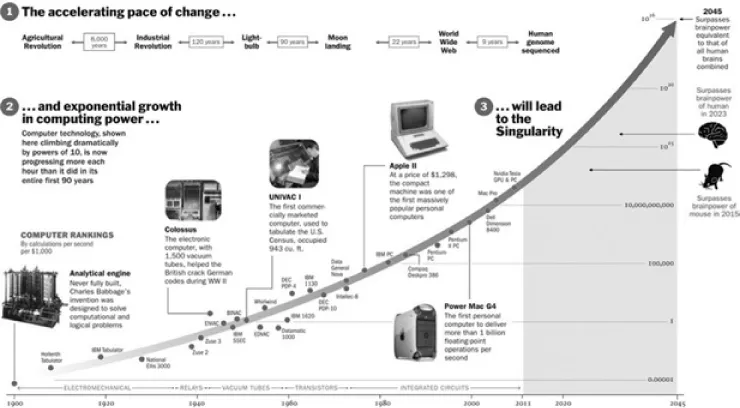
Figure 1.1 The exponential growth of technological progress according to Raymond Kurzweil
Expertise has to be combined with plenty of creativity. This imposes certain requirements on employees and the (project) manager’s leadership style. The latter will have to let things go and still meet the deadlines, c...
Table of contents
- Cover
- Title
- Colofon
- Inhoud
- Introduction
- 1 The &-&-&-paradox
- 2 Your Agile inspirator, the TomTom
- 3 First time right: The V-model and the critical parameter
- 4 The factor 10
- 5 The plan part I: project breakdown
- 6 The plan part II: sketch with the team and detailed plan
- 7 The project motivator
- 8 Heartbeat
- 9 The blind check
- 10 The Final Countdown
- Afterword
- Acknowledgements
- Appendix 1: Examples of the application of the project model
- Appendix 2: The complete project manager toolkit
- Bibliography
- About Roel Wessels
- Index
Trusted by 375,005 students
Access to over 1.5 million titles for a fair monthly price.
Study more efficiently using our study tools.
Frequently asked questions
Yes, you can cancel anytime from the Subscription tab in your account settings on the Perlego website. Your subscription will stay active until the end of your current billing period. Learn how to cancel your subscription
No, books cannot be downloaded as external files, such as PDFs, for use outside of Perlego. However, you can download books within the Perlego app for offline reading on mobile or tablet. Learn how to download books offline
Perlego offers two plans: Essential and Complete
- Essential is ideal for learners and professionals who enjoy exploring a wide range of subjects. Access the Essential Library with 800,000+ trusted titles and best-sellers across business, personal growth, and the humanities. Includes unlimited reading time and Standard Read Aloud voice.
- Complete: Perfect for advanced learners and researchers needing full, unrestricted access. Unlock 1.5M+ books across hundreds of subjects, including academic and specialized titles. The Complete Plan also includes advanced features like Premium Read Aloud and Research Assistant.
We are an online textbook subscription service, where you can get access to an entire online library for less than the price of a single book per month. With over 1.5 million books across 990+ topics, we’ve got you covered! Learn about our mission
Look out for the read-aloud symbol on your next book to see if you can listen to it. The read-aloud tool reads text aloud for you, highlighting the text as it is being read. You can pause it, speed it up and slow it down. Learn more about Read Aloud
Yes! You can use the Perlego app on both iOS and Android devices to read anytime, anywhere — even offline. Perfect for commutes or when you’re on the go.
Please note we cannot support devices running on iOS 13 and Android 7 or earlier. Learn more about using the app
Please note we cannot support devices running on iOS 13 and Android 7 or earlier. Learn more about using the app
Yes, you can access The complete project manager by Roel Wessels in PDF and/or ePUB format, as well as other popular books in Education & Architecture General. We have over 1.5 million books available in our catalogue for you to explore.