eBook - ePub
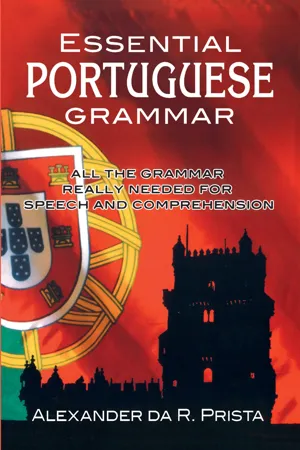
Essential Portuguese Grammar
All The Grammar Really Needed For Speech And Comprehension
- 128 pages
- English
- ePUB (mobile friendly)
- Available on iOS & Android
eBook - ePub
Essential Portuguese Grammar
All The Grammar Really Needed For Speech And Comprehension
About this book
This is the first Portuguese grammar designed specifically for adults with limited learning time, who have as their objective simple, everyday communication. The author covers the most important points of Portuguese grammar in the clearest possible way, concentrating upon the expressions that you would be most likely to use. All grammatical rules are illustrated with phrases and sentences that you can incorporate directly into your working vocabulary, and hints are generously sprinkled throughout, showing you how to replace difficult constructions with simpler ones.
Constantly drawing comparisons with English construction, it presents in logical order all the major aspects of Portuguese grammar: word order, forming questions, nouns and articles, adjectives and adverbs, possessives, demonstrative adjectives and pronouns, how to form negatives, personal pronouns, conjunctions and prepositions, how to conjugate verbs in the major tenses, prepositions and infinitives, and so on.
This grammar does not assume prior knowledge of either Portuguese grammar or of grammatical terms: one section is devoted to the definition of all grammatical terms used in the book.
This is not a simplified study, but rather a selected grammar for adult use that points out many time-saving short cuts. It can be used alone either as a beginner or as a refresher course in Portuguese grammar or it can be an ideal supplement to a phrase book or record course for home study or class use. Contains four appendices covering regular conjugations, orthographic-changing verbs, and irregular verbs. Glossary of grammatical terms. Index.

Constantly drawing comparisons with English construction, it presents in logical order all the major aspects of Portuguese grammar: word order, forming questions, nouns and articles, adjectives and adverbs, possessives, demonstrative adjectives and pronouns, how to form negatives, personal pronouns, conjunctions and prepositions, how to conjugate verbs in the major tenses, prepositions and infinitives, and so on.
This grammar does not assume prior knowledge of either Portuguese grammar or of grammatical terms: one section is devoted to the definition of all grammatical terms used in the book.
This is not a simplified study, but rather a selected grammar for adult use that points out many time-saving short cuts. It can be used alone either as a beginner or as a refresher course in Portuguese grammar or it can be an ideal supplement to a phrase book or record course for home study or class use. Contains four appendices covering regular conjugations, orthographic-changing verbs, and irregular verbs. Glossary of grammatical terms. Index.
Frequently asked questions
Yes, you can cancel anytime from the Subscription tab in your account settings on the Perlego website. Your subscription will stay active until the end of your current billing period. Learn how to cancel your subscription.
No, books cannot be downloaded as external files, such as PDFs, for use outside of Perlego. However, you can download books within the Perlego app for offline reading on mobile or tablet. Learn more here.
Perlego offers two plans: Essential and Complete
- Essential is ideal for learners and professionals who enjoy exploring a wide range of subjects. Access the Essential Library with 800,000+ trusted titles and best-sellers across business, personal growth, and the humanities. Includes unlimited reading time and Standard Read Aloud voice.
- Complete: Perfect for advanced learners and researchers needing full, unrestricted access. Unlock 1.4M+ books across hundreds of subjects, including academic and specialized titles. The Complete Plan also includes advanced features like Premium Read Aloud and Research Assistant.
We are an online textbook subscription service, where you can get access to an entire online library for less than the price of a single book per month. With over 1 million books across 1000+ topics, we’ve got you covered! Learn more here.
Look out for the read-aloud symbol on your next book to see if you can listen to it. The read-aloud tool reads text aloud for you, highlighting the text as it is being read. You can pause it, speed it up and slow it down. Learn more here.
Yes! You can use the Perlego app on both iOS or Android devices to read anytime, anywhere — even offline. Perfect for commutes or when you’re on the go.
Please note we cannot support devices running on iOS 13 and Android 7 or earlier. Learn more about using the app.
Yes, you can access Essential Portuguese Grammar by Alexander da R. Prista in PDF and/or ePUB format, as well as other popular books in Languages & Linguistics & Languages. We have over one million books available in our catalogue for you to explore.
Information
VERBS
Before proceeding to study this section, you should become acquainted with the material covered in pages 102 to 105 of the Glossary of Grammatical Terms. Although you may not remember everything at a first reading, this material will help you to understand special constructions and expressions as you come to them.
Comparison of English and Portuguese Verbs
Portuguese verbs are more complicated than English ones. In English there are very few changes in endings, and those that do occur are relatively uniform: I walk, he walks; I hope, he hopes. In Portuguese, each person has its own distinctive ending: eu falo (I speak), o senhor fala (you speak). Since the subject pronoun is very often omitted in Portuguese, failure to employ the correct ending results in misunderstanding: falo (I speak), fala (you speak).
Another aspect in which Portuguese verbs are more complicated than English is the greater number of tenses used in Portuguese. You will notice this when we speak of the various past tenses and of the subjunctive mood. Though it is possible to avoid some dif- ficulties by using short, simple sentences, it is necessary to be acquainted with the various features of the Portuguese verb for understanding the spoken and the written language. In the pages which follow, we shall always distinguish between those forms which must be memorized from the start and those which you can study at a later date.
The Three Conjugations
Every Portuguese verb belongs to one of three conjugations. Since the various endings which a particular verb takes are determined by the conjugation to which it belongs, you must pay special attention to this point. By classifying verbs into conjugations it is easier to remember their many forms.
The conjugation to which a Portuguese verb belongs is determined by the ending of its infinitive (that is, of the form which corresponds to the English “to run,” “to believe,” etc.).

All verbs which belong to the same conjugation (except irregular ones) are conjugated like the model verb of that conjugation. Our model verbs are:
| falar (to speak) | first conjugation |
| vender (to sell) | second conjugation |
| partir (to depart) | third conjugation |
Regular verbs ending in -ar will therefore take the same endings as the model verb falar. Regular verbs in -er and -ir will take the same endings as the models vender and partir, respectively.
Irregular verbs will be treated separately in Appendix D.
The Present Tense
Comparison of Present Tense in English and Portuguese
In English we have three different ways of expressing an action in the present. We can say “I laugh,” “I am laughing” or “I do laugh.” The three forms are distinguished by slight differences in meaning. In Portuguese, on the other hand, a single present tense conveys all three meanings of the English.
First Conjugation
Memorize the present tense of the model verb falar (to speak):
| (eu) falo | I speak, am speaking, do speak |
| (tu) falas | you (fam. sing.) speak, are speaking, do speak |
| (ele) fala | he (she, it) speaks, is speaking, does speak; you (polite sing.) speak, are speaking, do speak 18 |
| (nós) falamos | we speak, are speaking, do speak |
| (vós) falais | you (formal fam. pl.) speak, are speaking, do speak |
| (eles) falam | they speak, are speaking, do speak; you (polite pl.) speak, are speaking, do speak |
Second Conjugation
Memorize the present tense of the model v...
Table of contents
- DOVER BOOKS ON LANGUAGE
- Title Page
- Copyright Page
- Table of Contents
- INTRODUCTION
- SUGGESTIONS FOR VOCABULARY BUILDING
- WORD ORDER
- HOW TO FORM QUESTIONS
- NOUNS AND ARTICLES
- ADJECTIVES
- ADVERBS
- COMPARISONS OF ADJECTIVES AND ADVERBS
- EXPRESSING POSSESSION
- DEMONSTRATIVE ADJECTIVES AND PRONOUNS
- PERSONAL PRONOUNS
- NEGATIVES
- QUE AS CONJUNCTION AND RELATIVE PRONOUN
- PREPOSITIONS
- CONJUNCTIONS
- VERBS
- SOME USEFUL EXPRESSIONS
- Appendix A - COMPLETE PARADIGM OF THE THREE REGULAR CONJUGATIONS
- Appendix B - ORTHOGRAPHIC-CHANGING VERBS
- Appendix C - RADICAL-CHANGING VERBS
- Appendix D - IRREGULAR VERBS
- A GLOSSARY OF GRAMMATICAL TERMS
- INDEX
- A CATALOG OF SELECTED DOVER BOOKS IN ALL FIELDS OF INTEREST