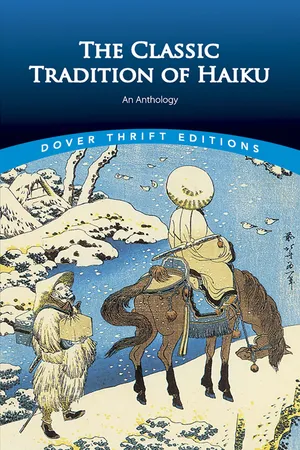
A highly distilled form of Japanese poetry, haiku consists of seventeen syllables, usually divided among three lines. Though brief, they tell a story or paint a vivid picture, leaving it to the reader to draw out the meanings and complete them in the mind's eye. Haiku often contains a hidden dualism (near and far, then and now, etc.) and has a seasonal tie-in, as well as specific word-images that reveal deeper layers in each poem.
This unique collection spans over 400 years (1488–1902) of haiku history by the greatest masters: Bashō, Issa, Shiki, and many more, in translations by top-flight scholars in the field. Haiku commands enormous respect in Japan. Now readers of poetry in the West can savor these expressive masterpieces in this treasury compiled by noted writer Faubion Bowers, who provides a Foreword and many informative notes to the poems.
- 96 pages
- English
- ePUB (mobile friendly)
- Available on iOS & Android
eBook - ePub
About this book
Information
Matsuo Bashō (1644–1694)3
bashō uete / mazu nikumu ogi no / futaba kana4
Having planted a plantain, at once / hate two stalks of reed
HS
I plant a banana tree
But first see only two stalks
Of dreaded weeds.
AK

by my new banana plant
the first sign of something I loathe –
a miscanthus bud
MU

kareeda ni / karasu no tomari keri / aki no kure 5
On dead branches crows remain perched at autumn’s end
HS

on a barren branch
a raven has perched —
autumn dusk
WJH

On a leafless bough
A crow is sitting: —autumn,
Darkening now —
HGH
furuike ya / kawazu tobikomu / mizu no oto6
Old Pond — frogs jumped in — sound of water
LH

A lonely pond in age-old stillness sleeps . . .
Apart, unstirred by sound or motion . . . till
Suddenly into it a lithe frog leaps.
CHP
The quiet pond
A frog leaps in,
The sound of water
EGS

old pond . . .
a frog leaps in
water’s sound
WJH
Th’old pond —a frog jumps in. Kerplunk!
AG

frog pond . . .
a leaf falls in
without a sound
BLE7
inazuma ni / satorenu hito no / tōtosa yo8
A flash of lightning
but still benighted
Oh worthy man!
FB

horohoro to / yamabuki chiru ka / taki no oto9
Do the yellow-rose petals
Tremble and fall
At the rapid’s roar?
NGS

umi kurete / kamo no koe / honoka ni shiroshi10
The waters fade
and the wild ducks’ cries
are faintly white
JBe
hiru neburu / aosagi no mi no / tōtosa yo11
sleeping at noon
the body of the blue heron
poised in nobility
EM

shizukasa ya / iwa ni shimiiru / semi no koe 12
How still it is!
Stinging into the stones,
The locusts’ trill.
DK

Quietness: seeping into the rocks, the cicada’s voice
HS

yagate shinu / keshiki wa miezu / semi no koe
Never an intimation in all those voices of sémi. . .
How quickly the hush will come . . . how speedily all must die.
LH

It gives no sign
that it knows its death is near
the cicada’s cry
EM
matsushima ya / ā matsushima ya / matsushima ya13
Matsushima!
Ah, Matsushima.
Matsushima!
FB

shimajima ya / chiji ni kudakete / natsu no umi
Islands: shattered into thousands of pieces in the summer sea
HS
ominaeshi / sono kuki nagara / hana nagara14
The ominaeshi, ah!
The stems as they are,
The flowers as they are.
RHB
kumo oriori / hito ni yasumuru / tsukimi kana
Clouds now and again
give a soul some respite from
moon-gazing — behold
BLE

clouds occasionally
make a fellow relax
moon-viewing
WJH

yoku mireba / nazuna hana saku / kakine kana15
Looking closely
I find a shepherd’s purse blooming
under the hedge.
SF

michinobe no / mukuge wa uma ni / kuware keri16
The roadside thistle, eager
To see the travellers pass,
Was eaten by the passing ass!
CHP
Mallow flowers
By the side of the road —
Devoured by my horse.
DK

mezurashi ya / yama o ideha no / hatsunasubi17
How rare, How lovely!
emerging from sacred peaks
young Ideha...
Table of contents
- Cover
- Title Page
- Copyright Page
- Contents
- Foreword
- Acknowledgments to Translators
- Iio Sōgi
- Sōchō
- Yamazaki Sōkan
- Arakida Moritake
- Matsunaga Teitoku
- Matsue Shigeyori [Ishū]
- Yasuhara Teishitsu
- Nishiyama Sōin
- Ihara Saikaku
- Yamaguchi Sodō
- Ichikawa Danjūrō I
- Kitamura Kigin
- Hōjō Dansui
- Matsuo Bashō
- Takarai Kikaku
- Hattori Ransetsu
- Mukai Kyorai
- Kosugi Isshō
- Ochi Etsujin
- Shida Yaba
- Kagami Shikō
- Tachibana Hokushi
- Nozawa Bonchō
- Yamamoto Kakei
- Ogawa Haritsu
- Sanboku
- Kawai Otokuni
- Anonymous
- Den Sute-jo
- Uejima Onitsura
- Chigetsu
- Shōfū-ni
- Ogawa Shūshiki
- Takeda [Tome] Ukō-ni
- Kaga no Chiyo
- Hayano Hajin
- Gozan
- Tan Taigi
- Yagi Shokyū-ni
- Yosa Buson
- Ōshima Ryōta
- Tagami Kikusha-ni
- Kobayashi Issa
- Ōtomo Ōemaru
- Ichikawa Danjūrō V
- Sakurai Baishitsu
- Kubota Seifū-jo
- Masaoka Shiki
Trusted by 375,005 students
Access to over 1.5 million titles for a fair monthly price.
Study more efficiently using our study tools.
Frequently asked questions
Yes, you can cancel anytime from the Subscription tab in your account settings on the Perlego website. Your subscription will stay active until the end of your current billing period. Learn how to cancel your subscription
No, books cannot be downloaded as external files, such as PDFs, for use outside of Perlego. However, you can download books within the Perlego app for offline reading on mobile or tablet. Learn how to download books offline
Perlego offers two plans: Essential and Complete
- Essential is ideal for learners and professionals who enjoy exploring a wide range of subjects. Access the Essential Library with 800,000+ trusted titles and best-sellers across business, personal growth, and the humanities. Includes unlimited reading time and Standard Read Aloud voice.
- Complete: Perfect for advanced learners and researchers needing full, unrestricted access. Unlock 1.5M+ books across hundreds of subjects, including academic and specialized titles. The Complete Plan also includes advanced features like Premium Read Aloud and Research Assistant.
We are an online textbook subscription service, where you can get access to an entire online library for less than the price of a single book per month. With over 1.5 million books across 990+ topics, we’ve got you covered! Learn about our mission
Look out for the read-aloud symbol on your next book to see if you can listen to it. The read-aloud tool reads text aloud for you, highlighting the text as it is being read. You can pause it, speed it up and slow it down. Learn more about Read Aloud
Yes! You can use the Perlego app on both iOS and Android devices to read anytime, anywhere — even offline. Perfect for commutes or when you’re on the go.
Please note we cannot support devices running on iOS 13 and Android 7 or earlier. Learn more about using the app
Please note we cannot support devices running on iOS 13 and Android 7 or earlier. Learn more about using the app
Yes, you can access The Classic Tradition of Haiku by Faubion Bowers in PDF and/or ePUB format, as well as other popular books in Literature & Poetry. We have over 1.5 million books available in our catalogue for you to explore.