This updated Participant Workbook now includes the Job Challenge Profile survey. With the aid of this action guide, you will determine what and how much you are learning, what parts of your job holds key challenges, and what strategies you might adopt to derive maximal learning from these experiences.
- 58 pages
- English
- ePUB (mobile friendly)
- Available on iOS & Android
eBook - ePub
Job Challenge Profile, Participant Workbook
About this book
Information
Topic
CommerceSubtopic
Éducation commercialeSECTION III
Capitalizing on the Learning Potential of Your Job
IN THIS SECTION OF YOUR WORKBOOK, you will examine the learning potential of job components that are particularly relevant for your job in more detail. A summary page is provided for each of the components that provides:
• A description of the job component;
• The managerial skills and perspectives that are most frequently developed from this component; and
• Strategies for getting the most from this component.
At the end of this section, you will be encouraged to consider three additional development strategies—feedback, relationships, and training—to maximize learning in your current job.
Keep in mind as you look at some of the specific developmental components of your job that the same components of your job that offer you the opportunity to learn and grow may also cause you stress and frustration. If you feel discouraged about any aspects of your job that are labeled “challenging,” take heart, as these feelings often accompany learning. Some powerful lessons come from dealing with frustrating situations. One method of dealing with these feelings is to talk to others about the situation. Peers, people who have formerly held your job, mentors, or spouses can help you find the learning points during discouraging moments.
Directions for completing this section:
1. Pick the developmental job components that seem the most important for you, using one or more of the following criteria:
• You rated the component as “quite descriptive” to “extremely descriptive” of your job, that is, your actual score is 20 or higher for the component;
• Your relative score on the component is high; or
• You feel particularly challenged by this component of your job.
2. Work through the summary page for each component you chose in Step 1 above. The page numbers are given below for each component:
• Unfamiliar Responsibilities | 15 |
• New Directions | 17 |
• Inherited Problems | 19 |
• Problems with Employees | 21 |
• High Stakes | 23 |
• Scope and Scale | 25 |
• External Pressure | 27 |
• Influence Without Authority | 29 |
• Work Across Cultures | 31 |
• Work Group Diversity | 33 |
3. When you have finished examining the job components of particular relevance to you, review the section on Linking the Developmental Power of Your Job with Learning Strategies on page 35.
4. Finally, complete the Summary Worksheet on page 38.
Unfamiliar Responsibilities
Description
You are expected to handle responsibilities that are new or very different for you. This is most likely the result of a job move (a promotion, a transfer, or a move to a new organization), but can also be experienced when a job is redefined due to organizational restructuring, strategic changes in the business, or new work technologies.
This component is characterized by the following:
• A lack of experience in some aspect of the job;
• A noticeable change from the type of work done previously; and
• A lack of background or credentials expected from someone in this position.
Learning Opportunities
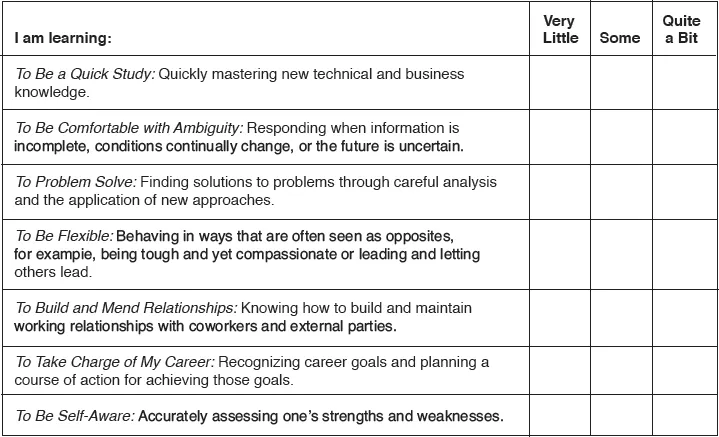
If unfamiliar responsibilities are an important aspect of your job, you have the opportunity to learn, particularly in the areas listed in the table below. Do a quick assessment of the degree to which you are learning from unfamiliar responsibilities and fill in the corresponding boxes.
Gaining the Most from Unfamiliar Responsibilities
Do not ignore the new aspects of your job. It is not unusual for a manager to begin a new assignment by focusing most of his or her attention on the familiar parts of the job. Resist this tendency by forcing yourself to spend time on aspects of the job on which you may have a lower comfort level.
Do not be intimidated by a lack of experience. Trial-and-error learning is necessary. Jump in and start learning by doing. Do not let fear that you won’t do something right the first time immobilize you. As a matter of fact, chances are pretty good that you won’t do it exactly right (that’s why they call it trial-and-error learning). Make your mistakes now. Coworkers are more likely to forgive those who are clearly inexperienced.
Discover the tacit responsibilities in the job—aspects that no one explicitly told you about when you took the job. For example, you may be expected to see that positive relationships are maintained between your group and the other department that shares the same floor of the building or your boss may expect you to act on her behalf when she is out of the office. These tacit responsibilities may also be unfamiliar responsibilities to be mastered.
New Directions
Description
You are responsible for initiating and carrying out something new for the organization, such as a new venture, a new strategic direction, a new process, a new unit, or a new function. There is a need to explore, create, build, and expand.
This component is characterized by the following:
• Something the organization has not tried before;
• Unknown outcomes; and
• A need for new staff, new policies, and new procedures.
Learning Opportunities
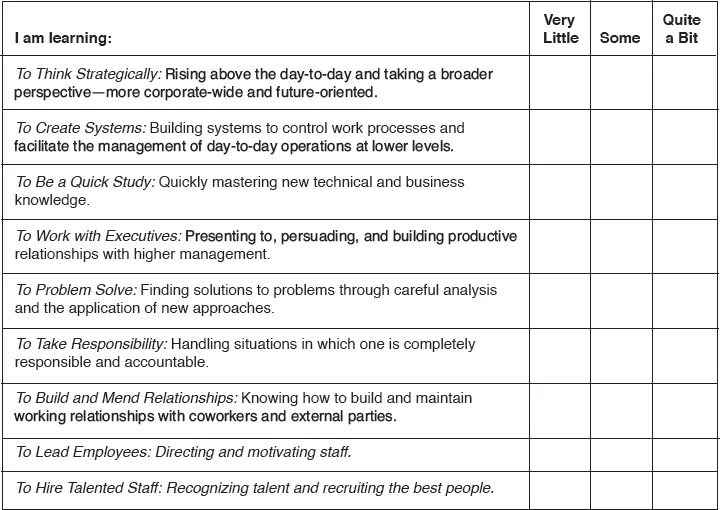
If new directions are an important aspect of your job, you have the opportunity to learn, particularly in the areas listed in the table below. Do a quick assessment of the degree to which you are learning from new directions and fill in the corresponding boxes.
Gaining the Most from New Directions
Be clear about where you are headed. Managers report learning the most when there is a clear vision or goal...
Table of contents
- Cover
- Title Page
- Copyright
- Contents
- Introduction
- Section I: The Job Challenge Profile
- Section II: Scoring the Job Challenge Profile
- Section III: Capitalizing on the Learning Potential of Your Job
- Section IV: Using Job Assignments for Ongoing Development
- Suggestions for Further Reading
Trusted by 375,005 students
Access to over 1.5 million titles for a fair monthly price.
Study more efficiently using our study tools.
Frequently asked questions
Yes, you can cancel anytime from the Subscription tab in your account settings on the Perlego website. Your subscription will stay active until the end of your current billing period. Learn how to cancel your subscription
No, books cannot be downloaded as external files, such as PDFs, for use outside of Perlego. However, you can download books within the Perlego app for offline reading on mobile or tablet. Learn how to download books offline
Perlego offers two plans: Essential and Complete
- Essential is ideal for learners and professionals who enjoy exploring a wide range of subjects. Access the Essential Library with 800,000+ trusted titles and best-sellers across business, personal growth, and the humanities. Includes unlimited reading time and Standard Read Aloud voice.
- Complete: Perfect for advanced learners and researchers needing full, unrestricted access. Unlock 1.5M+ books across hundreds of subjects, including academic and specialized titles. The Complete Plan also includes advanced features like Premium Read Aloud and Research Assistant.
We are an online textbook subscription service, where you can get access to an entire online library for less than the price of a single book per month. With over 1.5 million books across 990+ topics, we’ve got you covered! Learn about our mission
Look out for the read-aloud symbol on your next book to see if you can listen to it. The read-aloud tool reads text aloud for you, highlighting the text as it is being read. You can pause it, speed it up and slow it down. Learn more about Read Aloud
Yes! You can use the Perlego app on both iOS and Android devices to read anytime, anywhere — even offline. Perfect for commutes or when you’re on the go.
Please note we cannot support devices running on iOS 13 and Android 7 or earlier. Learn more about using the app
Please note we cannot support devices running on iOS 13 and Android 7 or earlier. Learn more about using the app
Yes, you can access Job Challenge Profile, Participant Workbook by Cynthia D. McCauley in PDF and/or ePUB format, as well as other popular books in Commerce & Éducation commerciale. We have over 1.5 million books available in our catalogue for you to explore.