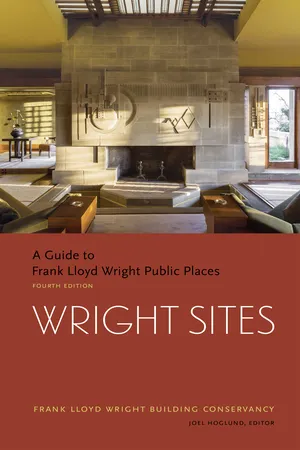
Frank Lloyd Wright's groundbreaking designs, innovative construction techniques, and inviting interiors continue to astound and inspire generations of architects and nonarchitects alike. The only comprehensive collection of Wright-designed buildings open to the public in the United States and Japan, Wright Sites has been revised and expanded to celebrate the 150th anniversary of the architect's birth in June 1867. The fourth edition of our best-selling guidebook contains twenty new sites, updated site descriptions and access information, and, for the first time, color photographs. It also includes itineraries for Wright road trips, a list of archives, and a selected bibliography.The introduction, revised for this edition, is by Jack Quinan, a founding member of the Frank Lloyd Wright Building Conservancy and author of Frank Lloyd Wright's Martin House.
- 160 pages
- English
- ePUB (mobile friendly)
- Available on iOS & Android
eBook - ePub
About this book
Information
Print ISBN
9781616895778
ALABAMA
Stanley and Mildred Rosenbaum House
1939
601 Riverview Dr.
Florence, AL 35630
(256) 718-5050
Florence, AL 35630
(256) 718-5050
wrightinalabama.com

“The house of moderate cost is not only America’s major architectural problem but the problem most difficult for her major architects,” Frank Lloyd Wright wrote in his 1943 autobiography. Wright spent much of the latter part of his career answering that challenge with his functional, cost-effective Usonian houses.
By omitting a basement and attic, embedding heating pipes in a concrete floor mat, centralizing the mechanical systems and plumbing near the kitchen, and building in furnishings and lighting, Wright intended to develop a simpler, more efficient house suited to the informality of middle-American family life. His concept anticipated the prefabrication of major building components. The walls, for example, were designed with a plywood core sandwiched between board-and-batten interior and exterior surfaces. Conventional framing, plaster, and paint were thus eliminated.
A pure example of the Usonian type, the Rosenbaum House was designed as a 1,540-square-foot, L-shaped plan on a two-by-four-foot grid, built at a cost of $12,000. The large living room includes an asymmetrically positioned fireplace and dining alcove at one end and a one-hundred-square-foot study at the other. The bedroom wing provided access to three rooms off a long, narrow gallery lined with bookshelves and storage. In 1948, Wright designed a significant addition to the house, adding 1,084 square feet and providing a larger kitchen, a playroom, and guest quarters that wrap three sides of a landscaped courtyard.

Tidewater cypress and red brick made from local northern Alabama clay combine to establish a nearly solid wall on the street side of the house. The twenty-foot-long cantilevered carport reinforces the house’s emphatic horizontal profile. By contrast, the rear of the house is open to the surrounding landscape, with floor-to-ceiling windows and glazed doors that reveal the terrace, a Japanese garden, and the woods beyond.
The fretwork plywood panels framing the clerestory windows and concealing recessed lights are typical of Usonian houses and are consistent with Wright’s philosophy of integral ornament. Original Wright-designed furnishings and reproductions of the original dining room chairs are supplemented by pieces by Charles and Ray Eames.
The house underwent a complete restoration and was opened as a city-owned museum in 2002. A new gift shop was added in 2014.
ARIZONA
NATIONAL HISTORIC LANDMARK
Taliesin West
Begun 1938
12345 N. Taliesin Dr.
Scottsdale, AZ 85258
(480) 627-5340
Scottsdale, AZ 85258
(480) 627-5340
franklloydwright.org

In 1937, Frank Lloyd Wright purchased six hundred acres of rugged land in the Sonoran Desert at the foot of Arizona’s McDowell Mountain. Here he established an experimental desert camp that would serve as his winter home, studio, and architectural laboratory until his death in 1959. Over the years, the complex was continually altered and expanded to comprise a drafting studio, Wright’s office and private living quarters, dining facilities, three theaters, and a workshop, as well as residences for apprentices and staff, all situated among pools, terraces, and gardens.
Constructed of stone, cement, redwood, and canvas, the buildings seem to grow out of the desert terrain that inspired their design. Their angled roofs, exposed beams, and rubble walls mirror the colors, textures, and forms of the surrounding landscape. As the buildings took on greater permanence, steel and fiberglass replaced the less durable materials.
The ninety-six-by-thirty-foot drafting room with a fireplace and desert masonry vault, a communal dining room, and two apartments form the core of the complex. An adjoining terrace leads to the fifty-six-foot-long garden room with a sloping, translucent roof and a fireplace. Wright’s private quarters were located in the wing extending at a ninety-degree angle to the southeast. Additional structures (the Cabaret Theater and a larger pavilion for live performances, concerts, and lectures) were designed to house social and cultural activities integrated into the educational program of the Taliesin Fellowship and Frank Lloyd Wright School of Architecture. Apprentices live in apartments on the site, as well as in shelters they construct of their own designs scattered throughout the surrounding desert.
Taliesin West is the international headquarters of the Frank Lloyd Wright Foundation, which owns and manages Taliesin West as well as Taliesin in Spring Green, Wisconsin.
ARIZONA
ASU Gammage
Grady Gammage Memorial Auditorium
1959
1200 S. Forest Ave.
Tempe, AZ 85281
(480) 965-5062
Tempe, AZ 85281
(480) 965-5062
asugammage.com

During the last year of his life, Frank Lloyd Wright received his only civic commission from the state of Arizona, where he lived during the winter months. This final Wright-designed public space is a circular performing arts center with a three-thousand-seat auditorium, classrooms, and offices. It was based on Wright’s Baghdad Opera House, one of a series of unrealized structures designed by the architect in 1957 as part of his Plan for Greater Baghdad.
The auditorium, commissioned by Grady Gammage, Arizona State University’s ninth president and a longtime friend of the architect, sits on a fifteen-acre site on the southwest corner of the campus. Wright designed two two-hundred-foot-long pedestrian bridges that rise from the adjacent lawn and sunken parking area to the circular building. Constructed of steel, cast concrete, and brick, the building cost $2.5 million.
An arcade of fifty fifty-five-foot-tall columns wraps the facade, framing the glass-walled lobby and supporting the outer edge of the thin-shell concrete roof. The plan is divided into two circles of unequal size. The larger contains the promenades, lobbies, and audience hall; the smaller, the stage, dressing rooms, workshops, classrooms, and offices.

Patrons enter and exit the auditorium’s continental-style seating area through twenty-four doors along the sides and rear of the hall. A grand tier and balcony provide upper-level seating. The grand tier, supported by a 145-foot-long girder,...
Table of contents
- Cover
- Title
- Copyright
- Contents
- Foreword
- Preface
- Introduction
- Sites in the United States
- Sites in Japan
- Suggested Itineraries
- Sites by State with Maps
- Site Index
- Archives Directory
- Selected Bibliography
- Illustration Credits
- About the Author
Trusted by 375,005 students
Access to over 1.5 million titles for a fair monthly price.
Study more efficiently using our study tools.