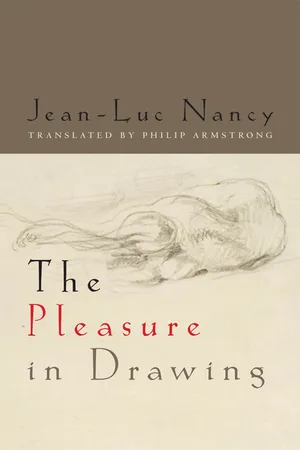
Originally written for an exhibition Jean-Luc Nancy curated at the Museum of Fine Arts in Lyon in 2007, this book addresses the medium of drawing in light of the question of form—of form in its formation, as a formative force, as a birth to form. In this sense, drawing opens less toward its achievement, intention, and accomplishment than toward a finality without end and the infinite renewal of ends, toward lines of sense marked by tracings, suspensions, and permanent interruptions.
Recalling that drawing and design were once used interchangeably, Nancy notes that drawing designates a design that remains without project, plan, or intention. His argument offers a way of rethinking a number of historical terms (sketch, draft, outline, plan, mark, notation), which includes rethinking drawing in its graphic,filmic, choreographic, poetic, melodic, and rhythmic senses.
If drawing is not reducible to any form of closure, it never resolves a tension specific to itself. Rather, drawing allows the pleasure in and of drawing, the gesture of a desire that remains in excess of all knowledge, to come to appearance. Situating drawing in these terms, Nancy engages a number of texts in which Freud addresses the force of desire in the rapport between aesthetic and sexual pleasure, texts that also turn around questions concerning form in its formation, form as a formative force. Between the sections of the text, Nancy has placed a series of "sketchbooks" on drawing, composed of a broad range of quotations on art from different writers, artists, or philosophers.
- 133 pages
- English
- PDF
- Available on iOS & Android
eBook - PDF
The Pleasure in Drawing
About this book
Information
Publisher
Fordham University PressYear
2013Print ISBN
9780823250943
9780823250936
eBook ISBN
9780823252329
Topic
ArtSubtopic
Art Techniques
N
O
T
E
S
T
O
PAG
E
S
6
8
–
1
0
0
‘Communism’
to
the
Community
of
‘Existence,’ ’’
trans.
Tracy
B.
Strong,
Political
Theory
20,
no.
3
(1992):
371–98.—Trans.]
36.
Allow
me
to
refer
here
to
my
book,
L’ ‘‘il
y
a’’
du
rapport
sexuel
(Paris:
Galile
´e,
2001),
forthcoming
in
English
translation
by
Anne
O’Byrne
in
Jean-Luc
Nancy,
Corpus
II:
Writings
on
Sexuality
,
trans.
Anne
O’Byrne
(Fordham,
2013).
37.
Leonardo
da
Vinci,
The
Notebooks
,
ed.
Edward
MacCurdy
(Lon-
don:
Jonathan
Cape,
1938),
1:106.
38.
William
Blake,
‘‘The
Marriage
of
Heaven
and
Hell,’’
in
The
Poems
of
William
Blake
,
ed.
W.
H.
Stevenson
(New
York:
W.
W.
Nor-
ton
&
Co.,
1972),
110.
39.
It
is
not
possible
here
to
address
the
discussion
concerning
the
definition
and
limits
of
pornography.
40.
Giorgio
Vasari,
Lives
of
the
Most
Eminent
Painters,
Sculptors,
and
Architects
,
trans.
Gaston
du
C.
de
Vere
(London:
Macmillan
and
Co.
and
the
Medici
Society,
1912–14),
xlii.
41.
Ibid,
72.
42.
No
doubt
there
exist
any
number
of
Stoic
and
Christian
tradi-
tions,
followed
by
Tristan,
Hamlet
and
Romeo,
Racine’s
Phaedra,
etc.
43.
See
Jacques
Derrida,
‘‘Desistance,’’
in
Philippe
Lacoue-Labarthe,
Typography:
Mimesis,
Philosophy,
Politics
,
ed.
Christopher
Fynsk
(Cam-
bridge:
Harvard
University
Press,
1989;
rpt.
Stanford,
Calif.:
Stanford
University
Press,
1998),
1–42.
44.
[Drawing
from
the
Latin
apparere
—‘‘to
appear,
come
in
sight,
make
an
appearance’’—in
which
parere
is
‘‘to
come
forth,
be
visible,’’
I
have
translated
Nancy’s
variations
on
la
paraı
ˆtre
or
l’apparaıˆtre
as
‘‘be-
coming
visible.’’—Trans.]
45.
[The
verb
s’enlever
has
the
senses
of
both
‘‘to
rise
up’’
and
‘‘to
remove,’’
in
the
sense
of
taking
something
away
from,
as
well
as
‘‘to
detach
something
from
something
else.
‘‘—Trans.]
46.
[To
continue
sur
sa
lance
´e
implies
that
something
continues
to
forge
ahead
or
continues
in
the
same
vein.—Trans.]
47.
Here
one
should
explicate
the
role
of
the
album
or
sketchbook,
drawing’s
handheld
transcendental.
116
Table of contents
- Cover
- Contents
- Translator’s Note
- Preface to the English-Language Edition
- Form
- Idea
- Formative Force
- The Pleasure of Drawing
- Forma Formans
- From Self Toward Self
- Consenting to Self
- Gestural Pleasure
- The Form-Pleasure
- The Drawing/Design of the Arts
- Mimesis
- Pleasure of Relation
- Death, Sex, Love of the Invisible
- Ambiguous Pleasure
- Purposiveness Without Purpose
- The Line’s Desire
- Notes
Trusted by 375,005 students
Access to over 1.5 million titles for a fair monthly price.
Study more efficiently using our study tools.
Frequently asked questions
Yes, you can cancel anytime from the Subscription tab in your account settings on the Perlego website. Your subscription will stay active until the end of your current billing period. Learn how to cancel your subscription
No, books cannot be downloaded as external files, such as PDFs, for use outside of Perlego. However, you can download books within the Perlego app for offline reading on mobile or tablet. Learn how to download books offline
Perlego offers two plans: Essential and Complete
- Essential is ideal for learners and professionals who enjoy exploring a wide range of subjects. Access the Essential Library with 800,000+ trusted titles and best-sellers across business, personal growth, and the humanities. Includes unlimited reading time and Standard Read Aloud voice.
- Complete: Perfect for advanced learners and researchers needing full, unrestricted access. Unlock 1.5M+ books across hundreds of subjects, including academic and specialized titles. The Complete Plan also includes advanced features like Premium Read Aloud and Research Assistant.
We are an online textbook subscription service, where you can get access to an entire online library for less than the price of a single book per month. With over 1.5 million books across 990+ topics, we’ve got you covered! Learn about our mission
Look out for the read-aloud symbol on your next book to see if you can listen to it. The read-aloud tool reads text aloud for you, highlighting the text as it is being read. You can pause it, speed it up and slow it down. Learn more about Read Aloud
Yes! You can use the Perlego app on both iOS and Android devices to read anytime, anywhere — even offline. Perfect for commutes or when you’re on the go.
Please note we cannot support devices running on iOS 13 and Android 7 or earlier. Learn more about using the app
Please note we cannot support devices running on iOS 13 and Android 7 or earlier. Learn more about using the app
Yes, you can access The Pleasure in Drawing by Jean-Luc Nancy, Philip Armstrong in PDF and/or ePUB format, as well as other popular books in Art & Art Techniques. We have over 1.5 million books available in our catalogue for you to explore.