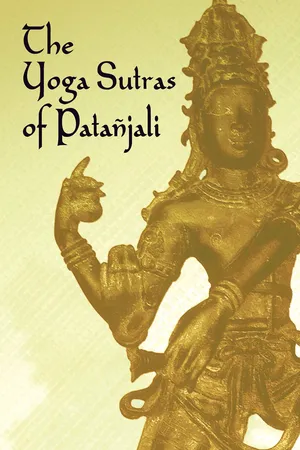
The Yoga Sutras of Patanjali
eBook - ePub

The Yoga Sutras of Patanjali

  1. 432 pages
  2. English
  3. ePUB (mobile friendly)
  4. Available on iOS & Android
eBook - ePub

The Yoga Sutras of Patanjali

About this book

One of yoga's most important and influential works, The Yoga Sutras of Patañjali forms a keystone of Indian philosophical and religious thought. Written by a sage in the second century B.C., the sutras have been translated many times. This interpretation by Professor James Haughton Woods, originally published under the aegis of the highly esteemed Harvard Oriental Series, ranks among the most acclaimed translations.
Patañjali's path is that of Raja Yoga, the royal yoga, or the yoga of the eight steps: restraint, observances, posture, breath control, sublimation (or withdrawal from the senses), attention, concentration, and meditation. The complete sutras appear here, encompassing a four-part analytical study intended to purify the practitioner's mind, body, and soul. Additional features include a commentary by Veda-Vyāsa and explanations by Vāchaspati-Miҫra that are crucial to developing an understanding of Patañjali's intent, along with invaluable background information provided by the translator's introduction and appendixes.
This outstanding English edition of a profound work of spiritual enlightenment is essential reading for all scholars and practitioners of yoga.

Frequently asked questions

Yes, you can cancel anytime from the Subscription tab in your account settings on the Perlego website. Your subscription will stay active until the end of your current billing period. Learn how to cancel your subscription.
No, books cannot be downloaded as external files, such as PDFs, for use outside of Perlego. However, you can download books within the Perlego app for offline reading on mobile or tablet. Learn more here.
Perlego offers two plans: Essential and Complete
  • Essential is ideal for learners and professionals who enjoy exploring a wide range of subjects. Access the Essential Library with 800,000+ trusted titles and best-sellers across business, personal growth, and the humanities. Includes unlimited reading time and Standard Read Aloud voice.
  • Complete: Perfect for advanced learners and researchers needing full, unrestricted access. Unlock 1.4M+ books across hundreds of subjects, including academic and specialized titles. The Complete Plan also includes advanced features like Premium Read Aloud and Research Assistant.
Both plans are available with monthly, semester, or annual billing cycles.
We are an online textbook subscription service, where you can get access to an entire online library for less than the price of a single book per month. With over 1 million books across 1000+ topics, we’ve got you covered! Learn more here.
Look out for the read-aloud symbol on your next book to see if you can listen to it. The read-aloud tool reads text aloud for you, highlighting the text as it is being read. You can pause it, speed it up and slow it down. Learn more here.
Yes! You can use the Perlego app on both iOS or Android devices to read anytime, anywhere — even offline. Perfect for commutes or when you’re on the go.
Please note we cannot support devices running on iOS 13 and Android 7 or earlier. Learn more about using the app.
Yes, you can access The Yoga Sutras of Patanjali by Patañjali, James Haughton Woods in PDF and/or ePUB format, as well as other popular books in Philosophy & Eastern Philosophy. We have over one million books available in our catalogue for you to explore.

Information

APPENDIX 7

INDEX OF WORDS IN THE SŪTRAS

An alphabetic index of the Sūtras themselves is given in the edition of the Bombay Sanskrit Series, and in that of the Ānandāçrama Series of Poona.—This index is designed to include all the words of the text of the Sūtras, and no others. The text is that of the Calcutta edition of Samvat 1947 (Baptist Mission Press, A.D. 1891); and accordingly pañca, for example, is included. The numbers refer to pāda and sūtra.
The Sūtras contain almost no finite verb-forms (asti, syāt, kṣῑyate, jāyante), and I have therefore put the participles, not under the verbal roots, but in their proper alphabetic place: so atῑta, apeta, udita, vῑta under a-, u-, v-, not under root i ; similarly abhijāta, āsanna, utpanna, ukta (not under vac), a-labdha (under al-) ; and so the other negatives beginning with an- or a-. On the other hand, the pronominal forms are assembled in the usual way: tat, tasya, tāḥ, sa, under tad ; asya, eṣām, under idam ; etena under etad.
akaraṇa,
e9780486117485_i0265.webp
-smaya‿akaraṇam
akalpita, bahir-akalpitā
akusīda, prasaṁkhyāne ’pi akusῑdasya
akṛṣṇa, açukla‿akṛṣam
akrama, akramaṁ ceti
akliṣṭa, kliṣṭa‿akliṣṭāh
e9780486117485_i0266.webp
, yoga⌣
e9780486117485_i0267.webp
; aṣṭav
e9780486117485_i0268.webp
;
e9780486117485_i0269.webp
; sva‿
e9780486117485_i0270.webp
- ga.
ajñata, vastu jñāta‿ajñātam
ajñāna, duhkha‿ajñāna .
añjanatā, tad-añjanatā .
aṇiman, aṇima‿ādi
atadrūpa, atadrūpa-pratiṣṭham
atῑta, atῑta‿anāgata-jñānam ; atῑta‿anāgatānāṁ svarūpato ’sty adhvabhedāt .
atyanta, atyanta‿asaṁkῑrṇayoḥ
. atha, atha yoga‿anuçāsanam.
adṛṣṭa, dṛṣṭa‿adṛṣṭa.
adhigama, pratyak-cetanā‿adhigamaḥ.
adhimātra, mṛdu-madhya‿adhimātra.
adhimatratva, mṛdu-madhya‿adhimā-tratvat.
adhiṣṭhātṛtvam, sarva-bhāva‿adhi-sthatrtvam.
adhyātman, adhyātma-prasādaḥ.
adhyāsa, itara‿adhyāsāt
adhvan, adhva-bhedat iv
Ananta, Ananta-samapattibhyam
ananta, ananta-phala
anabhighāta, dvandva‿anabhighātaḥ; tad-dharma⌣anabhighātaç ca
anavacchinna, samaya‿anavacchin-nah ii
anavaccheda, anyatā‿anavacchedāt; kālena‿anavacchedāt
anavadhāraṇa, ubhaya‿anavadhāra-ṇam
anavasthitatva
anaṣṭam, nastam apy anastam
anāgata, duḥkham anāgatam; anāgataṁ jñānam; anāgataṁ svarūpataḥ
anātman, duḥkha‿anātmasu
anāditva, tāsām anāditvaṁ ca
anāçaya, dhyāna-jam anāçayam
anitya, anitya‿açuci-duḥkha
aniṣṭa, aniṣṭa-
e9780486117485_i0271.webp
.
anukāra, svarūpa‿anukāra.
anugama, rūpa‿anugamāt
anuguṇa, vipāka‿anuguṇāṇām
anuttama, santoṣād anuttama-sukha-labhah ii.
anupaçya, pratyaya‿anupagyaḥ
anupātin, çabda-jñāna‿anupātῑ; dharma-anupātῑ
anubhūta, anubhūta-viṣaya
anumāna, pratyakṣa‿anumāna; çruta⌣anumāna
anumodita, kṛta-kārita‿anumodita,
anuçayin, sukha‿anuçayῑ; duḥkha⌣anuçayῑ
anuçāsana, yoga‿anuçāsana
anuṣṭhāna, yoga‿
e9780486117485_i0272.webp
‿anuṣṭhānāt
aneka, cittam ekam anekesam
anta, paramamahattva‿antaḥ
antara, jaty-antara; citta‿antara; pratyaya‿antarāṇi
e9780486117485_i0273.webp
, trayam
e9780486117485_i0274.webp
antarāya, te antarāyāḥ; antā-rāyābhāvaç ca
antardhānam,
anya, saṁskāra-çeṣo ’nyaḥ; anya-visaya; anya-saṁskāra; tad-anya-sādhāraṇatvāt.
anyatā, anyatā-khyāti; anyatā‿anavacchedāt
anyatva, krama‿anyatva; pariṇāma‿anyatve
anvaya, sūkṣma‿anvaya; asmitā‿anvaya; citta‿anvaya
aparānta, aparānta-jñanām; pariṇama‿aparānta-nirgrāhya
aparāmṛṣṭa, āçayāir aparāmṛṣṭaḥ
aparigraha, brahmacarya‿aparigrahāḥ; aparigraha-sthāirye
apariṇāmitva, puruṣasya‿apariṇāmi-tvat iv
apavarga, bhoga‿apavarga
api, tato ‘pi; pūrveṣām api; adhigamo ’pi; tasya‿api; viduso ‘pi; çuddho ’pi; naṣṭam api; tad api; vāirāgyād api; vyava...

Table of contents

  1. Title Page
  2. Copyright Page
  3. Table of Contents
  4. PREFACE
  5. INTRODUCTION
  6. TRANSLATION OF THE YOGA-SUTRAS WITHOUT THE COMMENT OR THE EXPLANATION - BEING THE SŪTRAS TRANSLATED IN GROUPS, TOGETHER WITH GROUP-HEADINGS ADDED BY THE TRANSLATOR
  7. BOOK FIRST - CONCENTRATION
  8. BOOK SECOND - MEANS OF ATTAINMENT
  9. BOOK THIRD - SUPERNORMAL POWERS
  10. BOOK FOURTH - ISOLATION
  11. APPENDIX 7 - INDEX OF WORDS IN THE SŪTRAS
