![]()
Chapter 1
Ferroelectric Materials and Their Properties
1.1Introduction
Explosive ferroelectric generators produce pulses of high voltage, high current and high power. A ferroelectric element of an FEG combines a few stages of a conventional pulsed power system in one, i.e. a prime power source, a high-current generator, a high-voltage generator, and a capacitive energy storage device. The properties of ferroelectric materials are essential for understanding the operation of ferroelectric generators. In this chapter, the fundamental properties of ferroelectric materials are examined. This is not an extensive review, but rather an introduction to those properties of ferroelectric materials that are important to ferroelectric generators. Since Lead Zirconate Titanate (PZT) is the material that has been extensively employed in the explosive ferroelectric generators, a detailed description of the properties of PZT ferroelectric ceramics is presented in Chapter 2. The operation of FEGs relies on the shock compression of ferroelectric materials, which has been under study since the end of the 1950s. Therefore, a brief review of the extensive literature on the shock compression of ferroelectric materials is presented in Chapter 3.
1.2Spontaneous Polarization
Several discoveries that were made at the end of the nineteenth century looked like curiosities at that time, but now they are the basis for numerous modern engineering applications. In 1880, Pierre and Jacques Curie observed that when certain crystalline minerals are subjected to mechanical stress, an electric charge accumulates at their surface forming an electric field across the bulk of the materials. In 1881, Hankel called this phenomenon “piezoelectricity” from the Greek word piezein, meaning to press or squeeze [1]. Piezoelectricity is a linear reversible process. The magnitudes of piezoelectric movements, voltages produced by natural materials (tourmaline crystals, quartz) are small. However, these materials were used in the first electromechanical systems during World War I, piezoelectric ultrasonic transducers for submarine detection.
For many years natural crystals were the exclusive source of piezoelectric capabilities and many types of devices were developed with these materials. During World War II, intensive studies of piezoelectric materials were performed in the U.S., Japan and Russia [2, 3]. At the beginning of the 1940s, man-made materials, ferroelectric ceramics prepared from mixed metal oxides (TiO2 and BaO) which formed barium titanate, BaTiO3, were discovered.
Unlike piezoelectricity, ferroelectricity is the complex interaction of the dielectric and elastic properties of highly nonlinear, anisotropic, polarizable, deformable crystals [3]. The roots of ferroelectricity can be traced back to the work of Valasek in the 1920s [4–9], who at the time was investigating the piezoelectric properties of Rochelle salt (potassium sodium tartrate), which was first produced by P. Seignette in La Rochelle, France, in 1655. Valasek was the first to use the term “Curie Point” to describe the onset of polar ordering in Rochelle salts below certain temperatures. The anomalous properties of Rochelle salt, i.e., extremely high dielectric and piezoelectric responses, were for a considerable time called Seignette electricity. The term ferroelectricity was not commonly used until the early 1940s.
In the 1950s, Japanese researchers began to investigate the properties of lead titanate and lead zirconate and their mixtures [3]. This resulted in the formulation of the ferroelectric ceramic materials based on these compounds, notably lead zirconate titanate that exhibited greater sensitivity and a higher operating temperature relative to barium titanate ceramics. Ferroelectric ceramics can be hundreds of times more sensitive to mechanical or electrical input than natural crystalline materials, and the composition, shape, and dimensions of ceramics can be tailored to meet the requirements of a specific purpose. These materials enabled designers to employ the piezoelectric effect in many new applications.
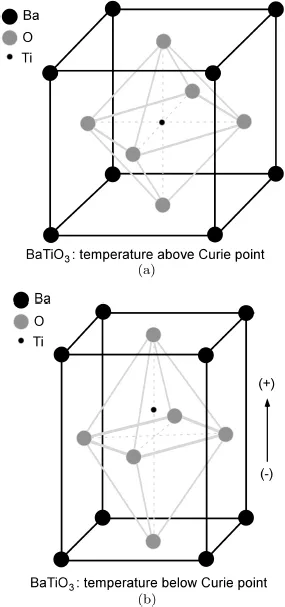
Barium titanate and lead zirconate titanate have a perovskite crystal structure [10], each unit cell of which consists of a small, tetravalent metal ion, usually titanium or zirconium, in a lattice of large, divalent metal ions, usually lead or barium, and O2− ions. Figure 1.1 shows schematic diagrams of a BaTiO3 unit cell at temperatures above and below Curie point.
The high-temperature (above Curie point) cubic phase (Figure 1.1(a)) is easier to describe, as it consists of regular corner-sharing octahedral TiO6 units that define a cube with O vertices and Ti-O-Ti edges. In the cubic phase, Ti4+ is located in the center of the cube. The unit cell is charge neutral. The cubic phase does not exhibit the ferroelectric effect.
The lower symmetry tetragonal phase is stabilized at temperatures below Curie point and involve the movement of the Ti4+ to an off-center position (Figure 1.1(b)). At ambient conditions, each crystal has a net dipole moment in the absence of an external electric field. This net dipole moment is due to the center of positive charge in the crystal not coinciding with the center of the negative charge due to its crystalline structure (Figure 1.1(b)). The polarization induced by a phase transformation (in this case from the cubic to the tetragonal phase) is referred to as the spontaneous polarization, Ps. The remarkable properties of this material arise from the cooperative behavior of the ions in the unit cell.
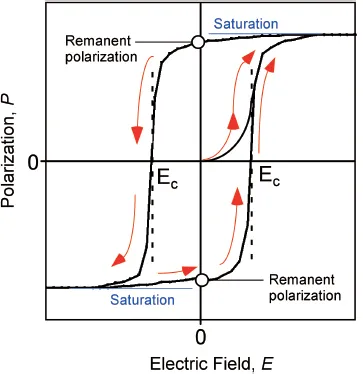
Ferroelectrics can be defined as polar materials that have at least two equilibrium orientations for the spontaneous polarization vector in the absence of an external electric field and that can have their spontaneous polarization switched between these two equilibrium orientations by an applied external electric field [11]. The name “ferroelectric” was given to these materials because their electrical behavior is analogous to the magnetic behavior of ferromagnetic materials. If an electric field is applied to a ferroelectric material and then slowly reversed and plotted against the resulting change in polarization of the material, a hysteresis loop is generated (Figure 1.2), much like for ferromagnetic materials.
Fig. 1.1.Schematic diagrams of the crystal structure of a BaTiO3 ferroelectric ceramic. (a) The high-temperature cubic phase (temperature above Curie point). Symmetric arrangement of positive and negative charges, charge neutrality. (b) The lower-temperature tetragonal phase (temperature below Curie point). The Ti4+ ion is off-center; the crystal has an electric dipole.
Fig. 1.2.Effect of electric field (E) on electric polarization (P) of ferroelectric material (P-E hysteresis curve or hysteresis loop). Ec is the coercive field for a ferroelectric material.
1.3Ferroelectrics and Piezoelectrics
The piezoelectric effect is observed when a mechanical stress induces electric polarization in a material due to the distortion of the unit cells of the crystal. The direct piezoelectric effect is a linear reversible process, where the magnitude of the polarization is dependent on the magnitude of the stress and the direction of the polarity is dependent on the type of stress, i.e. tensile or compressive.
The direct piezoelectric effect is always accompanied by an inverse piezoelectric effect, where a solid is strained when placed in an external electric field. The inverse piezoelectric effect is defined to be primarily an electromechanical effect, i.e. the strain is proportional to the electric field.
A necessary condition for the piezoelectric effect to occur is that there has to be a lack of a center of symmetry in the material’s crystalline structure. There are 32 classes or point groups of crystals of which 11 have a center of symmetry (centrosymmetric) and 21 do not have a center of symmetry. When there is a lack of symmetry, the net movement of positive and negative ions with respect to each other as a result of stress will produce an electric dipole. When there is a centrosymmetry, the centers of the positive and negative charges will still coincide, even after deformation of the crystal due to stress, and the unit cell will be charge neutral.
Of the 21 non-centrosymmetric crystal classes, 20 are piezoelectric. Of the 20 classes of crystals that are piezoelectric, 10 have a unique polar axis and are called polar crystals. Even when no external stress is being applied, those 10 classes of crystals with unique polar axes have a permanent electric dipole moment within their unit cells and are, thus, said to be spontaneously polarized.
The other 10 classes of piezoelectric crystals do not have polar axes. When no external stress is being applied, these 10 classes of crystals do not have a permanent electric dipole moment within their unit cells and they are not spontaneously polarized. These 10 classes of crystals possess piezoelectric effect but they are not ferroelectric.
Spontaneous polarization, Ps, is defined to be the magnitude of the dipole moment per unit volume or the magnitude of the electrical charge per unit area on the surface perpendicular to the axis of spontaneous polarization.
The magnitude of the spontaneous polarization depends on temperature. The temperature dependence of spontaneous polarization i...