![]()
CHAPTER I
The Woodcut and Wood Engraving and its place in the Graphic Arts
TO ALMOST EVERY ARTIST there comes a time when he feels the urge to make a woodcut. The result is often exciting, although not necessarily a woodcut in the sense of manifesting a true mastery of the craft.
There is a keen, fresh pleasure in cutting into a block of wood with knife or graver to bring forth a composition of different levels, of heights and depths; and, in the ensuing printing, in rolling the black ink over the surface and pulling the first proof. The process is as unpredictable as the result. There is breathless suspense in awaiting the outcome, which always has an element of surprise. For the past few hours I have been cutting, graving, boring, gouging, scraping and scratching, and the result of my work appears suddenly before me as a whole the instant I lift the paper from the inked block. The contrast between the darkened surface of the block and the lighter shade of the natural wood which shows in the cutting is much less than the bold contrast of black ink on white paper.
The visual experience is, therefore, entirely different from that in painting or sketching, where the visible result keeps pace with the progress of the work. No wonder, then, that the first proof makes a profound impression and immediately captivates the creator’s eye. Whether or not anything artistically worthwhile has been accomplished can be decided only after the first intoxication has passed.
Always there is the danger of bluffing, or of glossing over imperfections. This danger, incidentally, has subtly insinuated itself into the whole field of the graphic arts, and concerns not only the woodcut. It is most obvious in etching, where the untalented artist achieves the easiest result. Etchings are the most popular form of print in the art shops. The very name elicits from the layman a degree of respect, and gives him a mystic thrill which affects him so deeply that he has no urge to examine its source. Seldom does he have any idea of the technical process involved. All he wants of art is a thrill—perhaps the rudimentary thrill of possession. The word “etching” has a greater appeal to his romantic imagination than the more homely word “woodcut.”
In the technique of etching the chief danger lies in possible accident or in deliberate trickery. In drypoint, for instance, there is the tendency to leave a lot of roughness. Later, when the ink is applied, this will widen the needle-lines three-or-four-fold. Then, in the printing of an etched plate, much ink may be applied, or the acid for etching may be permitted to bite deeply and wide. Veritable mountain ranges will appear on the paper, as though made of lava or bronze, and will be called evidences of temperament and sensuousness. Once during my student days I placed a copperplate in the acid bath, intending to let it etch for an hour, and then forgot to take it out. It spent the night there. Ruefully, nine hours later, I pulled it out, convinced that it was ruined. The result—lava, bronze, “temperament,” general applause.
To all of this, copper engraving is an exception—an unique exception. This technique demands skill from artist and engraver alike. Unfortunately, in America it is comparatively little used.
In the woodcut, the temptation to bluff lies in the effectiveness of the simple black-and-white style and in the appealing freshness of the technical execution, which gives the illusion of strength and conceals inner sterility. Even a paltry drawing translated into a woodcut has a greater chance of succeeding, of getting to “look like something.”
From this it follows that the clever dilettante will aways prefer one of the print-making processes to any other artistic medium. In the right hands, the woodcut affords the artist a highly concentrated means of conveying strength and integrity. Without these qualities it is a mere superficial eye-catcher.
Modern woodcutting and wood engraving was born when photomechanical methods of reproduction replaced the work of the older woodcutter or wood engraver. This field, which had lain fallow for a long time, was now approached by artists with caution and timidity.
Since most artists who desired to practice wood engraving as a creative art had not learned the technique of reproductive wood engraving, which is seldom taught in these days, at first they groped their way in darkness. There was a hush before the breaking of the storm, and when it came it appeared in a new form. The artist had sighted unexplored land and found revolutionary possibilities in the new woodcut as a means of expression. Instead of the graver and boxwood block which the reproductive woodcutters had used, he chose a softer wood and a knife and gave vent to his emotion in these materials when brush and pencil no longer satisfied him.
We know that the woodcut (that is, cutting with a knife in the long-grain block), was in vogue during the Expressionist (1910-1925) period, and even at the present time it is used more than any other of the graphic arts to convey the artist’s more exalted moods. This applies, it seems to me, especially in Germany, and particularly to the revolutionary period at the end of the World War, at which time there was an abrupt break with almost every existing tradition. The possibilities of this new graphic medium of expression quickly made it popular among the artists. An entirely new style of print appeared. Anything was justified so long as it was expressive. Rarely did the artist hark back to the woodcut of the middle ages—the line woodcut.
Gradually woodcutting was taken up by a wider circle of artists, and soon it was introduced into the art schools. It grew more sedate and more settled. The artist began to concern himself more seriously with the fascinating crafts of cutting and engraving, casting occasional glances at the best examples of woodcuts of the reproductive period, which showed almost superhuman virtuosity. For years he tried out his knife on all kinds of woods, from the most delicate to the coarsest grained. He produced significant broadsides and portfolios in hitherto unknown formats. In every center of culture the woodcut came to be recognized as a rowdy, but by no means negligible, member of the graphic arts family.
After a while it quieted down still further. It settled into a smaller format, took on a more modest, cultured appearance; it showed its tranquil side. The versatility of the medium began to be recognized by artists. It presented itself, further, in a new guise, that of the wood engraving. And this meant that artists especially enamored of craftsmanship undertook long years of practice to master the engraving technique. Then wood engraving moved naturally into its true sphere, that of book illustration.
Nevertheless it has not yet found a perfect haven. I have the feeling that the woodcut will always be the problem child among the original printmaking processes. The technique of the woodcut is very simple, while that of the wood engraving is laborious and time-consuming, and beset with problems of style which are not inherent to the etching. I shall try to explain this.
Etching is an intaglio surface, while the woodcut is relief. The indentation in the copper plate, made with a needle or acid, is designed to come out black in the proof. The indentation made with knife or graver on the wood block will be white in the proof. In printing, the copper plate is spread with ink, which is then wiped off the surface, permitting the ink to remain only in the depressions of the plate, and in the printing the ink is pressed onto the paper. The wood block, on the other hand, is inked in such a manner that only the surface receives the color, not the indentations. The lines in the copper plate correspond to black lines on white paper; in the woodblock they correspond to white chalk lines on a blackboard.
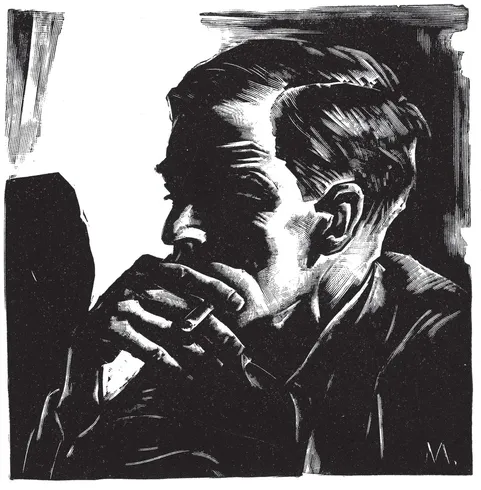
SELF PORTRAIT OF THE AUTHOR
Engraved in Wood
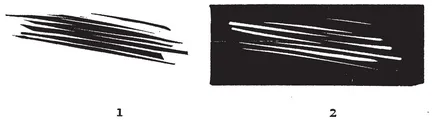
If my conception of a woodcut is such that I wish to show black lines on a white background, then I must cut or grave away all those portions of the surface which are not part of the lines. [Illus. No. 1.] If I conceive it in such a style that the result is to be white lines on a dark ground, then these lines must be cut deep into the block. [Illus. No. 2.] The preliminary consideration of what should be white and what black is as important as the style in determining the final interplay of black and white. The nature of etching does not include this double possibility.
I will not attempt to deal with lithography (planography), for I have too high a respect for this noble art, with its technical complexity and flexibility, its sensitivity and expressiveness, to dismiss it with only a few words.
The modern woodcut and wood engraving has given the artist a medium by which he can create directly on the block. The original is the carved block, and the print is made from this block. That this process allows a great number of impressions to be pulled from a single block is of secondary importance. It may be said that in the creation of a woodcut its reproductivity is not a decisive factor. This quality is of great importance, however, in the making of book illustrations. The block is the original, and no supplementary step is required in the printing of the book. Theoretically, one proof of the block is sufficient for the artist, just as the painter concludes his task with only one copy of a painting. For one, the artist will take oils and brush; for another, pencil or pastel; for a third, woodblock and knife, in accordance with the form suggested by the subject. In addition, of course, the copper plate or the lithographic stone is at his disposal.
So it follows that he will turn to ...