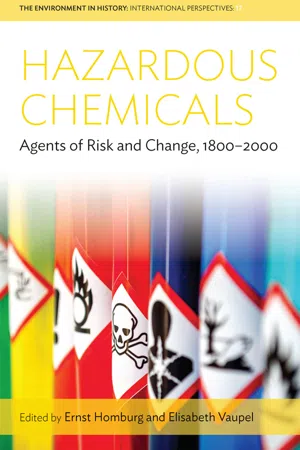
Although poisonous substances have been a hazard for the whole of human history, it is only with the development and large-scale production of new chemical substances over the last two centuries that toxic, manmade pollutants have become such a varied and widespread danger. Covering a host of both notorious and little-known chemicals, the chapters in this collection investigate the emergence of specific toxic, pathogenic, carcinogenic, and ecologically harmful chemicals as well as the scientific, cultural and legislative responses they have prompted. Each study situates chemical hazards in a long-term and transnational framework and demonstrates the importance of considering both the natural and the social contexts in which their histories have unfolded.
Trusted by 375,005 students
Access to over 1.5 million titles for a fair monthly price.
In 1775, Carl Wilhelm Scheele published a detailed study of the chemical properties of white arsenic (arsenic trioxide), which he had found to be an acid. He investigated the reactions of this acid with various substances, including a series of metals such as gold, silver, mercury, cobalt, and copper. The combination of copper and white arsenic resulted in a green-colored compound.1 He then started to experiment with this copper arsenite green as a painter’s pigment and found it worked quite well. Moreover, the color did not show any signs of fading or discoloration, even after three years. So, the Royal Swedish Academy of Sciences invited Scheele to publish the mode of preparation of this green color. He did so in 1778. His method consisted essentially in adding a solution of blue vitriol (copper sulfate) to a solution of potassium arsenite. A German translation of this synthesis appeared in 1783, followed by a French translation in 1785 and English in 1786.2
Despite Scheele’s and the academy’s optimism, and despite the many arsenite green hues in J. M. William Turner’s Guildford from the Banks of the Wey (1805), the new pigment was never very popular. The reviewer of Thomas Beddoes’s translation of Scheele’s recipe remarked that, in Great Britain at least, Scheele’s green was sold at a high price. In Thomas Bardwell’s Treatise on Painting (1795), Scheele’s green appears in the list of green colors, as does a short description of its preparation, but was absent from the usual palette of British painters.3 There were some technical problems as well. When Scheele’s laboratory synthesis was scaled up to commercial quantities, the resulting green was not always of the same shade due to impurities in commercial potash, white arsenic, and blue vitriol. Moreover, the precipitate was sometimes very hard to grind.4 All these problems—chemical, mechanical, commercial, esthetic—were solved by the invention of an industrial method to produce a modified copper arsenite green, by Ignaz von Mitis in Vienna (1805) and Wilhelm Sattler in Schweinfurt (1814).
This new green, superior to Scheele’s green, was a double salt, copper acetoarsenite. Mitis, who produced it between 1805 and 1818, sold it under the name Mitis Grün, and Sattler, who produced and exported large quantities of it, called it Schweinfurter Grün. Over the years, many new names such as Vienna green, Brunswick green, Paris green, and parrot green were adopted. In England, it came to be known as emerald green. Up to 1822, both the composition and the method of preparation of Schweinfurt green were kept secret, which gave Sattler a virtual monopoly all over Europe. In 1822, however, both secrets were published: in Germany by Justus Liebig and in France by Henri Braconnot. In 1822, a Mr. Noël, who owned a paper hangings manufactory in Nancy and used a “secret” green pigment imported from Schweinfurt, asked Braconnot to carry out a chemical analysis of this mysterious substance. Braconnot quickly discovered the green pigment consisted of three components: white arsenic, copper oxide, and acetic acid. It resembled Scheele’s green but was much more beautiful. Braconnot also tried hard to find a method of synthesis and, after many experiments, succeeded in finding a method that combined copper sulfate, white arsenic, and acetic acid. Scaling up this laboratory synthesis to manufacturing conditions led to some modifications, but in the end, Noël produced his own beautiful arsenical green. Braconnot published his results “in order to do a service to the arts.”5
Braconnot’s article provoked a reaction from Liebig. In a letter to the editors of the Annales de chimie et de physique, Liebig said he had found a better method than Braconnot’s, which he had published in the Repertorium für die Pharmacie and was both less cumbersome and less costly. His method consisted in combining verdigris (a mixture of copper acetate and copper carbonates), acetic acid, and arsenic, verdigris being cheaper than copper sulfate.6 In his original article, Liebig said he had already begun to investigate the “secret” substances called Mitis green and Schweinfurt green in 1820 to find a mode of preparation of these green colors and thus subvert “commercial speculations” in the interests of science and the diffusion of inventions.7 Both Braconnot’s and Liebig’s methods were widely publicized. At the end of the 1820s, the French were no longer dependent on imports from abroad. From about 1827, they began to manufacture their own Schweinfurt green, one of the first producers being Henri Ringaud (1805–1876), of Paris. More importantly, the arsenical color was used not so much as a painter’s pigment but rather as a coloring material in the manufacture of confectionary and wallpaper. And this was the source of worries and concerns among hygiénistes on public health, and of the emerging field of forensic medicine (médecine légale).8
Green Confectionary
In 1830, Gabriel Andral—a professor of hygiene (public health) at the University of Paris Faculty of Medicine and a member of the Royal Academy of Medicine—wrote a report to the Paris Police Prefecture on the dangers of colored confectionary.9 Andral proposed that the new prefect, Achille Libéral Treilhard, issue an ordinance that would list all coloring substances to be prohibited, including many mineral pigments, among which Schweinfurt green received special attention. To understand Andral’s report and its position in the French fight against copper arsenite green, we must go into the history of the Council of Sanitation (Conseil de Salubrité), the role played by the police prefect, the meaning of the ordinances issued by this prefect, and some events preceding Andral’s report. Every ordinance against Schweinfurt green, from 1830 onward, refers explicitly to a series of previous ordinances, laws, and regulations pertaining to hazardous chemicals in consumer products. The first in this series dates from 1742 and was addressed to the kingdom’s confectioners, pastry chefs, and traiteurs, who were told not to use dangerous colors such as copper and lead compounds for preparing their sweetmeats, sugarplums, jams, and marzipan figurines.10 Infractions of these rules would lead to confiscation of merchandise, severe fines, and even imprisonment. This ordinance also presented a series of allowable colors, all of them innocuous dyestuffs such as cochineal, saffron, turmeric, litmus, indigo, and so on. The structure of this Ancien Régime regulation—what colors were prohibited in what kind of goods, what punishments were incurred, what colors were allowed—survived into the nineteenth century.
On 22 July 1791, the National Assembly issued a decree on the organization of the municipal police. The police received the explicit authority to visit public places such as markets, cafés, and shops (butchers, bakers, grocers, apothecaries) to check the wholesomeness of foodstuffs and medicines. At the same time, offering bad or harmful foodstuffs was defined as an offence to be punished with confiscation and a heavy fine.11 On 1 July 1800, this authority was attributed to the newly created magistrate, the police prefect, who was responsible for public health in the city of Paris.12 This legal structure survived Waterloo, and in the Bourbon Restoration and the July Monarchy, the fight against copper arsenite green was undertaken against this legal background. The police prefect presided over the Council of Sanitation, which had been instituted in 1802 on the instigation of Charles Louis Cadet de Gassicourt, a professional pharmacist, who served as this council’s secretary until his death in 1821. Just before he died, he prepared an agreement between the prefect and the editors of the Annales de l’Industrie on publishing the council’s reports. It was a further step in the evolution of the scientific disciplines of public hygiene and legal medicine. After the discontinuation of the Annales de l’Industrie in 1827 and to “fill a serious gap in our medical literature,”13 the new discipline founded its own journal in 1829, the Annales d’Hygiène Publique et de Médecine Légale.14 Gabriel Andral was both a member of the Council of Sanitation and a cofounder of the Annales, in the fourth volume of which his report to the police prefect on dangerous confectionary was published.
Andral was not the first to worry about green confectionary. In January 1827, Claude François Barruel, a préparateur for chemistry lessons at the University of Paris Faculty of Science, became curious about the beautiful green color of the New Year sugarplums. He subjected these sweets to a chemical analysis and soon found they contained substantial amounts of copper acetoarsenite (Schweinfurt green). Arsenic and its compounds were known for centuries to be toxic, so the police authorities ordered an investigation to be carried out among several Parisian confectioners. Their arsenic-containing sweets were confiscated and destroyed, and no such sweets were allowed to be sold.15 These measures were probably based on the decrees issued in 1800. Furthermore, in 1827, Jean Baptiste Alphonse Chevallier wrote an article about two cases of green confectionary, which chemical analysis proved to contain copper arsenite. To prevent serious mishaps, Chevallier proposed an educational strategy: those engaged in preparing foodstuffs, and confectionary in particular, should acquire some elementary chemical knowledge and acquaint themselves with recent developments in public health.16
For the dangers of Schweinfurt green, Chevallier referred to Wilhelm Remer’s Traité de police judiciaire, the French translation of the second edition of Remer’s Lehrbuch der polizeilich-gerichtlichen Chemie.17 Remer wondered whether the use of Scheele’s green by confectioners, bakers, and pastry chefs ought not to be prohibited altogether, a measure much more drastic than Chevallier’s “information strategy.”18 In 1829, Barruel was inclined to think no confectioner would use poisonous colors for their sweets in the future. He was proved wrong by the police prefect who had ordered Henri-François Gaultier-Claubry to analyze various green confectionary articles imported from Germany, which turned out to contain significant amounts of copper arsenite. Alarmed, the police prefect sent out a circular authorizing the Paris police to confiscate confectionary containing poisonous mineral colors such as Schweinfurt green. Chevallier showed this circular to some of his pharmacy colleagues of the Royal Academy of Medicine. They decided to investigate the problem of colored confectionary and encourage the Council of Sanitation to publish a list of innocuous colors. Nothing came of this initiative, because of the Revolution in Paris of 1830.19 Prefect of Police Treilhard took up the problem and ordered the Council of Sanitation to report on the dangers resulting from colored confectionary and on how to remove those sweets from the market. Gabriel Andral wrote the report.
Andral’s report is important in two respects. First, the dangers arising from the presence of Schweinfurt green pertained not only to the sweets themselves but also to the wrappers around them. Wrappers and wrapping paper were the next issues in the fight against copper arsenite. Second, the report led to an ordinance issued by Treilhard dated 10 December 1830.20 It refers to the ordinances of 1742 and 1791, mentioned earlier, but also to articles 319 and 320 of the Penal Code, which specify the punishments for manslaughter or injury by negligence. These articles were applicable to the problems of green confectionary and green liqueurs, because the confectioners producing and selling these goods were held personally responsible for accidents resulting from their consumption. One of Andral’s proposals further stipulated that a special committee would visit Paris confectioners to ensure the observance of the new ordinance. Finally, the ordinance specified the colors that were prohibited and those that were not. Schweinfurt green was strictly prohibited and should be replaced by a mixture of Prussian blue and Persian berry, which was as brilliant as Schweinfurt green, according to the Council of Sanitation experts.
William Brooke O’Shaughnessy was very jealous of France, where such strict measures could be taken: “The statute law of England affords the public little protection against any system of this kind, no matter how deadly in its nature … In these particulars it is that our continental brethren, whether medical or judicial, have most outstripped us in thei...
Table of contents
Cover
Title Page
Copyright Page
Contents
List of Figures and Tables
Acknowledgments
List of Abbreviations
Introduction. A Conceptual and Regulatory Overview, 1800–2000
Part I. From Acute to Chronic Poisoning: Regulating Old Poisons in the Industrial Age
Part II. Discovering New Health Impacts: Carcinogenesis, Mutagenesis, and More in Times of Uncertainty and Non-knowledge
Part III. New Products, New Effects: The Discovery of the Environment and the Long Shadow of the 1960s
Conclusion
Index
Frequently asked questions
Yes, you can cancel anytime from the Subscription tab in your account settings on the Perlego website. Your subscription will stay active until the end of your current billing period. Learn how to cancel your subscription
No, books cannot be downloaded as external files, such as PDFs, for use outside of Perlego. However, you can download books within the Perlego app for offline reading on mobile or tablet. Learn how to download books offline
Perlego offers two plans: Essential and Complete
Essential is ideal for learners and professionals who enjoy exploring a wide range of subjects. Access the Essential Library with 800,000+ trusted titles and best-sellers across business, personal growth, and the humanities. Includes unlimited reading time and Standard Read Aloud voice.
Complete: Perfect for advanced learners and researchers needing full, unrestricted access. Unlock 1.5M+ books across hundreds of subjects, including academic and specialized titles. The Complete Plan also includes advanced features like Premium Read Aloud and Research Assistant.
Both plans are available with monthly, semester, or annual billing cycles.
We are an online textbook subscription service, where you can get access to an entire online library for less than the price of a single book per month. With over 1.5 million books across 990+ topics, we’ve got you covered! Learn about our mission
Look out for the read-aloud symbol on your next book to see if you can listen to it. The read-aloud tool reads text aloud for you, highlighting the text as it is being read. You can pause it, speed it up and slow it down. Learn more about Read Aloud
Yes! You can use the Perlego app on both iOS and Android devices to read anytime, anywhere — even offline. Perfect for commutes or when you’re on the go. Please note we cannot support devices running on iOS 13 and Android 7 or earlier. Learn more about using the app
Yes, you can access Hazardous Chemicals by Ernst Homburg, Elisabeth Vaupel, Ernst Homburg,Elisabeth Vaupel in PDF and/or ePUB format, as well as other popular books in History & Environmental Science. We have over 1.5 million books available in our catalogue for you to explore.