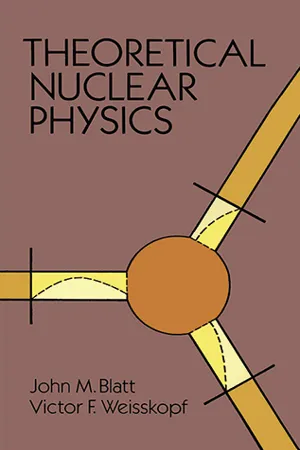
A classic work by two leading physicists and scientific educators endures as an uncommonly clear and cogent investigation and correlation of key aspects of theoretical nuclear physics. It is probably the most widely adopted book on the subject. The authors approach the subject as "the theoretical concepts, methods, and considerations which have been devised in order to interpret the experimental material and to advance our ability to predict and control nuclear phenomena."
The present volume does not pretend to cover all aspects of theoretical nuclear physics. Its coverage is restricted to phenomena involving energies below about 50 Mev, a region sometimes called classical nuclear physics. Topics include studies of the nucleus, nuclear forces, nuclear spectroscopy and two-, three- and four-body problems, as well as explorations of nuclear reactions, beta-decay, and nuclear shell structure. The authors have designed the book for the experimental physicist working in nuclear physics or graduate students who have had at least a one-term course in quantum mechanics and who know the essential concepts and problems of nuclear physics.
- 896 pages
- English
- ePUB (mobile friendly)
- Available on iOS & Android
eBook - ePub
Theoretical Nuclear Physics
About this book
Information
CHAPTER I
General Properties of the Nucléus
1. INTRODUCTION
In spite of the tremendous amount of information now available about atomic nuclei, nuclear physics is a very young science. The existence of a nucleus in each atom was discovered by Rutherford (11)1 in the year 1911. Some of the fundamental properties of nuclei were found at that time:
(1) They have radii very small compared to atomic dimensions; Rutherford showed that the nucleus acts like a point charge down to distances of the order of 10−11 cm, at least.
(2) They are charged. The charge on each nucleus turned out to be an integral multiple of the charge on the electron, i.e., nuclear charge = Ze, where Z = 1,2,3,··· is called the atomic number.
(3) Nuclei are very heavy compared to electrons. Most of the mass in an atom resides in the nucleus.
Since atoms are neutral entities, it was necessary to assume that the charge on the nucleus is exactly neutralized by the charges of the surrounding electrons. The charge Z of the nucleus then determines the number of the electrons in the atom and is the only property of the nucleus of importance for atomic physics, and consequently for most of the properties of matter as we know it.
The next important quantity of the nucleus is its mass. J. J. Thomson (13) discovered that the mass of the nucleus is not determined by its charge. Rather, there exist nuclei of the same charge Z but of different masses. Such nuclei are called isotopes. The mass of each isotope is nearly (but not precisely) equal to an integral number of proton masses.2 The nearest integer is called the “mass number” and is denoted by A.
The simplest hypothesis regarding nuclear constitution would be that all nuclei are made up of protons. This is contradicted by the fact that the mass number A is at least twice the atomic number Z in practically all nuclei. Thus other particles are needed in the nucleus besides protons.
The next hypothesis, which was current until 1932, postulated that nuclei are made up of protons and electrons. The nucleus N14 (Z = 7, A = 14), for example, was thought to consist of 14 protons (to give the correct mass) and 7 electrons (to give the correct charge). Ehrenfest and Oppenheimer (31) pointed out that this hypothesis leads to a serious contradiction with known properties of N14 (see Section 8).
The experimental discovery of the neutron (Curie-Joliot 32, Chadwick 32) led Heisenberg (32) to suggest the hypothesis that nuclei are made up of neutrons and protons and to explore the consequences of this assumption. Thus nuclear physics, as we know it today, dates back no farther than 1932.3
Under the assumption (which is very well confirmed by now) that nuclei are made up of neutrons and protons, the number of neutrons, N, in the nucleus is equal to A − Z. Neutrons and protons have nearly equal masses, and both will be referred to as “nucleons.” Nuclei with equal mass number A but different atomic number Z are called isobars or isobaric nuclei. Nuclei with equal Z but different A are called isotopes or isotopic nuclei. Nuclei with equal N = A − Z but different Z are called isotones. Isotopes are chemically equal and therefore hard to separate. From the point of view of nuclear physics, however, isotopes are nuclei with a different number of constituents. Isobars are chemically different because of their different atomic number Z. They are, however, more similar than isotopes from the nuclear point of view, since they consist of the same number of nucleons, and protons and neutrons have very similar properties within the nucleus.
The forces which hold a nucleus together cannot be ordinary electrostatic forces, since the (electrically neutral) neutrons are bound in the nucleus. The “nuclear forces,” unlike the forces which hold an atom together, have no analogy in classical physics. The fundamental steps in the exploration of nuclear forces were taken by Wigner (33a, 33b), who showed that they must have a very short range of action but must be very strong (millions of times as strong as the electr...
Table of contents
- DOVER BOOKS ON PHYSICS
- Title Page
- Copyright Page
- PREFACE
- Table of Contents
- CHAPTER I - General Properties of the Nucléus
- CHAPTER II - Two-Body Problems at Low Energies
- CHAPTER III - Nuclear Forces
- CHAPTER IV - Two-Body Problems at High Energies
- CHAPTER V - Three- and Four-Body Problems
- CHAPTER VI - Nuclear Spectroscopy I. General Theory
- CHAPTER VII - Nuclear Spectroscopy II. Special Models
- CHAPTER VIII - Nuclear Reactions: General Theory
- CHAPTER IX - Nuclear Reactions; Application of the Theory to Experiments
- CHAPTER X - Formal Theory of Nuclear Reactions
- CHAPTER XI - Spontaneous Decay of Nuclei
- CHAPTER XII - Interaction of Nuclei with Electromagnetic Radiation
- CHAPTER XIII - Beta-Decay
- CHAPTER XIV - Nuclear Shell Structure
- APPENDIX A - Angular Momentum Operators and Eigenfunctions
- APPENDIX B - Multipole Radiation
- References
- INDEX
- A CATALOG OF SELECTED DOVER BOOKS IN SCIENCE AND MATHEMATICS
Trusted by 375,005 students
Access to over 1.5 million titles for a fair monthly price.
Study more efficiently using our study tools.
Frequently asked questions
Yes, you can cancel anytime from the Subscription tab in your account settings on the Perlego website. Your subscription will stay active until the end of your current billing period. Learn how to cancel your subscription
No, books cannot be downloaded as external files, such as PDFs, for use outside of Perlego. However, you can download books within the Perlego app for offline reading on mobile or tablet. Learn how to download books offline
Perlego offers two plans: Essential and Complete
- Essential is ideal for learners and professionals who enjoy exploring a wide range of subjects. Access the Essential Library with 800,000+ trusted titles and best-sellers across business, personal growth, and the humanities. Includes unlimited reading time and Standard Read Aloud voice.
- Complete: Perfect for advanced learners and researchers needing full, unrestricted access. Unlock 1.5M+ books across hundreds of subjects, including academic and specialized titles. The Complete Plan also includes advanced features like Premium Read Aloud and Research Assistant.
We are an online textbook subscription service, where you can get access to an entire online library for less than the price of a single book per month. With over 1.5 million books across 990+ topics, we’ve got you covered! Learn about our mission
Look out for the read-aloud symbol on your next book to see if you can listen to it. The read-aloud tool reads text aloud for you, highlighting the text as it is being read. You can pause it, speed it up and slow it down. Learn more about Read Aloud
Yes! You can use the Perlego app on both iOS and Android devices to read anytime, anywhere — even offline. Perfect for commutes or when you’re on the go.
Please note we cannot support devices running on iOS 13 and Android 7 or earlier. Learn more about using the app
Please note we cannot support devices running on iOS 13 and Android 7 or earlier. Learn more about using the app
Yes, you can access Theoretical Nuclear Physics by John M. Blatt,Victor F. Weisskopf, Victor F. Weisskopf in PDF and/or ePUB format, as well as other popular books in Physical Sciences & Physics. We have over 1.5 million books available in our catalogue for you to explore.