![]()
CHAPTER I
INTRODUCTION
The Coming of Music
The lantern of science, throwing its light down the long corridors of time, enables us to trace out the gradual evolution of terrestrial life. Far away in the dim distances of the remote past we see it emerging from lowly beginnings —possibly single-cell organisms on the sea shore—and gradually increasing in complexity until it culminates in the higher mammals of to-day, and in man, the most complicated form of life which has so far emerged from the workshop of nature. And as living beings become more complex, they acquire an ever more intricate battery of sense-organs which help them to find their way about the world, to escape danger, to capture their food and avoid being themselves captured as food.
One of these is of special interest to musicians, for out of it has developed our present organ of hearing. Sunk into the skin of a fish, and running the whole length of its body, from head to tail on either side, there is a line of pits or depressions. Under these lies an organ known as the “lateral-line” organ. This is believed to register differences of pressure in the water, which will acquaint the fish with the currents and eddies in which he is swimming, and may also warn him of the proximity of other fish, especially of large fish of hostile intentions.
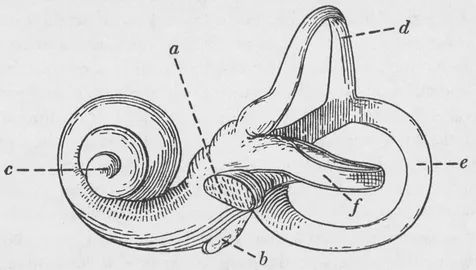
Even the most primitive fishes seem to have possessed a simple organ of this kind. Gradually the depression nearest to the head developed into something far more intricate, namely the hard bony structure known as the “labyrinth”, which is found in all vertebrates, including ourselves. It consists of hollow tubes filled with fluid, and the main part of it is shaped so as to form three (or in rare cases only one or two) semicircular canals, lying in directions mutually at right angles to one another, as on the right of fig. 1.
Fig. 1. The labyrinth of the left human ear (magnified about 5 times). The three semicircular canals are on the right (d, e, f ) and the cochlea on the left (c). a is the oval window to which the ear-drum transmits its vibrations; b is the round window, the function of which is explained below (p. 246).
When an animal turns its head or the upper part of its body, the fluid in the semicircular canals lags behind, because of its inertia, and so rubs over a set of paint-brushes of fine hairs, one in each canal; the bending of these hairs sends a series of nerve-impulses to the brain, which inform it of the change of direction and initiate a set of reflex actions to balance the change. Human beings are seldom conscious that they possess such organs, although it is by their help that we regain our balance after a sudden slip. They are also responsible for the giddiness we feel after spinning round too often or too rapidly, and for part at least of the even less agreeable sensations we experience when we are on a small ship in a turbulent sea.
A simple equipment of this kind would be adequate for primaeval fish, which lived entirely in the water, but would soon prove inadequate under new conditions which were to come. For the geologists tell us of a period of great drought occurring some 300 million years ago, when seas, lakes and marshes were all drying up. It must have been an anxious time for the fishes, many of which would desert their pools and shallows, and flop across dry land in the hope of finding new water. Clearly the more amphibious they could become, the greater was their chance of survival. In time some of the survivors became pure land-animals—our own ancestry. Organs for registering differences of pressure in water would be of little use to them now. What they needed was an organ to register minute differences of pressure in air, for these were associated with sounds which might indicate the presence of food or of danger, of friends or of enemies.
Gradually the required new organ seems to have developed out of the old. The story of the change provides one of the most fascinating—and, one is almost tempted to say, most incredible—chapters in the evolutionary record. A small area of the bony structure of the labyrinth became thinned down into a yielding membrane of mere skin, thin and soft enough to transmit variations of pressure from the air outside to the fluid within. At the same time, the labyrinth itself grew in size and increased in complexity. That of the frog shews a small bulge, which, as we proceed farther upwards in the scale of life, gradually develops into the cochlea, which forms the essential part of the ear of vertebrates. The external appearance of this wonderfully intricate piece of apparatus is shewn in fig. 1 on p. 2; its interior is described later (p. 246). For the moment we can only compare it to the case, the sound-board and the strings of a pianoforte of many strings—about 3000 in birds, 16,000 in cats and 24,000 in man—all compressed to the dimensions of less than a pea. It enables its possessor not only to hear sounds, but also to analyse them into their constituent tones. This power of analysis must obviously have had a great “survival value” for primitive life, since sounds which have been analysed can be remembered, and those which have once been found to be associated with danger can be promptly acted upon when heard again—just as we do with the motor-horn in our less primitive life of to-day.
In some such way as this, the human race became possessed of its ears. At first they would merely be helps in the struggle for existence. But we can imagine primitive man one day discovering in them an interest and a value of another kind; we can imagine him finding that the hearing of some simple sound, perhaps the twang of his bowstring or the blowing of the wind over a broken reed, was a pleasure in itself. On that day music was born, and from that day to this innumerable workers of many ages and of many peoples have been trying to discover new sounds of a pleasure-giving kind, and to master the art of blending and weaving these together so as to give the maximum of enjoyment, with the result that music of one kind or another now figures largely in the lives of most civilised beings.
The Sense of Hearing
As life slowly climbed the long ladder of evolution, one sense after another arrived and developed. Hearing was the last to arrive, and the last to attain a state bordering on perfection. When it reached this state, the other senses were already highly developed, and one, the sense of seeing, had already attained too much importance to be displaced. For most animals seeing must always have been more important than hearing, and whether we think in terms of our pleasure or of our well-being we must admit that the same is true for us to-day; we would sooner lose any of our other senses than that of sight. Throughout most of our waking life, we are seeing and hearing at the same time, and our sensations of sight are usually far more intense than those of sound. And as we obtain more pleasure through our eyes than through our ears, we have acquired the habit of giving the greater part of our attention to what we see, leaving a mere fraction for what we hear. Not only so, but hearing and seeing do not blend well; they rather compete—in an unequal competition in which seeing usually wins. In the opera house, many of us miss much of the music through watching the acting too intently. Only when the distraction of sight is removed can our minds give full attention to what we hear. Our appreciation of sound then becomes far keener and more critical. This is why blind people so often become exceptionally good musicians, and why many people who are not blind find it well to listen to the radio with the room darkened, and to close their eyes in the concert room, resisting the temptation to watch the fingers of the pianist, or the mouth of the prima donna.
The Human Ear
The visible part of the ear consists of an external shell, the relics of an earlier sound-collector, with an aperture—the “meatus” or auditory canal—somewhere in its lower half. At the far end of this canal, approximately an inch inside the head, is a small delicate membrane of skin, only about three thousandths of an inch in thickness. It is oval in shape, being about a third of an inch in height, and two-fifths of an inch in width. It is stretched tightly over a hard frame of bone, much as the skin of a drum is stretched over a hard frame of wood; because of this it is known as the “membrana tympani”, or ear-drum (see fig. 2, p. 9 below).
Sound reaches our ears in the form of waves which have travelled through the surrounding air, much as waves travel over the surface of a sea or river; some of these waves travel down the inch-long backwater formed by the auditory canal, and finally encounter the ear-drum, which forms a barrier at the far end.
When water-waves are stopped by a barrier, the pressure they exert on it varies with the rise and fall of the waves, and the variations of pressure may shake it into motion. We may often feel a sea-wall tremble under the pounding of the waves, and a delicate seismograph many miles inland will record the impact of sea-waves on a rocky coast. In the same way, sound-waves in air exert a varying pressure on our ear-drums which may set them into motion. But there is one essential difference. The sea-wall may be shaken to pieces in a few years, but the ear-drum has the capacity of continually renovating itself, and so keeping its efficiency almost unimpaired. Even if it is completely shattered by the intense noise of an explosion or a gun-blast, it will renew itself in a few weeks.
Our ear-drums are sensitive to an almost inconceivable degree. The tiniest ripple in the air sets them into motion; under favourable conditions a sound-wave of such feeble intensity that the air is displaced only through a ten-thousand-millionth part of an inch will send an audible sound to the brain. The change of pressure produced by such a sound-wave is less than a ten-thousand-millionth part of the whole pressure of the atmosphere, so that the human ear is incomparably more sensitive than any barometer which has ever been constructed. The ordinary barometer will record the lowering of atmospheric pressure which we experience as we walk upstairs in our house, or climb a few feet up the mountain-side, but the change of pressure just mentioned is that produced by an ascent of only a 30,000th of an inch. The feeblest nodding of our head changes the pressure on our ear-drums by more than is necessary to set them into motion, and if we do not hear a musical sound, it is only because we cannot nod our heads with sufficient rapidity. For, although our ear-drums are very sensitive to minute changes of pressure, it is only when these changes are repeated in rapid succession that messages are passed on to the brain. We shall see later why this is.
Immediately behind the ear-drum lies a chain of small bones, known as “ossicles”. The first of these is in contact with the ear-drum, while the last presses against the “oval window” of the labyrinth, the thin yielding membrane of skin already described (a in fig. 1). The ossicles transmit the motion of the ear-drum to this oval window much as a bell-wire transmits a pull from a bell-rope to a bell. The oval window passes the motion on to the fluid inside the labyrinth, and in this way it reaches the cochlea—the miniature pianoforte which has already been mentioned. The workings of the cochlea are not yet fully understood, but we know that out of it emerges a bundle of nerves, and that when the ear-drum is set into vibration, minute currents of electricity pass through these nerves to the brain, and produce in it sensations which keep it informed as to the vibratory motions of the ear-drum.
The Process of Hearing
To obtain a more precise picture of the process of hearing, let us imagine that we are listening to an ordinary telephone conversation.
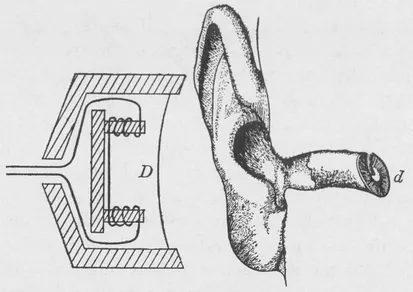
The essentials are shewn diagrammatically in fig. 2. The ear is on the right, and is open to the air as far as the ear-drum d. The telephone is on the left, and is open to the air as far as a metal diaphragm D. We at once notice a sort of symmetry between the two instruments, the solid cartilage and bone of the ear corresponding to the vulcanite framework of the telephone, while the ear-drum d corresponds to the diaphragm D of the telephone.
This diaphragm, like the ear-drum, has a complex piece of apparatus behind it, but out of this only a single pair of wires emerges. This is the telephone line, which may have its other end hundreds of miles away. Its function is to bring into the telephone electric currents which represent sound produced at its other end. The telephone transforms these currents into motions of the diaphragm, and so acts in just the opposite way to the ear, which transforms motions of the ear-drum into electric currents.
Fig. 2. Diagrammatic representation of the process of hearing. The action of the ear is somewhat like that of a telephone, but reversed. The telephone transforms the variations of an electric current into the vibrations of a diaphragm D, while the ear transforms the vibrations of the ear-drum d into electric currents which transmit sensations to the brain.
The apparatus behind the diaphragm of the telephone consists primarily of a magnet of the rather special kind known as a “polarising” magnet. Unlike the familiar horse-shoe magnet, this is not made of magnetised steel throughout, but has two projecting ends of soft iron. The telephone line makes several turns round each of these. Now a well-known law of physics tells us that a piece of soft iron which is encircled by an electric current becomes a temporary magnet, and so attracts any steel or iron which may be in its proximity, for so long as the current is flowing. In our diagram the magnet attracts the diaphragm D all the time, but when an electric current is flowing through the telephone line, the two pieces of soft iron form an additional magnet, and so give an extra pull to the diaphragm.
When we are listening to a telephone conversation, the current in the telephone line is not of unvarying strength; it continually waxes and wanes. As a result of this varying current, the diaphragm D experiences an extra pull which also waxes and wanes; it is pulled at one moment weakly, at another forcibly, at still another not at all, and so is kept continually in motion. Each time it moves a bit to the right, the air between it and the ear-drum is pushed a bit to the right, so that the ear-drum itself is pushed a bit to the right. Conversely, when the diaphragm moves to the left, the air is sucked outw...