"To the reader who wishes to obtain a bird's-eye view of the theory of differential forms with applications to other branches of pure mathematics, applied mathematic and physics, I can recommend no better book." — T. J. Willmore, London Mathematical Society Journal. This excellent text introduces the use of exterior differential forms as a powerful tool in the analysis of a variety of mathematical problems in the physical and engineering sciences. Requiring familiarity with several variable calculus and some knowledge of linear algebra and set theory, it is directed primarily to engineers and physical scientists, but it has also been used successfully to introduce modern differential geometry to students in mathematics. Chapter I introduces exterior differential forms and their comparisons with tensors. The next three chapters take up exterior algebra, the exterior derivative and their applications. Chapter V discusses manifolds and integration, and Chapter VI covers applications in Euclidean space. The last three chapters explore applications to differential equations, differential geometry, and group theory. "The book is very readable, indeed, enjoyable — and, although addressed to engineers and scientists, should be not at all inaccessible to or inappropriate for ... first year graduate students and bright undergraduates." — F. E. J. Linton, Wesleyan University, American Mathematical Monthly.
Everything in this section will be based on the local theory of Section 4.5. Now we have integration at our disposal and we shall discuss a few global results. Let
be a closed surface in E3. For e3 we take the outward drawn normal to
. The mapping
x → e3
is a map on
to the unit sphere S2. As x varies over
, e3 varies over S2 a whole number of times, called the degree of the normal map (cf. Section 6.2). The element of area of the normal map is
ω1ω2 = Kσ1σ2
since
de3 = ω1e1 + ω2e2.
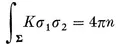
Here K is the Gaussian curvature. Hence
where n is the degree. The factor 4π is simply the area of the unit sphere.
In particular, if
is a closed convex surface, then e3 covers S2 exactly once as x covers
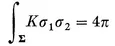
, hence
in this case.
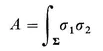
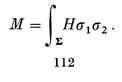
After this, we shall limit our discussion to closed convex surfaces. Two important invariants are the total area
and the integrated mean curvature
Given a closed convex surface
and a fixed positive number a, we form the surface
’parallel to
at distance a by marking off on the outward-drawn normal at each point x of
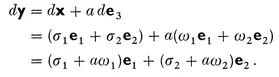
the distance a and taking the locus of all points so obtained. Thus the typical point on the parallel surface is
y = x +ae3
where e3 always denotes the normal at x. We have
It follows that the normal to the parallel sur...
Table of contents
Title Page
Copyright Page
Dedication
Foreword
Preface to the Dover Edition
Preface to the First Edition
Table of Contents
I - Introduction
II - Exterior Algebra
III - The Exterior Derivative
IV - Applications
V - Manifolds and Integration
VI - Applications in Euclidean Space
VII - Applications to Differential Equations
VIII - Applications to Differential Geometry
IX - Applications to Group Theory
X - Applications to Physics
Bibliography
Glossary of Notation
Index
Trusted by 375,005 students
Access to over 1.5 million titles for a fair monthly price.
Study more efficiently using our study tools.
Frequently asked questions
Yes, you can cancel anytime from the Subscription tab in your account settings on the Perlego website. Your subscription will stay active until the end of your current billing period. Learn how to cancel your subscription
No, books cannot be downloaded as external files, such as PDFs, for use outside of Perlego. However, you can download books within the Perlego app for offline reading on mobile or tablet. Learn how to download books offline
Perlego offers two plans: Essential and Complete
Essential is ideal for learners and professionals who enjoy exploring a wide range of subjects. Access the Essential Library with 800,000+ trusted titles and best-sellers across business, personal growth, and the humanities. Includes unlimited reading time and Standard Read Aloud voice.
Complete: Perfect for advanced learners and researchers needing full, unrestricted access. Unlock 1.5M+ books across hundreds of subjects, including academic and specialized titles. The Complete Plan also includes advanced features like Premium Read Aloud and Research Assistant.
Both plans are available with monthly, semester, or annual billing cycles.
We are an online textbook subscription service, where you can get access to an entire online library for less than the price of a single book per month. With over 1.5 million books across 990+ topics, we’ve got you covered! Learn about our mission
Look out for the read-aloud symbol on your next book to see if you can listen to it. The read-aloud tool reads text aloud for you, highlighting the text as it is being read. You can pause it, speed it up and slow it down. Learn more about Read Aloud
Yes! You can use the Perlego app on both iOS and Android devices to read anytime, anywhere — even offline. Perfect for commutes or when you’re on the go. Please note we cannot support devices running on iOS 13 and Android 7 or earlier. Learn more about using the app
Yes, you can access Differential Forms with Applications to the Physical Sciences by Harley Flanders in PDF and/or ePUB format, as well as other popular books in Mathematics & Applied Mathematics. We have over 1.5 million books available in our catalogue for you to explore.