![]()
The HEART(H) of the Home
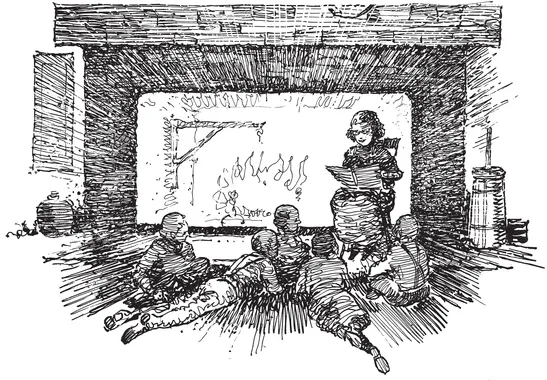
The disappearance of the old-time great fireplace is sad; it was the favorite American family gathering place. Now we gather about the TV set, but there is little or no contact or even conversation among a family watching a TV show. The hearth was once exactly what the word meant—the “heart” of the home, the center of communication.
Just off the kitchen fireplace in most early farmhouses was the “borning room.” It wasn’t reserved entirely for births, although families were so large then, I am sure the little room was a busy place in its own right. There, behind the wall-sized fireplace where it was warm and near the kitchen chores of the day, children saw the first light of day; and later started their lessons in reading and writing. I found my earliest example of the schoolroom blackboard (a six-foot-long by thirty-five-inch-wide blackened pine board) on the wall of a Vermont farmhouse borning room. When slate was being used only for roofing, the first “blackboards” were exactly that—black boards, or slabs of wood blackened with a mixture of egg white and the carbon of charred potato. Some of the old writing could still be seen, scratched by all-too-hard chalk (unrefined chalkstone ) : one line was probably put there by some teacher-mother over two centuries ago. It read: TIME IS SHORT. For them it certainly was.
In a wall cabinet of this borning room, I found a well-worn booklet named The Mother’s Primer. Each page showed words with illustrations, with fine print below instructing the adult. “Point to the picture,” one page read, “and say ‘What is that?’ Now ask the child to say the word over and over again. Now point to the word and sing it as in song, encouraging the child to do the same.”
the Mother’s Primer. c. 1830
The little book, as shown herewith, promised to prepare the child for school. “The author cannot but hope,” it says, “that this book will enable many a mother or aunt, or elder brother or sister, or perhaps a beloved grandmother, by the family fireside, to go through in a pleasant and sure way with the art of preparing the child for his first school days.”
Every now and then you will hear, while commenting upon how well things used to be built, that time-worn phrase, “those old-timers had all the time in the world!” This common misinformation is very sad because the old-timers actually had so little time. Even their life expectancy was less; without modern timesavers, electricity, lighting and ready-made materials, construction took as much as twenty times longer. Work days (without proper illumination) were nearly half as long. Even before starting work, the average man did primary house chores equal to a modern man’s full day’s labor.
Boys then had less time for schooling, attending only during the winter when there was less outside farm work. The winter term began the day after Thanksgiving and lasted from twelve to sixteen weeks. Girls, likewise, went to school when there was less indoor housework—their summer term starting the first Monday in May. Those pioneers did well for so little time available.
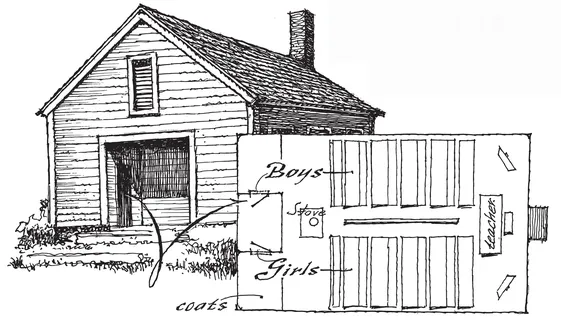
New England Recessed Entrance with Separate doors
Mixed classes were at first only for very young boys and girls. A sort of advanced kindergarten, they were taught by women and known as “dames” in “dame schools.” It wasn’t until the 1800s that mixed grammar school classes were introduced, and then, as in Shaker Meetinghouses, the room was separated by a partition, with the girls on one side and the boys on the other. There were even separate entrances—one for girls and the other for boys—both in one recessed doorway.
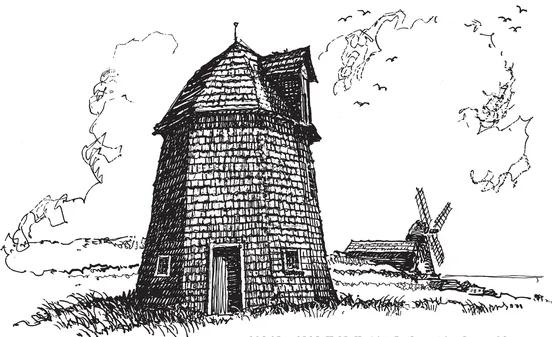
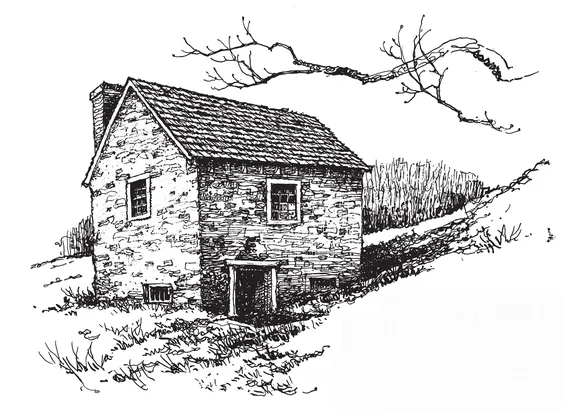
The earliest school buildings were often makeshift outbuildings, unused barns, chicken coops and wagon sheds. One abandoned Cape Cod windmill, with its inner machinery removed, served as a schoolhouse for several decades. One school was held in a room over a stone well house at the John Chad Homestead in Chadd’s Ford, Pennsylvania, where it still stands as a monument.
old abandoned windmill on 1790 Cape Cod used as a Schoolhouse
Most old county maps indicate all the houses with the names of the owners, and you might be surprised at the number of schoolhouses (usually marked as “S.H.”) in any one area. This indicates that the early one-room schoolhouses were so scattered that students seldom walked more than a mile. An 1850 map of my own village (Warren, Connecticut) shows seven schoolhouses within an area of a two-mile circle; the present-day Warren school now serves an area of over fifteen miles, only possible, of course, because of the motor bus. It becomes evident that a great number of tiny one-room school buildings were not only adequate but because of their tininess were most efficient.
The Well. House Pennsylvania.
There is a New England legend about how some early schoolhouses had built-in watchtowers with spy windows, and one student always acted as a lookout agains...