![]()
PART TWO
SEC. XXXIV. COUNT OF THE YUCATECAN YEAR. CHARACTERS OF THE DAYS. THE FOUR BACABS AND THEIR NAMES. GODS OF THE UNLUCKY ’ DAYS.
The sun does not sink or go away far enough in this land of Yucatan for the nights to become longer than the days; thus in their full maximum, from San Andrés to Santa Lucia [Nov. 30 to Dec. 13] they are equal, and then they begin to lengthen. To know the hour of the night the natives governed themselves by the planet Venus, the Pleiades and the Twins. During the day they had terms for midday, and for different sections from sunrise to sunset, according to which they recognized and regulated their hours for work.
They had their perfect year like ours, of 365 days and 6 hours, which they divided into months in two ways. In the first the months were of 30 days and were called U, which signifies the moon, and they counted from the rising of the new moon until it disappeared.
In the other method the months had 20 days, and were called uinal hunekeh; of these it took eighteen to complete the year, plus five days and six hours. Out of these six hours they made a day every four years, so that they had a 366-day year every fourth time.27
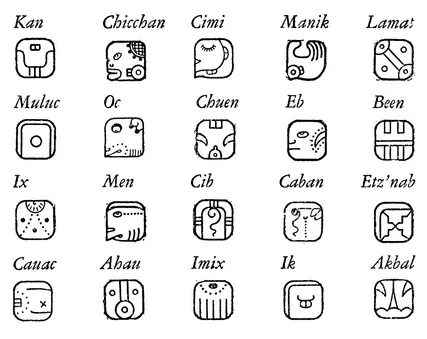
For these 360 days they had 20 letters or characters by which to designate them, without assigning names to the five supplementary days,27 as being sinister and unlucky. The letters are as follows, each with its name above to understand their correlation with ours.
I have already related that the Indian method of counting was from five to five, and four fives making 20; thus then from these 20 characters they take the first of each set of five, so that each of these serves for a year as do our Dominical letters, being the initials days of the various 20-day months (or uinals). Thus:
Among the multitude of gods worshipped by these people were four whom they called by the name Bacab. These were, they say, four brothers placed by God when he created the world, at its four corners to sustain the heavens lest they fall. They also say that these Bacabs escaped when the world was destroyed by the deluge. To each of these they give other names, and they mark the four points of the world where God placed them holding up the sky, and also assigned one of the four Dominical letters to each, and to the place he occupies; also they signalize the misfortunes or blessings which are to happen in the year belonging to each of these, and the accompanying letters.
The evil one, who has in this as in many other cases deceived them, fixed for them the services and offerings that had to be made in order to evade these misfortunes. Thus if they failed to occur, they said it was because of the ceremonies performed; but if they did come to pass, the priests made the people believe that it was because of some error or fault in the ceremonies,
The first of these Dominical letters, then, is
Kan. The year served by this letter had as augury that Bacab who was otherwise called
Hobnil, Kanal-bacab, Kan-pauahtun, Kan-xibchac. To him belonged the South.
The second letter, or
Muluc, marked the East, and this year had as its augury the Bacab called
Can-sicnal, Chacal-bacab, Chac-pauahtun, Chac-xibchac.The third letter is Ix, and the augury for this year was the Bacab called
Sac-sini, Sacal-bacab, Sac-pauahtun, Sac-xibchac, marking the North.
The fourth letter is
Cauac, its augury for that year being the Bacab called
Hosan-ek, Ekel-bacab, Ek-pauahtun, Ek-xibchac; this one marked the West.
In whatever ceremony or solemnity these people celebrated for their gods, they always began by driving away the evil spirit, in order the better to perform it. This exorcism was at times by prayers and benedictions they had for this purpose, and at other times by services, offerings and sacrifices which they performed for that end. In order to celebrate the solemnity of the New Year with the greatest rejoicing and dignity, these people, with their false ideas, made use of the five supplementary days, which they regarded as
unlucky,’ and which preceded the first day of their new year, in order to put on a great fiesta for the above Bacabs and the evil one, to whom they gave four other names, as they had done to the Bacabs; these names were:
Kan-uvayeyab, Chac-uvayeyab, Sac-uvayeyab, Ek-uvayeyab.28 These ceremonies and fetes being over, and the evil one driven away, as we shall see, they began their new year.
SEC. XXXV. FESTIVALS OF THE ‘UNLUCKY ’ DAYS. SACRIFICES FOR THE BEGINNING OF THE NEW YEAR KAN.
In all the towns of Yucatan it was the custom to have at each of the four entrances to the town two heaps of stones, one in front of the other; that is, at the east, west, north and south; and here they celebrated the two festivals of the
unlucky’ days, in the following manner.
For the year whose Dominical letter was Kan, the augury was Hobnil, and they say that both of these ruled the South. In this year, then, they made an image or clay figure of the demon they called Kan-uvayeyab and carried it to the piles of stone they had erected at the South. They chose a leading man of the town, at whose house was celebrated this fiesta on these days, and then they made a statue of a demon whom they called Bolon-tz’acab, which they set at the house of the principal, erected in a public spot to which all might come.
This being done, the chiefs, the priest and the men of the town, assembled and having the road clean and prepared, with arches and green branches, as far as the two heaps of stone where the statue was, there they gathered most devoutly; on arriving there the priest incensed the statue with forty-nine grains of ground maize, mixed with incense; then the nobles put their incense into the brazier of the idol, and incensed it. The ground maize alone was called sacah, and that of the lords chahalté.
Thus incensing the image, they cut off the head of a fowl, and presented it as an offering. When all had done this, they placed the image on a wooden standard called kanté, placing on his shoulders an angel as a sign of water and of a good year, and these angels they painted so as to make them frightful in appearance. Then they carried it with much rejoicing and dancing to the house of the principal, where there was the other statue of Bolon-tz’acab.
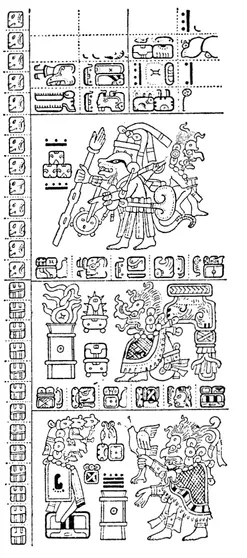
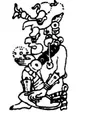
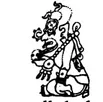
The illustration is a page of the Dresden codex, showing the Kan-uvayeyab ceremonies at the East.
From the house of this principal they brought out to the road, for the chiefs and the priest, a drink made of 415 grains of toasted maize (which they call picula kakla, of which all drank. On arrival at the house they set the image they were carrying in front of the statue of the demon they had there, and then made many offerings of food and drink, of meat and fish; these offerings were given to whatever strangers there were there; and to the priest they gave a leg of venison.
Others drew blood by cutting their ears and anointing therewith a stone image they had there, of the demon Kanal-acantun. They molded a heart of bread and another of calabash seeds, and offered those to the image of the demon Kan-uvayeyab. They kept this statue and image through those fateful days, and perfumed them with their incense, and with the ground maize and incense. They believed that if they did not perform these ceremonies, certain sicknesses would come on them in the ensuing year. When these fatal days were over they took the statue of Bolon-tz’acab to the temple, and the image to the eastern entrance where the next year they would go for it; there they left it and went to their houses to do what was their part in celebrating the new year.
These ceremonies over, and the evil spirit exorcised according to their deluded beliefs, they looked on the coming year as a good one, because it was ruled by the character Kan and the bacab Hobnil; and of him they said that in him there was no sin as in his brothers, and because of that no evils would come upon them. But since they often did so come, the evil one provided ceremonies therefor, so that when they happened they might throw the blame on the ceremonies or celebrants; and thus they continued always deluded and blind.
It was then commanded to make an idol called Itzamná-kauil, and place it in the temple. Then in the temple court they burned three balls of a milk or resin they called kik (rubber), while sacrificing a dog or a man; this they did keeping the same procedure I have described in chapter 100 (Sec. xxvii), except that in this case the method of the sacrifice differed. In the temple court they erected a great pile of stones, and then placed the dog or the man to be sacrificed on something much higher, from which they threw him, tied, upon the pile below; there the attendants seized him and with great swiftness drew out his heart, raised it to the new idol, and offered it between two plates. They offered other gifts of food, and in this festival there danced old women of the town, chosen therefor, clothed in certain vestures. They say that an angel descended and received this sacrifice.
SEC. XXXVI. SACRIFICES FOR THE NEW YEAR OF THE CHARACTER MULUC. DANCES OF THE STILT-WALKERS. DANCE OF THE OLD WOMEN WITH TERRACOTTA DOGS.
In the year whose dominical letter was Muluc the augury was Cansicnal. On this occasion the chiefs and the priest selected a president to care for the festival, after which election they made an image of the demon as they had done in the previous year, and which they called Chac-uvayeyab, and carried this to the piles of stone at the East, where they had left the other one the year before. They also made a statue of the idol called Kinchahau, and placed it in the house of the president in a convenient place; from there, with the road all cleaned and dressed, they all proceeded together for their accustomed devotions before the god Chac-uvayeyab.
On arriving the priest perfumed it with 53 grains of the ground maize, with the incense, which they call sacah. The priest gave this to the chiefs, who put in the brazier more incense, of the kind called chahalté; then they cut off a fowl’s head, as before, and taking the image on a wooden standard called chacté, they carried it very devoutly, while dancing certain war-dances they call holcan-okot, batel-okot. During this they brought to the road for the chiefs and principal men their drink made from 380 grains of maize, toasted as before.
When they had arrived at the house of the president they put this image in front of the statue of Kinch-ahau, and made all their offerings to it, which were then distributed like the rest. They offered to the image bread formed like the yolks of eggs, others like deer’s hearts, and another made of dissolved peppers. Many of them drew blood from their ears, and with it anointed the stone they had there, of the god Chac-acantun. They took boys and forcibly drew blood from their ears, by blows. They kept this statue and the image until the fatal days were passed, meanwhile burning their incense. When the days were over, they took the image to the part of the North, where next year they had to go to seek it; the other they took to the temple, and then went to their houses to care for the works of the new year. If they did not do all these things, they feared the coming especially of eye troubles.
The dominical letter of this year being Muluc, the Bacab Can-sicnal ruled, whence they held it a favorable year, for they said he was the best and greatest of these Bacab gods; for this they put him first in their prayers. Yet for all this the evil one caused them to make an idol called Yaxcoc-ahmut, which they placed in the temple and took away the old images; then they erected in the temple court a stone block on which they burned their incense, and a ball of the resin or milk kik, with a prayer there to the idol, asking relief for the ills they feared for the coming year; these were a scarcity of water, buds (hijos) on the maize, and the like. To gain this protection the evil one ordained...